
Items related to Remember Me: A Novel
Synopsis
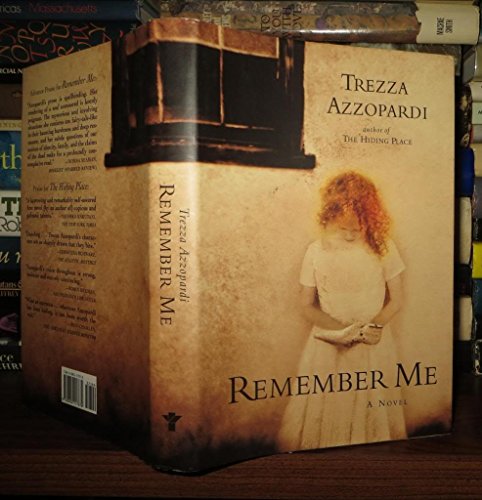
Winnie would say she's no trouble. She's content to let the days go by, minding her own business, bothering no one. She'd rather not recall the past and, at seventy-two, doesn't see much point in thinking about the future. But when her closed existence is shattered by a random act of violence, Winnie is catapulted out of her exile. Robbed of everything she owns, she embarks on a journey to track down the thief - only to find that what began as a search for stolen belongings has become the rediscovery of a stolen life.
Winnie unearths the betrayals which have marked her from the very beginning - constant family upheaval, the separations inflicted by war, and the days leading up to her 'fall'. Winnie is an unforgettable heroine, and her account of displacement and exclusion gives voice to the many whose stories are so rarely heard.
"synopsis" may belong to another edition of this title.
About the Author
Trezza Azzopardi was born in Cardiff. She is a graduate of the Creative Writing School at the University of East Anglia. She is the author of The Hiding Place, a national best-seller and Booker Prize finalist.
Reviews
In this odd and moving second novel from Azzopardi, whose first novel, The Hiding, was a Booker finalist, a thief makes off with a small case containing some useless relics belonging to an elderly homeless woman—variously called Patricia, Lillian and Winifred, depending on the people who "care" for her. Patricia's search for the thief and her belongings becomes an excavation of her past, beginning with her prewar girlhood in the English town of Chapelfield; it's a haunting evocation of neglect, abuse and mental illness. Born with a head of spiky red locks that her dad refers to as "telltale" hair, the "feeble-minded" Patricia is passed off to her grandfather (after her depressed, delusional mother dies), then, during WWII, sent to live with a bitter, lonely aunt on a scraggly farm. But when 15-year-old Patricia gets pregnant, she's shuttled back to Chapelfield, only to discover that all her relatives have disappeared. It's a harrowing, painful story, saved from melodrama by the unsentimental first-person perspective and a challenging, elliptical narrative. The backstory, revolving around the telltale hair, is slow to emerge, but as the pieces of the plot begin to fall into place, the book gains sweep and power, building to an unexpected (and unexpectedly horrifying) climax. The prose has flashes of brilliance—"the rain is a river of silver coins"—and while some readers won't respond to the fatalistic acquiescence of Patricia/Lillian/Winnie, they can't fail to be moved by the sadness that shrouds this largely lost life.
Copyright © Reed Business Information, a division of Reed Elsevier Inc. All rights reserved.
Azzopardi's canny sense of the link between trauma and mental instability shaped her first novel, The Hiding Place (2000). In her second, she hones both her craft and her insights to create a darkly mystical tale of loss, betrayal, and disconnection. Her narrator, Winnie, a homeless woman in her seventies, is a compelling yet enigmatic narrator whose memories of her painful past are abruptly reawakened when she is robbed of her precious few possessions. The reader is carried back to her lonely childhood, when she was known as Patsy, then Lillian, and farmed out to unloving relatives in the English countryside after her mother commits suicide and the Nazis begin their bombing blitz. Considered simpleminded, she suffers every sort of deprivation and is at everyone's mercy, including a lustful shoemaker and a Svengali-like couple who transform her into a crowd-thrilling clairvoyant. Azzopardi's prose is spellbinding. Her rendering of a soul unmoored is keenly poignant. The mysterious and involving situations she conjures are fairy-tale-like in their haunting harshness and deep resonance, and her subtle questioning of our notions of identity, family, and the claims of the dead make for a profoundly contemplative read. Donna Seaman
Copyright © American Library Association. All rights reserved
Excerpt. © Reprinted by permission. All rights reserved.
I ve got to go and live with my grandfather. I don t know him, and my father won t be coming with me, but there s nothing to be done. It s been decided.
Needs must, Pats, my father says. It s a mystery to me. He doesn t explain the words, and I m not allowed to question. I m going to live with an old man that I don t know and my father can t abide. He used to call him That Old Devil, but now that needs must, my father doesn t call him anything at all. I ve never met the devil, but I ve seen his face.
Under the stairs in the pantry there was a carton which I wasn t allowed to touch, sitting alongside other things that weren t touchable, like the Vim and my father s shoe polish. The carton had got lye inside, which is poison. There was a picture of the devil on the outside, to prove it. He had a red face, red hair, pointed teeth, and a tail going up in a loop, sharp as a serving fork. He didn t look at all like my grandfather. My mother kept a photograph of him in a silver frame on the table next to her bottles of Wincarnis. I wasn t allowed to touch that either. The picture was in black and white. When my mother did her hair, or sometimes when she slept, I would sit on the stool by her bed and stare at him, and think about the devil inside. I reasoned that his face could be red in real life, and he wasn t smiling, so he could easily have pointed teeth. In the photograph, he looked uncomfortable. That would be the tail, doing that: he d be sitting on it.
"About this title" may belong to another edition of this title.
Search results for Remember Me: A Novel

Stock Image
Remember Me A Novel
Seller: World of Books (was SecondSale), Montgomery, IL, U.S.A.
Seller rating 5 out of 5 stars

Condition: Good. Item in good condition. Textbooks may not include supplemental items i.e. CDs, access codes etc. Seller Inventory # 00070058449
Stock Image
Remember Me
Seller: World of Books Inc, Montgomery, IL, U.S.A.
Seller rating 4 out of 5 stars

Hardback. Condition: Good. Determined to be no trouble to anyone, homeless septuagenarian Winnie pursues a young girl who has stolen her suitcase and wig, an endeavor that causes her to evaluate the events that culminated in her current status. Seller Inventory # CIN0802117678G
Stock Image
Remember Me: A Novel
Seller: Once Upon A Time Books, Siloam Springs, AR, U.S.A.
Seller rating 4 out of 5 stars
paperback. Condition: Acceptable. This is a used book. It may contain highlighting/underlining and/or the book may show heavier signs of wear . It may also be ex-library or without dustjacket. This is a used book. It may contain highlighting/underlining and/or the book may show heavier signs of wear . It may also be ex-library or without dustjacket. Seller Inventory # mon0003547424
Stock Image
Remember Me: A Novel
Seller: ThriftBooks-Atlanta, AUSTELL, GA, U.S.A.
Seller rating 5 out of 5 stars
Paperback. Condition: Very Good. No Jacket. May have limited writing in cover pages. Pages are unmarked. ~ ThriftBooks: Read More, Spend Less. Seller Inventory # G0802117678I4N00
Stock Image
Remember Me: A Novel
Seller: HPB-Movies, Dallas, TX, U.S.A.
Seller rating 4 out of 5 stars
paperback. Condition: Very Good. Connecting readers with great books since 1972! Used books may not include companion materials, and may have some shelf wear or limited writing. We ship orders daily and Customer Service is our top priority! Seller Inventory # S_468799459
Stock Image
Remember Me
Published by
Grove Press. New York., New York, 2004
ISBN 10: 0802117678
ISBN 13: 9780802117670
Used
Soft cover
First Edition
Seller: Marvin Minkler Modern First Editions, St. Johnsbury, VT, U.S.A.
Seller rating 4 out of 5 stars
Soft cover. Condition: As New. Dust Jacket Condition: As New. 1st Edition. This is the Advance Reading Copy/Uncorrected Proofs of the book that was published in March 2004. Softcover, in pictorial wrapper. 309 pages. Set in England against the backdrop of World War II, the much anticipated second novel by the Booker Prize finalist and national best-selling author. A story of pursuit: of stolen goods, of missing years, and of one woman's forgotten history. As new. Unread. From my smoke-free collection. Seller Inventory # 758
Stock Image
Remember Me: A Novel
Seller: The Maryland Book Bank, Baltimore, MD, U.S.A.
Seller rating 5 out of 5 stars
paperback. Condition: Very Good. Used - Very Good. Seller Inventory # 10-F-2-0238
Stock Image
Remember Me
Published by
Grove Press, New York, 2004
ISBN 10: 0802117678
ISBN 13: 9780802117670
Used
Soft cover
First Edition
Seller: Encanto Books, Santa Monica, CA, U.S.A.
Seller rating 4 out of 5 stars
Soft cover. Condition: Fine. First Edition. Seller Inventory # 18535
Stock Image
Remember Me: A Novel
Seller: Symposia Community Bookstore INC, Hoboken, NJ, U.S.A.
Seller rating 5 out of 5 stars
paperback. Condition: New. Brand new. Seller Inventory # 260305011
Stock Image
Remember Me: a Novel
Published by
Grove Press, New York, New York, U.S.A., 2004
ISBN 10: 0802117678
ISBN 13: 9780802117670
Used
Soft cover
First Edition
Seller: Ash Grove Heirloom Books, Pueblo, CO, U.S.A.
Seller rating 5 out of 5 stars
Soft cover. Condition: Fine. Dust Jacket Condition: No Dust Jacket as Issued. Uncorrected Proof. Seller Inventory # 005448