
Items related to An Expensive Education
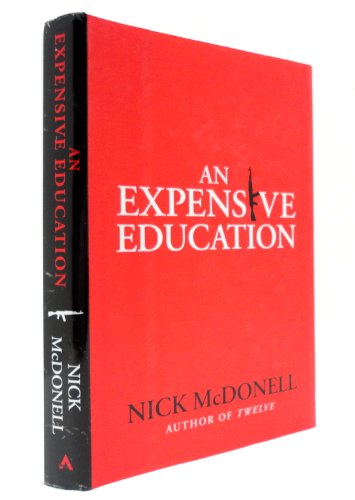
Synopsis
Professor Susan Lowell has it made. A happily married mother of two in a tenure-track job at Harvard, she has just won a Pulitzer Prize for her book lionizing Hatashil, an East African freedom fighter. David Ayan is her singular Somali-born student. He is trying to become a member of one of Harvard’s elite finals clubs. He is trying to understand Jane, his girlfriend from a privileged background. He is trying, sometimes, just to get by in a foreign place. Michael Teak is a twenty-five-year-old recent Harvard grad working as an American intelligence operative who meets Hatashil in David’s village minutes before the massacre that will upend all their lives.
Nick McDonell’s third novel takes his readers into Harvard—through its dormitories and dining halls, into its elite finals clubs and lecture halls, and within the offices of its ambitious professors—giving us an incredibly authentic insider’s view of this illustrious university. A powerful portrait of personalities all ensnared in the African conflict and of the Harvard campus on which the debate takes place, An Expensive Education is a smart, relentless novel set at the troubled intersection of ivory academia and realpolitik.
Nick McDonell’s third novel takes his readers into Harvard—through its dormitories and dining halls, into its elite finals clubs and lecture halls, and within the offices of its ambitious professors—giving us an incredibly authentic insider’s view of this illustrious university. A powerful portrait of personalities all ensnared in the African conflict and of the Harvard campus on which the debate takes place, An Expensive Education is a smart, relentless novel set at the troubled intersection of ivory academia and realpolitik.
"synopsis" may belong to another edition of this title.
About the Author
NICK MCDONELL was born in 1984 in New York City. A graduate of Harvard University, he is the author of two previous novels, Twelve and The Third Brother.
Reviews
Critics praised McDonell's third foray into fiction as an engaging mixture of political thriller and campus novel. Even those who found minor faults with its lack of depth and lack of moral ambiguity commended McDonell's vibrant writing and feverish, page-turning pace. Though the plot isn't terribly innovative and the central mystery is quickly solved, Teak's disarming idealism and sulky soul searching—"more Holden Caulfield than James Bond" (New York Times Book Review)—propel the story forward and give it charm. Critics also appreciated McDonell's caustic behind-the-scenes tour of his alma mater and his biting descriptions of its privileged elite. Compared to Graham Greene and John le Carré for his storytelling skills, McDonell has proved that the third time is the charm.
McDonell's third novel, a story of the messy consequences attendant upon a rogue American operation conducted against a Somalian freedom fighter, introduces a spy who could have easily walked off the pages of le Carré's better works. An American agent and recent Harvard graduate, Michael Teak has been assigned to deliver money to a band of east African freedom fighters led by local hero Hatashil. But while they're meeting, the village is decimated by a missile strike. Immediately, a mysterious story hits the wire, claiming Hatashil's men massacred the villagers. The news coincides with the Pulitzer Prize being awarded to a Harvard professor, Susan Lowell, whose book celebrates Hatashil. As Teak tries to come to terms with his own apparent expendability, Lowell fights vilification when a video that purportedly shows her pledging to kill for Hatashil surfaces. Meanwhile, an old Agency hand, Alan Green—Harvard alum and godfather to Teak—ties the stories together with his nefarious black world maneuverings. Teak is the most attractive fictional spy in quite some time, and even if the Harvard subplots feel too self-indulgent and insidery, one hopes this isn't Teak's only appearance. (Aug.)
Copyright © Reed Business Information, a division of Reed Elsevier Inc. All rights reserved.
Excerpt. © Reprinted by permission. All rights reserved.
An Expensive Education
A novel By Nick McDonellAtlantic Monthly Press
Copyright © 2009 Nick McDonellAll right reserved.
ISBN: 978-0-8021-1893-6
Chapter One
Kenya-Somalia Border, 200X That morning a young American named Michael Teak drove north through the rolling scrub on a mission for his government, which was at that time the most powerful in the world. A kite, hunting on well-traveled winds from the Indian Ocean, floated overhead as his Land Cruiser bumped slowly over the remote track. Teak was in no hurry to reach the village under the white sun of the afternoon. Evening would be cooler and, he hoped, calm.It was a simple mission, really. Deliver some money and a cell phone to a rebel named Hatashil, take a look around. Too good to be true had been Teak's first thought when he finished reading the file on Hatashil. Hatashil was a freedom fighter. An autodidact orphan warrior. A humanitarian and a leader. Teak was trained to be wary of those words, as if promise too bright was never fulfilled, ultimately betrayed. Daylight on colonial brick.
But Teak had been comfortably in-country for a year and a half and also thought that maybe it didn't have to be that way. Or at least he didn't have to be that way. He wasn't sure. This was his problem and as he drove deeper into the green and brown landscape he felt disconnected from his surroundings, and then alienated too from his car, his gun. It occurred to him that finally on the right kind of mission, he might be the wrong kind of guy. He chalked this up to nerves and drove on, which was what, he understood at age twenty-five, a professional did.
There were five suitcases in the backseat. Cheap luggage for poor travelers, inelegant, plastic. They were Teak's second cover. He stopped the truck and consulted his phone, checking his position against the village coordinates. On track, on time.
As he shifted back into gear, Teak noticed movement on the horizon. Through a gap in a stand of acacias far down the track, a dust cloud. It was the first dust he had seen in over a hundred miles and he resumed his drive at a faster pace. He lost sight of the cloud, caught sight again as it rose over the trees. At best a lunatic safari, at worst-Teak briefly recalled the tortures that had befallen one of his predecessors, his jellies scooped out, his abdomen cut to bits on rusty blades. Tied to a tree and left to die. No reason to waste a bullet.
Three vehicles. They stopped, lined up across the track. Teak stopped too, a mile out, and looked at them through his monocular. A white minivan, of the sort that usually safaried Japanese tourists, and two rusted pickups. Teak watched the men riding in the back of the trucks jump out and pull a metal gate off the roof of the van. All armed.
Shifta, Teak thought, tensing. In Amharic the word meant social bandits. A whole story distilled into a single word. Wrong-doer. He drove toward them.
* * *
The shifta, twenty-two of them by Teak's count, waited for him. They were younger than he expected and rich, with the van and that gate, which they had set up across the track. Might be a particularly shrewd crew, Teak thought.
Two men stood directly in front of the gate. One wore camouflage pants and a T-shirt with the D.A.R.E. antidrug logo. The other wore mesh shorts and a khaki safari shirt. Both carried Kalashnikovs. The man in shorts also wore a leather shoulder holster.
"Hello," said Teak, sticking his head out the window as he slowed. Best to use English, lingua idiota.
"Checkpoint," said the man in the antidrug shirt.
Teak stopped and let the Land Cruiser idle. He looked off to the sides of the track. He could drive around them but then they might chase him, shoot at his tires, probably miss, but maybe break his windows. Maybe worse. Better to talk. A boy holding a cleaver sat cross-legged on the side of the track, staring at Teak. Strange. Usually no children with the shifta. Teak winked at the child but the child just stared.
"Checkpoint?" said Teak, in his best baffled colonial, "on whose authority?"
The two men in front looked at each other. Mesh Shorts theatrically drew an old .38 from his shoulder holster. "Authority of General Hatashil," he said, tapping the rear door of the car with his pistol. "What's here?"
"Shit," Teak said for their benefit, putting his head in his hands.
They opened the doors, pulled the suitcases out onto the dirt, and ripped one open.
"You know, there's a zipper on that you could use," said Teak.
A cheer went up when they saw that grey-green khat filled the case.
Teak shook his head.
"You have a problem?" asked the shoulder-holster boss.
"No," said Teak, suddenly brightening and extending a hand out the window. "I'm Teak."
"I am Commander Moalana," said the man in mesh shorts, surprised, briefly taking Teak's hand in a kind of half shake. Teak smiled at him and Moalana began to stroke his chin. He was almost gleeful, toying with Teak for his men, extremely grateful that this lone man with his bags full of drugs had crossed his path.
Moalana's men had been frustrated that morning. But then, Moalana reflected, they're frustrated all the time. He could take the car, too, but orders were orders. Restraint, Hatashil had said. After they had killed that last man as a spy, Hatashil had been angry. We do not leave our allies tied to trees! Hatashil had calmed down quickly, though, and delivered a lecture. Misunderstandings happen, he had concluded, but always restrain yourself. Moalana had been grateful for Hatashil's understanding in the face of so great a blunder.
Moalana offered Teak a bit of khat. Teak accepted and began to chew. He did not enjoy the bitter taste, like cabbage. "Can I keep one?" he asked.
"One bag," Moalana laughed for the benefit of his men, "how will you keep one?"
Before Teak could answer, Moalana cut him off. "Not one," he said, and his men began loading the cases into the trucks. The boy sitting cross-legged, Teak noticed, had become distracted from robbery and was drawing in the dry dirt with his cleaver. An older boy called to him as the rest of the shifta put the gate back on top of the van and lashed it in place.
Moalana waved his hand once from the window of his truck as it passed.
Teak spat the khat out and watched them disappear down the track. The whole encounter had taken less than five minutes. The khat cases had worked. He was still in no hurry.
Miles down, hours later, off a track off the track, the scrub dissipated into rocky plain, but first, a blessed stream. On the bank a crooked date palm, a dozen huts, goats, and children like miniature guardian angels. Teak liked the look of it. He parked a hundred yards from the village so as not to further disturb the corraled livestock. A few tattered goats bleated at the Land Cruiser.
From his pocket, a key, and Teak unlocked the glove box, took out a sealed FedEx envelope. He stepped out of the car and stretched his legs, reflecting on the temperature as he put on the wrinkled jacket of his khaki suit. He wore the same thing everywhere, and it was cooler now. Not that he minded the heat. His pale skin had a permanent burn but that was fine with him. A short lifetime of New England winters had been enough. He checked the SIG P220 in his waistband, tucked the FedEx envelope under his arm, and walked to meet the children approaching him through the dry crackle of the burnt grass. Behind them, leaning mothers, knowing disdain.
Then the most curious of the children was at his knee, looking up at him. Teak greeted the child in the local dialect, and the child was not old enough to find this strange.
"Riddle!" said Teak, grinning whiter teeth than the child had ever seen in a grown-up.
"Riddle me!" said the child.
"My house has no doors," said Teak. It was an easy and famous riddle about an egg, but the child was so young that Teak guessed it could be new to him, and he was right. The child ran back to commiserate with his fellows.
As Teak entered the village everyone stared. Two teenage boys waved antique Enfield rifles at him. One asked Teak his business, in English.
"Come to see Hatashil," said Teak cheerfully, surprising them with their own language.
The boys looked at each other and pretended to consider the situation. Puffing up, they told Teak to follow. They walked down to the stream. Under the date palm three men sat on a thick but worn rug, sipping from small bowls of fermented camel milk. Two in full camouflage, one, whom Teak immediately picked for Hatashil, in a white djellaba. They rose when Teak approached. Hatashil, also the shortest of the three, was heavyset, almost fat. He was also vaguely lighter skinned, Teak noted, and had sharper features. He carried a walking stick topped with some kind of skull, Teak couldn't tell what species. He looked at Teak with heavy, recessed eyes and dismissed his associates, who walked down the stream with the two rifle boys. When they were beyond hearing, Hatashil gestured Teak to the rug.
They exchanged greetings and sat down. Teak complimented Hatashil on the rifle boys' English capabilities.
"If only mine were better," responded Hatashil, "but thank you. They are good boys. At the camp, we have even better."
A smiling, grasshopper-thin woman brought a tray of dates, goat cheese, and two cans of Fanta. Cans instead of bottles, thought Teak. That's new. Bowing, the woman put the tray on the rug between Teak and Hatashil. Hatashil smiled at her and she might have blushed.
Out of politeness, Teak ate a piece of the cheese. After that, neither man touched the food. Hatashil described to him the number of men, weapons, horses, and vehicles he had in a nearby camp. He pointed across the stream to where his own truck was parked. It was a Toyota pickup with a 12.7 millimeter machine gun mounted in the bed.
Teak opened the FedEx envelope with a folding knife and passed it across the tray to Hatashil. Hatashil looked inside and saw, to his satisfaction, many American dollars.
"Twenty-five thousand," said Teak. Then he reached into his pocket for a black cell phone, which he also handed over.
"Will I be talking with you?" asked Hatashil.
"No. You'll be talking with my colleague."
"It is too bad to make agreements with men who might be good men and then never to see them again," said Hatashil, sliding the phone open and turning it on.
Beep.
High above them, in one of the random afternoon cumulus formations, an alarm went off and a pilot adjusted his course.
Teak heard the slow drone of the Antonov as he was walking back to his Land Cruiser. He should have noticed it approaching from farther off, but he hadn't. Aerial ordinance. And then he was concussed forward through the air onto his face. Dazed, he rolled as a wave of heat blew over him. The date palm was splintered. The wooden corral was gone, only a crater left behind. The air was thick with dust. Belly-down in the dirt, Teak saw Hatashil's truck speeding away from the stream. He forced himself to his feet and ran to the Land Cruiser, where he retrieved the first aid kit from under the backseat. Teak was all training. He didn't look at the dead as he ran back into the village; he looked for the almost dead. The spot fires repeated the heat of the midday sun in the dusk.
He heard the grind of Humvees arriving from the east and saw a chalk of paramilitaries bearing down on what was left of the village. One of the Enfield boys ran toward the Humvees and they shot him down. The other had run in the opposite direction and one of the Humvees was chasing him.
Teak ducked into one of the charred huts. The woman who had brought him the cheese and Fanta lay facedown. A trail of blood led from the door to the thin pallet where the woman had dragged herself. An adolescent girl sat next to her, rubbing at her own ears, trying to restore her hearing. Teak knelt down beside them. Turning the woman over he saw, in the shiny gash across her neck, that it was too late for her.
He was reaching for the girl when he noticed at his feet a mug, the sort that he had received in his alumni package when he had graduated from college four years before. It was crimson, with the Harvard shield on it and, in white letters, the word Veritas. Teak did not have time to think about this before he heard the crack of M4s and felt the whistle of a bullet through the hut. Teak threw himself over the girl.
(Continues...)
Excerpted from An Expensive Education by Nick McDonell Copyright © 2009 by Nick McDonell . Excerpted by permission.
All rights reserved. No part of this excerpt may be reproduced or reprinted without permission in writing from the publisher.
Excerpts are provided by Dial-A-Book Inc. solely for the personal use of visitors to this web site.
"About this title" may belong to another edition of this title.
Search results for An Expensive Education

Stock Image
An Expensive Education
Seller: More Than Words, Waltham, MA, U.S.A.
Seller rating 5 out of 5 stars

Condition: Good. A sound copy with only light wear. Overall a solid copy at a great price! Seller Inventory # BOS-G-09b-01765
Stock Image
An Expensive Education
Published by
Atlantic Monthly Press (edition First Edition), 2009
ISBN 10: 0802118933
ISBN 13: 9780802118936
Used
Hardcover
First Edition
Seller: BooksRun, Philadelphia, PA, U.S.A.
Seller rating 5 out of 5 stars
Hardcover. Condition: Very Good. First Edition. With dust jacket. It's a well-cared-for item that has seen limited use. The item may show minor signs of wear. All the text is legible, with all pages included. It may have slight markings and/or highlighting. Seller Inventory # 0802118933-8-1-29
Stock Image
An Expensive Education
Seller: Open Books, Chicago, IL, U.S.A.
Seller rating 5 out of 5 stars
hardcover. Condition: Very Good. Open Books is a nonprofit social venture that provides literacy experiences for thousands of readers each year through inspiring programs and creative capitalization of books. Seller Inventory # mon0000748065
Stock Image
An Expensive Education
Seller: Wonder Book, Frederick, MD, U.S.A.
Seller rating 5 out of 5 stars
Condition: As New. Like New condition. Very Good dust jacket. A near perfect copy that may have very minor cosmetic defects. Seller Inventory # J11E-00316
Stock Image
An Expensive Education
Published by
Atlantic Monthly Press, 2009
ISBN 10: 0802118933
ISBN 13: 9780802118936
Used
Hardcover
First Edition
Seller: The Maryland Book Bank, Baltimore, MD, U.S.A.
Seller rating 5 out of 5 stars
hardcover. Condition: Very Good. First Edition. Used - Very Good. Seller Inventory # 2-C-1-1386
Stock Image
An Expensive Education
Seller: ThriftBooks-Dallas, Dallas, TX, U.S.A.
Seller rating 5 out of 5 stars
Hardcover. Condition: As New. No Jacket. Pages are clean and are not marred by notes or folds of any kind. ~ ThriftBooks: Read More, Spend Less. Seller Inventory # G0802118933I2N00
Stock Image
An Expensive Education
Seller: Wonder Book, Frederick, MD, U.S.A.
Seller rating 5 out of 5 stars
Condition: As New. Like New condition. Like New dust jacket. A near perfect copy that may have very minor cosmetic defects. Seller Inventory # K11A-04451
Stock Image
An Expensive Education
Seller: Wonder Book, Frederick, MD, U.S.A.
Seller rating 5 out of 5 stars
Condition: Very Good. Very Good condition. Very Good dust jacket. A copy that may have a few cosmetic defects. May also contain light spine creasing or a few markings such as an owner's name, short gifter's inscription or light stamp. Seller Inventory # W07K-01950
Stock Image
An Expensive Education
Published by
Grove/Atlantic, Incorporated, 2009
ISBN 10: 0802118933
ISBN 13: 9780802118936
Used
Hardcover
First Edition
Seller: Better World Books, Mishawaka, IN, U.S.A.
Seller rating 5 out of 5 stars
Condition: Very Good. First Edition. Former library copy. Pages intact with possible writing/highlighting. Binding strong with minor wear. Dust jackets/supplements may not be included. Includes library markings. Stock photo provided. Product includes identifying sticker. Better World Books: Buy Books. Do Good. Seller Inventory # 11084736-6
Stock Image
An Expensive Education
Published by
Atlantic Monthly Press, New York, NY, 2009
ISBN 10: 0802118933
ISBN 13: 9780802118936
Used
Hardcover
Seller: 2Vbooks, Derwood, MD, U.S.A.
Seller rating 5 out of 5 stars
Hard cover. Condition: Fine in fine dust jacket. Sewn binding. Cloth over boards. With dust jacket. 294 p. Audience: General/trade. No previous owner's name. Clean, tight pages. No bent corners. Not price clipped. HC 354. Seller Inventory # Alibris.0047066