
Items related to Measuring the Universe: Our Historic Quest to Chart...
Synopsis
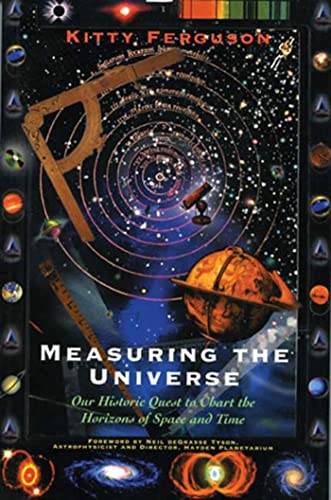
More than 2,000 years ago, Eratosthenes, in Alexandria, used a stick, a hole in the ground, sunllght at summer solstice, and elementary geometry to measure the circumference of the Earth with surprising accuracy, long before anyone was able to circumnavigate it. Today, scientists are attempting to measure the entire universe and to determine its origin. Although the methods have changed, the quest to chart the horizons of space and time continues to be one of the great adventures of science.
Measuring the Universe is an eloquent chronicle of the men and women– from Aristarchus to Cassini, Sir Isaac Newton to Henrietta Leavitt and Stephen Hawking–who have gradually unlocked the mysteries of "how far" and in so doing have changed our ideas about the size and nature of the universe and our place in it. Kitty Ferguson reveals their methods to have been as inventive as their results were–and are–eye-opening. Advances such as Copernicus's revolutionary insights about the arrangement of the solar system, William Herschel's meticulous creation of the first three-dimensional map of the universe, and Edwin Hubble's astonishing discovery that the universe is expanding have by turns revolutionized our concept of the universe. Connecting centuries of breakthroughs with the political and cultural events surrounding them, Ferguson makes astronomy part of the sweep of history.
To measure the seemingly immeasurable, scientists have always pushed the boundaries of the imagination–today, for example, facing the paradox of an ever-expanding universe that doesn't appear to expand into anything. In Kitty Fergeson's skillfill hands, the unimaginable becomes accessible and the splendid quest something we all can share.
"synopsis" may belong to another edition of this title.
About the Author
Kitty Ferguson is a science writer and the author of Prisons of Light: Black Holes; The Fire in the Equations: Science, Religion, and the Search for God; and Stephen Hawking: Quest for a Theory of Everything. She is also a professional musician. Ms. Ferguson lives in Northern New Jersey.
Reviews
When you wish upon a star, do you ever consider that the bright one over there in the Hyades might be closer than the one in the Big Dipper that you usually wish on? Or that your wish might get there faster? Although even the closest star (Proxima Centauri) is so far away (25 1/4 trillion miles) that humanity will probably never travel to it, Ferguson (Prisons of Light: Black Holes) demonstrates why knowing its distance from us is important, and not just for reasons of wish fulfillment. For only by drawing an accurate scale map of the universe, she explains, can scientists estimate its age, one of the most hotly contested issues of our time. Ferguson begins with attempts in antiquity to establish the distance to the sun and the five planets seen by the naked eye. She discusses the findings of Copernicus, Kepler and Galileo, and how each drew on the others' work. Her simple explanations of the discoveries of stellar parallax, the Doppler effect and redshift, and of absorption spectra make important scientific concepts clear for general readers. She goes on to elucidate how astronomers determine how far away other stars are by using a type of star called Cepheid, as well as the spectacular stellar self-destructions known as supernovae as "standard candles." To conclude her engrossing survey, Ferguson covers some of the paradoxes that scientists confront, such as that some estimates of the age of the universe have determined that it is younger than some of its oldest stars, and that the amount of observable mass in the universe is only about 10% of what should be there. (July)
Copyright 1999 Reed Business Information, Inc.
Science writer Ferguson (Prisons of Light: Black Holes, not reviewed) traces astronomers efforts to gauge the size and age of the earth, moon, and stars, from the ancient Greeks to space-age cosmologists. Think big. The saga begins with a pint-size system centered on earth and ends (for now) with today's picture of the sun as a minor player on the outskirts of a mid-size galaxy, one of billions in the universe. Think ingenious. Ferguson covers everything from the canny methods Eratosthenes used to measure the circumference of the earth (plane geometry played a big part) to the numerous measuring techniques available today, including the use of Cepheid variable stars, statistical parallax, spectroscopy/luminosity methods, etc. To some extent, this book chronicles the history of technology, because only with the construction of bigger and better telescopes (and, ultimately, the ability to place telescopes in orbit to eliminate atmospheric distortion) could more accurate measurements be made. You would think with all that, there would be some consensus. Uh-uh: Think margins of error, think many unknowns. The boundaries of space remain problematic; the issues of whether the universe is closed or open, spherical or tuba-shaped are undecided. Even the ``inflationary'' theorythe idea that shortly after the Big Bang the universe underwent a spectacularly rapid expansion that scattered matter around in ways that could condense into blobs and clusters of galaxies with voids betweenis under attack. Many weird and wonderful puzzles remain: the issue of dark matter, the ``weight'' of neutrinos, a conjectured fifth force that works like anti-gravity, not to mention parallel universes, wormholes, singularities, and others ideas bubbling from the fertile imaginations of Hawking, Penrose, and others. In addition to lucidly detailing the wild surmises of today's astronomers and astrophysicists, Ferguson sets past pioneersGalileo, Cassini, Newton, et al.in their cultural context, seeing them vis-...-vis contemporary challengers, as well as church and state. Good science history finely seasoned with politics, personality, and sociology. -- Copyright ©1999, Kirkus Associates, LP. All rights reserved.
Ferguson (The Fire in the Equations: Science, Religion, and the Search for God) is a popular science author, and deservedly soAshe has a gift for explaining difficult scientific concepts in clear prose, and her engaging style conveys a real sense of the social, political, and intellectual times in which these discoveries were made. She captures the excitement and wonder of discovery and provides an understanding of what motivates scientists. This book has the feel of a historical novelAin Ferguson's hands, astronomy becomes part of the sweep of history. Starting with Eratosthenes and his calculation of the earth's circumference using the shadows cast in a well, and moving through Stephen Hawking's work on black holes, Ferguson tells the tale of our search for our place in the universe. This book is nicely illustrated with photos, tables, and diagrams, and there is also a useful glossary. Recommended for academic as well as public libraries.AJames Olson, Northeastern Illinois Univ. Lib., Chicago
Copyright 1999 Reed Business Information, Inc.
"About this title" may belong to another edition of this title.
Search results for Measuring the Universe: Our Historic Quest to Chart...

Stock Image
Measuring the Universe: Our Historic Quest to Chart the Horizons of Space and Time
Published by
Bloomsbury Publishing USA, 1999
ISBN 10: 0802713513
ISBN 13: 9780802713513
Used
Hardcover
Seller: World of Books (was SecondSale), Montgomery, IL, U.S.A.
Seller rating 5 out of 5 stars

Hardback. Condition: Good. Seller Inventory # 00101490122
Stock Image
Measuring the Universe: Our Historic Quest to Chart the Horizons of Space and Time
Published by
Bloomsbury Publishing USA, 1999
ISBN 10: 0802713513
ISBN 13: 9780802713513
Used
Hardcover
Seller: World of Books (was SecondSale), Montgomery, IL, U.S.A.
Seller rating 5 out of 5 stars
Hardback. Condition: Very Good. Seller Inventory # 00110049451
Stock Image
Measuring the Universe: Our Historic Quest to Chart the horizons of Space and Time
Seller: HPB-Emerald, Dallas, TX, U.S.A.
Seller rating 5 out of 5 stars
hardcover. Condition: Very Good. Connecting readers with great books since 1972! Used books may not include companion materials, and may have some shelf wear or limited writing. We ship orders daily and Customer Service is our top priority! Seller Inventory # S_479323145
Stock Image
Measuring the Universe: Our Historic Quest to Chart the horizons of Space and Time
Seller: Wonder Book, Frederick, MD, U.S.A.
Seller rating 5 out of 5 stars
Condition: Good. Good condition. Acceptable dust jacket. A copy that has been read but remains intact. May contain markings such as bookplates, stamps, limited notes and highlighting, or a few light stains. Seller Inventory # J00B-02796
Stock Image
Measuring the Universe: Our Historic Quest to Chart the horizons of Space and Time
Published by
Walker Books (edition 0), 1999
ISBN 10: 0802713513
ISBN 13: 9780802713513
Used
Hardcover
Seller: BooksRun, Philadelphia, PA, U.S.A.
Seller rating 5 out of 5 stars
Hardcover. Condition: Very Good. 0. With dust jacket. It's a well-cared-for item that has seen limited use. The item may show minor signs of wear. All the text is legible, with all pages included. It may have slight markings and/or highlighting. Seller Inventory # 0802713513-11-6-29
Stock Image
Measuring the Universe : Our Historic Quest to Chart the horizons of Space and Time
Seller: Better World Books, Mishawaka, IN, U.S.A.
Seller rating 5 out of 5 stars
Condition: Good. 0th Edition. Former library copy. Pages intact with minimal writing/highlighting. The binding may be loose and creased. Dust jackets/supplements are not included. Includes library markings. Stock photo provided. Product includes identifying sticker. Better World Books: Buy Books. Do Good. Seller Inventory # 2498448-6
Stock Image
Measuring the Universe : Our Historic Quest to Chart the horizons of Space and Time
Seller: Better World Books, Mishawaka, IN, U.S.A.
Seller rating 5 out of 5 stars
Condition: Very Good. 0th Edition. Former library copy. Pages intact with possible writing/highlighting. Binding strong with minor wear. Dust jackets/supplements may not be included. Includes library markings. Stock photo provided. Product includes identifying sticker. Better World Books: Buy Books. Do Good. Seller Inventory # GRP93989154
Seller Image
Measuring the Universe: Our Historic Quest to Chart the horizons of Space and Time
Seller: -OnTimeBooks-, Phoenix, AZ, U.S.A.
Seller rating 5 out of 5 stars
Condition: very_good. Gently read. May have name of previous ownership, or ex-library edition. Binding tight; spine straight and smooth, with no creasing; covers clean and crisp. Minimal signs of handling or shelving. 100% GUARANTEE! Shipped with delivery confirmation, if you're not satisfied with purchase please return item! Ships USPS Media Mail. Seller Inventory # OTV.0802713513.VG
Stock Image
Measuring the Universe: Our Historic Quest to Chart the horizons of Space and Time
Seller: HPB-Diamond, Dallas, TX, U.S.A.
Seller rating 5 out of 5 stars
hardcover. Condition: Very Good. Connecting readers with great books since 1972! Used books may not include companion materials, and may have some shelf wear or limited writing. We ship orders daily and Customer Service is our top priority! Seller Inventory # S_475096192
Stock Image
Measuring the Universe: Our Historic Quest to Chart the horizons of Space and Time
Seller: ThriftBooks-Dallas, Dallas, TX, U.S.A.
Seller rating 5 out of 5 stars
Hardcover. Condition: Very Good. No Jacket. Former library book; May have limited writing in cover pages. Pages are unmarked. ~ ThriftBooks: Read More, Spend Less. Seller Inventory # G0802713513I4N10