
Items related to The Dragon and the Foreign Devils: China and the World,...
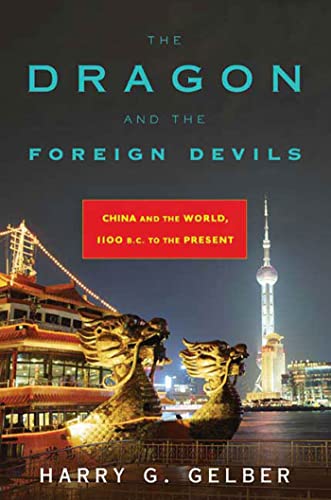
Synopsis
China is the most exciting rising power in the world today. The fact that China may be the next superpower attracts endless interest from all quarters―yet China is still utterly inscrutable to most outsiders. In The Dragon and the Foreign Devils Harry Gelber illuminates China's present by looking at the broad sweep of foreign relations in its past. From the incursions by the steppe horsemen and the Mongol conquests to the first arrival of European travelers, foreign fascination with China has followed certain patterns: curiosity, admiration, and greed for trade or territory. But, as China gradually rises from the turbulence in the wake of Mao Zedong to the economic growth and political stability of the twenty-first century, the dynamic between East and West has slowly shifted. Essential reading for anyone interested in China and its evolving relations with foreigners, The Dragon and the Foreign Devils breaks down the walls between East and West and shines a light on the recurring cycles of Chinese history.
"synopsis" may belong to another edition of this title.
About the Author
Harry Gelber is an internationally renowned scholar of history and political science. He is the author of thirteen books and numerous papers and articles. He has taught at Harvard, Boston University, and the London School of Economics, among many others.
Reviews
The challenges for China change—Mongol horse archers in the 13th century, European gunboats in the 19th—but the response remains remarkably steady in this engaging survey of Chinese foreign relations. Historian Gelber (Opium, Soldiers and Evangelicals) takes a cyclical view of Chinese history. From ancient times, he contends, dynasties underwent patterns of population growth, governmental decay caused by bureaucratic sclerosis and inept emperors (exacerbated by overmighty concubines and court eunuchs), and outside military pressure. This led to chaos and conquest until a new strongman restored order. As crises and foreign incursions come and go, China's insular Confucian culture remains, and so does the sense of cultural superiority—symbolized by the prostration ritual called the kowtow,loathed by Western ambassadors—that enables China to neutralize outside influences. Even the current Communist regime, Gelber argues, is in many ways a traditional imperial dynasty, with foreign policy interests similar to those of the past. The author also assesses China's shifting image in foreign eyes, as either a model of sophisticated order or a cesspool of backward despotism. Gerber is a bit sketchy on the premodern period; his account comes into its own as a lucid, insightful narrative history of China's evolving place in the modern, Western-dominated world order. Maps. (May)
Copyright © Reed Business Information, a division of Reed Elsevier Inc. All rights reserved.
A survey of China's foreign relations, Gelber's narrative discusses China's rulers over millennia. Their realm was the civilized world; beyond were the barbarians. This worldview prevented the Chinese from regarding foreign relations as interactions between nominally equal sovereignties; instead, the ruling dynasty compelled obeisance from bordering peoples. Gelber ably relates this process, the sense of cultural superiority behind it, and an emperor's power to impose relations, from the first unification of China by the Qin in 221 BCE to China's tumults of the twentieth century. Gelber presents these notions, associated with xenophobia, as deep continuities in Chinese history, and dynamically illustrates them through the threats a dynasty confronted on its borders, such as nomadic Mongols. The protracted nineteenth-century decline of China's final Qing dynasty and territorial encroachment upon China dominate the latter half of this fluent text and, argues Gelber, inform China's contemporary approach to foreign affairs. With maps, illustrations, and sidebars about the kowtow and Mao, Gelber lends a comprehensible structure to the vastness of Chinese history. Gilbert Taylor
Copyright © American Library Association. All rights reserved
"About this title" may belong to another edition of this title.
Search results for The Dragon and the Foreign Devils: China and the World,...

Stock Image
The Dragon and the Foreign Devils: China and the World, 1100 B.C. to the Present
Seller: World of Books (was SecondSale), Montgomery, IL, U.S.A.
Seller rating 5 out of 5 stars

Hardback. Condition: Good. Seller Inventory # 00110323973
Stock Image
The Dragon and the Foreign Devils: China and the World, 1100 B.C. to the Present
Seller: World of Books Inc, Montgomery, IL, U.S.A.
Seller rating 4 out of 5 stars

Hardback. Condition: Good. Seller Inventory # CIN0802715915G
Stock Image
The Dragon and the Foreign Devils : China and the World, 1100 B. C. to the Present
Seller: Better World Books, Mishawaka, IN, U.S.A.
Seller rating 5 out of 5 stars
Condition: Good. 1 Edition. Former library copy. Pages intact with minimal writing/highlighting. The binding may be loose and creased. Dust jackets/supplements are not included. Includes library markings. Stock photo provided. Product includes identifying sticker. Better World Books: Buy Books. Do Good. Seller Inventory # 2914126-6
Stock Image
The Dragon and the Foreign Devils : China and the World, 1100 B. C. to the Present
Seller: Better World Books, Mishawaka, IN, U.S.A.
Seller rating 5 out of 5 stars
Condition: Very Good. 1 Edition. Pages intact with possible writing/highlighting. Binding strong with minor wear. Dust jackets/supplements may not be included. Stock photo provided. Product includes identifying sticker. Better World Books: Buy Books. Do Good. Seller Inventory # 13802684-6
Stock Image
The Dragon and the Foreign Devils: China and the World, 1100 B.C. to the Present
Seller: ThriftBooks-Dallas, Dallas, TX, U.S.A.
Seller rating 5 out of 5 stars
Hardcover. Condition: Very Good. No Jacket. May have limited writing in cover pages. Pages are unmarked. ~ ThriftBooks: Read More, Spend Less. Seller Inventory # G0802715915I4N00
Stock Image
The Dragon and the Foreign Devils: China and the World, 1100 B.C. to the Present
Seller: ThriftBooks-Atlanta, AUSTELL, GA, U.S.A.
Seller rating 5 out of 5 stars
Hardcover. Condition: Very Good. No Jacket. May have limited writing in cover pages. Pages are unmarked. ~ ThriftBooks: Read More, Spend Less. Seller Inventory # G0802715915I4N00
Stock Image
The Dragon and the Foreign Devils: China and the World, 1100 B.C. to the Present
Seller: HPB-Diamond, Dallas, TX, U.S.A.
Seller rating 5 out of 5 stars
hardcover. Condition: Very Good. Connecting readers with great books since 1972! Used books may not include companion materials, and may have some shelf wear or limited writing. We ship orders daily and Customer Service is our top priority! Seller Inventory # S_481162422
Stock Image
The Dragon and the Foreign Devils: China and the World, 1100 B.C. to the Present
Seller: Amazing Books Pittsburgh, Pittsburgh, PA, U.S.A.
Seller rating 5 out of 5 stars
Hardcover. Condition: Very Good. Sturdy unmarked copy. Dj intact. Lh. Seller Inventory # Sq14875
Stock Image
The Dragon and the Foreign Devils: China and the World, 1100 B.C. to the Present
Seller: HPB Inc., Dallas, TX, U.S.A.
Seller rating 5 out of 5 stars
hardcover. Condition: Very Good. Connecting readers with great books since 1972! Used books may not include companion materials, and may have some shelf wear or limited writing. We ship orders daily and Customer Service is our top priority! Seller Inventory # S_482216316
Stock Image
The Dragon and the Foreign Devils: China and the World, 1100 B.C. to the Present
Seller: Half Price Books Inc., Dallas, TX, U.S.A.
Seller rating 5 out of 5 stars
hardcover. Condition: Very Good. Connecting readers with great books since 1972! Used books may not include companion materials, and may have some shelf wear or limited writing. We ship orders daily and Customer Service is our top priority! Seller Inventory # S_484659364