
Items related to Toward the Light of Liberty: The Struggles for Freedom...
Toward the Light of Liberty: The Struggles for Freedom and Rights That Made the Modern Western World - Hardcover
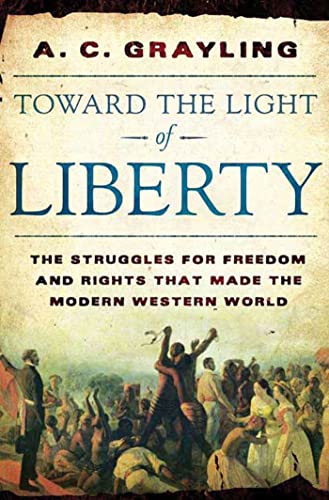
Synopsis
The epic story of the interlocking struggles to achieve the individual rights and freedoms that characterize Western civilization, by one of the world's leading public intellectuals.
Perhaps the hallmark of western civilization over the past five hundred years, writes A. C. Grayling, is the series of liberation struggles without which the ordinary citizen in Western countries would not enjoy the rights and freedoms we now take for granted. They began with the often violent battle to allow independent thought, uncontrolled by the Church, which led in time to political freedom as monarchies were gradually replaced by more representative forms of government. These in turn made possible the abolition of slavery, rights for working men and women, universal education, the enfranchisement of women, and much more.
Each of these struggles was a memorable human drama, and Grayling skillfully interweaves the stories of celebrated and little-known heroes alike―from Martin Luther and John Locke to the sixteenth-century French scholar Sebastien Castellio and the nineteenth-century feminist Elizabeth Cady Stanton. The triumphs and sacrifices of those who dared to oppose authority ring loudly down the ages, proving how hard-won each successive victory has been. And yet, as Grayling persuasively shows in a cautionary coda, democratic governments under pressure have often thought it necessary to restrict rights in the name of freedom, further underlining how precious they are. Toward the Light of Liberty is, thus, particularly relevant as we head toward an election season in which our own civil liberties will surely be an issue.
"synopsis" may belong to another edition of this title.
About the Author
A. C. Grayling is a professor of philosophy at Birkbeck College, University of London. He is the author of the acclaimed Among the Dead Cities, and of Descartes: The Life and Times of a Genius. A frequent contributor to newspapers and magazines, he lives in London.
Reviews
Do we take our liberties for granted at the risk of losing them in the war on terror? Grayling (Descartes: The Life and Times of a Genius), a professor of philosophy at Birkbeck College, University of London, and a leading British public intellectual, believes so. This book is, in some respects, an old-fashioned, triumphalist history of the rise of Western liberty since the 16th century (with Martin Luther, John Locke and Elizabeth Cady Stanton playing leading role), but nevertheless serves as a stirring call to arms to defend freedom from its enemies within and without. Grayling argues that the struggle for liberty has been one of sacrifice and hardship on the part of many heroic individuals. Despite the blood and the violence, it has been worth it: Today's ordinary Western citizen is, in sixteenth-century terms, a lord: a possessor of rights, entitlements, opportunities and resources that only an aristocrat of that earlier period could hope for. But, Grayling somberly writes, the process of losing our inheritance of liberty might have already begun. Grayling provides a refreshing tonic to any inclination toward apathy or cynicism, and his book will only gain in relevance as the 2008 presidential election looms. Color photos. (Oct.)
Copyright © Reed Business Information, a division of Reed Elsevier Inc. All rights reserved.
Our current president has proclaimed that individual liberty is a universal, even biological human aspiration. But a free society, in which individuals accept, even defend, the liberties of others is a social construct that has taken Western nations centuries to achieve. Philosophy professor Grayling has written an excellent survey that tracks the development of free, democratic societies and institutions over the past five centuries. He begins with the Protestant Reformation. Although Luther was hardly a tolerant man regarding religious issues, he did insist on persuasion rather than persecution. Eventually, the diversity fostered by the splintering of Christianity made acceptance of the primacy of the individual conscience a necessity. Grayling proceeds to examine the role of Enlightenment figures, early feminists, and the Chartist movement in securing both individual liberty and the expansion of the franchise. Importantly, he reminds us that the liberty we too often take for granted is the result of a long, often painful process. Freeman, Jay
"About this title" may belong to another edition of this title.
Search results for Toward the Light of Liberty: The Struggles for Freedom...

Stock Image
Toward the Light of Liberty Th
Seller: World of Books (was SecondSale), Montgomery, IL, U.S.A.
Seller rating 5 out of 5 stars

Condition: Good. Item in good condition. Textbooks may not include supplemental items i.e. CDs, access codes etc. Seller Inventory # 00108960755
Stock Image
Toward the Light of Liberty: The Struggles for Freedom and Rights That Made the Modern Western World
Seller: ThriftBooks-Atlanta, AUSTELL, GA, U.S.A.
Seller rating 5 out of 5 stars
Hardcover. Condition: Good. No Jacket. Pages can have notes/highlighting. Spine may show signs of wear. ~ ThriftBooks: Read More, Spend Less. Seller Inventory # G0802716369I3N00
Stock Image
Toward the Light of Liberty: The Struggles for Freedom and Rights That Made the Modern Western World
Seller: ThriftBooks-Dallas, Dallas, TX, U.S.A.
Seller rating 5 out of 5 stars
Hardcover. Condition: Very Good. No Jacket. Former library book; May have limited writing in cover pages. Pages are unmarked. ~ ThriftBooks: Read More, Spend Less. Seller Inventory # G0802716369I4N10
Stock Image
Toward the Light of Liberty : The Struggles for Freedom and Rights That Made the Modern Western World
Published by
Walker & Company, 2007
ISBN 10: 0802716369
ISBN 13: 9780802716361
Used
Hardcover
First Edition
Seller: Better World Books, Mishawaka, IN, U.S.A.
Seller rating 5 out of 5 stars
Condition: Very Good. 1st. Former library copy. Pages intact with possible writing/highlighting. Binding strong with minor wear. Dust jackets/supplements may not be included. Includes library markings. Stock photo provided. Product includes identifying sticker. Better World Books: Buy Books. Do Good. Seller Inventory # 5393154-6
Stock Image
Toward the Light of Liberty : The Struggles for Freedom and Rights That Made the Modern Western World
Published by
Walker & Company, 2007
ISBN 10: 0802716369
ISBN 13: 9780802716361
Used
Hardcover
First Edition
Seller: Better World Books, Mishawaka, IN, U.S.A.
Seller rating 5 out of 5 stars
Condition: Very Good. 1st. Pages intact with possible writing/highlighting. Binding strong with minor wear. Dust jackets/supplements may not be included. Stock photo provided. Product includes identifying sticker. Better World Books: Buy Books. Do Good. Seller Inventory # 2914753-6
Stock Image
Toward the Light of Liberty : The Struggles for Freedom and Rights That Made the Modern Western World
Published by
Walker & Company, 2007
ISBN 10: 0802716369
ISBN 13: 9780802716361
Used
Hardcover
First Edition
Seller: Better World Books: West, Reno, NV, U.S.A.
Seller rating 5 out of 5 stars
Condition: Good. 1st. Former library copy. Pages intact with minimal writing/highlighting. The binding may be loose and creased. Dust jackets/supplements are not included. Includes library markings. Stock photo provided. Product includes identifying sticker. Better World Books: Buy Books. Do Good. Seller Inventory # 2914752-75
Stock Image
Toward the Light of Liberty: The Struggles for Freedom and Rights That Made the Modern Western World
Seller: Midtown Scholar Bookstore, Harrisburg, PA, U.S.A.
Seller rating 5 out of 5 stars
Hardcover. Condition: Good. torn/chipped dj, some wear, still NICE - may have remainder mark or previous owner's name Standard-sized. Seller Inventory # 0802716369-01
Seller Image
Toward the Light of Liberty The Struggles for Freedom and Rights That Made the Modern Western World
Seller: eCampus, Lexington, KY, U.S.A.
Seller rating 4 out of 5 stars

Condition: Very Good. Seller Inventory # U:9780802716361:ONHAND
Stock Image
Toward the Light of Liberty: The Struggles for Freedom and Rights That Made the Modern Western World
Published by
Walker Books October 2007, 2007
ISBN 10: 0802716369
ISBN 13: 9780802716361
Used
Hardcover
Seller: Dunaway Books, St. Louis, MO, U.S.A.
Seller rating 5 out of 5 stars
Hardcover. Condition: Good. Seller Inventory # 277337
Stock Image
Toward the Light of Liberty: The Struggles for Freedom and Rights That Made the Modern Western World
Published by
Walker & Company, New York, 2007
ISBN 10: 0802716369
ISBN 13: 9780802716361
Used
Hardcover
First Edition
Seller: BookEnds Bookstore & Curiosities, Ojai, CA, U.S.A.
Seller rating 5 out of 5 stars
Hardcover. Condition: Fine. Dust Jacket Condition: Near Fine. 1st Edition. Fine condition Hardcover blue boards with silver lettering on the spine. Includes color and b/w photographs, Notes, Bibliography and Index, 336 pages. The DJ is in Near Fine condition. Seller Inventory # 005565