
Items related to What Do Muslims Believe?: The Roots and Realities of...
What Do Muslims Believe?: The Roots and Realities of Modern Islam - Softcover
Book 4 of 8: What Do We Believe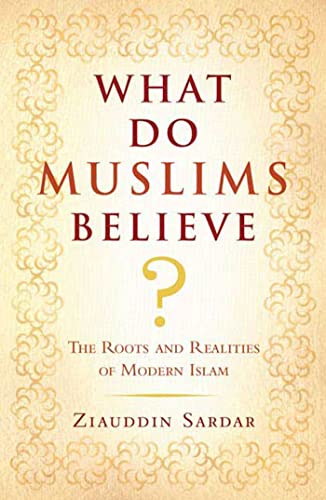
Synopsis
Perfect for adolescents and teens who are beginning to ask the big questions about life, religion, and current events, What Do Jews Believe? and What Do Muslims Believe? are the first a new series exploring the history and practices of world religions, their influences on current events and conflicts, as well as discussions on where these religions are headed. Both include a chronology of the religion's history through today, a glossary of terms, and recommended further reading lists.
"synopsis" may belong to another edition of this title.
About the Author
Ziauddin Sardar is Visiting Professor of Postcolonial Studies at City University, London. He is the author of several books for Pluto Press, most recently Postmodernism and the Other.
Reviews
Starred Review. Pakistani-born and British-educated Sardar, author of 40 other books on Islam, pens this elucidating and very original introduction to the religion. He describes the basics of Islam, including the Qur'an and hadith, the life of Muhammad and the history of Islam and Muslims, in an easy-to-read and cogent manner. Sprinkled throughout are surprising facts, including that Muslims do not believe in original sin and that there are as many Muslims in China as in Egypt. Sardar clarifies some troubling aspects of the Prophet Muhammad's life, explaining polygamy as mainly alliance building and Muhammad's participation in battle as more limited than generally described. He criticizes Muslims for their rigidity and for losing touch with reason—which, in his opinion, is a cornerstone of Islam. He decries the literalism behind the creation of sharia law, the rejection of free interpretation of the Qur'an (called ijtihad) and unfair treatment of women, but sees these behaviors as anomalies. In contrast, Sardar acknowledges Muslims' tolerance, such as their acceptance of other prophets, their flourishing book trade and societal advancements. With its manageable length and optimistic outlook, this introduction to Islam is a cut above the rest. (Sept.)
Copyright © Reed Business Information, a division of Reed Elsevier Inc. All rights reserved.
Among the many sanguine introductions to Islam, Sardar's moves immediately to the front rank for its readability (despite a few grammatical stumbles) and salutary perspective. Very much a Muslim progressive, Sardar allows, without going into specifics, that Muslims have often violated and contradicted the faith's essence, which he assures us is peaceful. He exalts the classical age of Islam, from the eighth through the fourteenth centuries, with its many great thinkers and writers, stressing that its accomplishments attest to Islam's great respect for and exploitation of reason. Reason, he suggests, will bring Islam to greatness again as, having finally shed colonialism and, he foresees, Islamic Fundamentalism and puritanism, Islamic societies assimilate and Islamically adapt modern science and technology. Recent developments, such as Morocco's reformation of Shariah law, show that such modernizing is under way, he says. Sardar's progressive argument undergirds a précis of Muslim history, beliefs, sectarian divisions, religious practices, and historic effects that one would expect of any similar primer. Olson, Ray
"About this title" may belong to another edition of this title.
Search results for What Do Muslims Believe?: The Roots and Realities of...

Stock Image
What Do Muslims Believe?: The
Seller: World of Books (was SecondSale), Montgomery, IL, U.S.A.
Seller rating 5 out of 5 stars

Condition: Very Good. Item in very good condition! Textbooks may not include supplemental items i.e. CDs, access codes etc. Seller Inventory # 00102562358
Stock Image
What Do Muslims Believe?: The
Seller: World of Books (was SecondSale), Montgomery, IL, U.S.A.
Seller rating 5 out of 5 stars
Condition: Good. Item in good condition. Textbooks may not include supplemental items i.e. CDs, access codes etc. Seller Inventory # 00098756208
Stock Image
What Do Muslims Believe?: The Roots and Realities of Modern Islam
Published by
Bloomsbury Publishing (edition First Edition), 2007
ISBN 10: 0802716423
ISBN 13: 9780802716422
Used
Paperback
First Edition
Seller: BooksRun, Philadelphia, PA, U.S.A.
Seller rating 5 out of 5 stars
Paperback. Condition: Very Good. First Edition. It's a well-cared-for item that has seen limited use. The item may show minor signs of wear. All the text is legible, with all pages included. It may have slight markings and/or highlighting. Seller Inventory # 0802716423-11-1
Seller Image
What Do Muslims Believe?: The Roots and Realities of Modern Islam
Seller: Greenworld Books, Arlington, TX, U.S.A.
Seller rating 5 out of 5 stars
Condition: very_good. Fast Free Shipping â" Very Good condition book with a firm cover and clean pages. Shows normal use and some light wear or limited notes markings. A solid, nice copy to enjoy. Seller Inventory # GWV.0802716423.VG
Stock Image
What Do Muslims Believe?: The Roots and Realities of Modern Islam
Seller: HPB-Ruby, Dallas, TX, U.S.A.
Seller rating 5 out of 5 stars
Paperback. Condition: Very Good. Connecting readers with great books since 1972! Used books may not include companion materials, and may have some shelf wear or limited writing. We ship orders daily and Customer Service is our top priority! Seller Inventory # S_468169217
Stock Image
What Do Muslims Believe?: The Roots and Realities of Modern Islam
Seller: World of Books Inc, Montgomery, IL, U.S.A.
Seller rating 4 out of 5 stars

Paperback. Condition: Very Good. Seller Inventory # CIN0802716423VG
Stock Image
What Do Muslims Believe?: The Roots and Realities of Modern Islam
Seller: World of Books Inc, Montgomery, IL, U.S.A.
Seller rating 4 out of 5 stars
Paperback. Condition: Good. Seller Inventory # CIN0802716423G
Stock Image
What Do Muslims Believe?: The Roots and Realities of Modern Islam
Seller: HPB-Diamond, Dallas, TX, U.S.A.
Seller rating 5 out of 5 stars
Paperback. Condition: Very Good. Connecting readers with great books since 1972! Used books may not include companion materials, and may have some shelf wear or limited writing. We ship orders daily and Customer Service is our top priority! Seller Inventory # S_478630772
Stock Image
What Do Muslims Believe?: The Roots and Realities of Modern Islam
Seller: Wonder Book, Frederick, MD, U.S.A.
Seller rating 5 out of 5 stars
Condition: Very Good. Very Good condition. A copy that may have a few cosmetic defects. May also contain light spine creasing or a few markings such as an owner's name, short gifter's inscription or light stamp. Seller Inventory # L05A-03483
Stock Image
What Do Muslims Believe?: The Roots and Realities of Modern Islam
Seller: ThriftBooks-Atlanta, AUSTELL, GA, U.S.A.
Seller rating 5 out of 5 stars
Paperback. Condition: Very Good. No Jacket. May have limited writing in cover pages. Pages are unmarked. ~ ThriftBooks: Read More, Spend Less. Seller Inventory # G0802716423I4N00