
Items related to Music for the End of Time
Synopsis
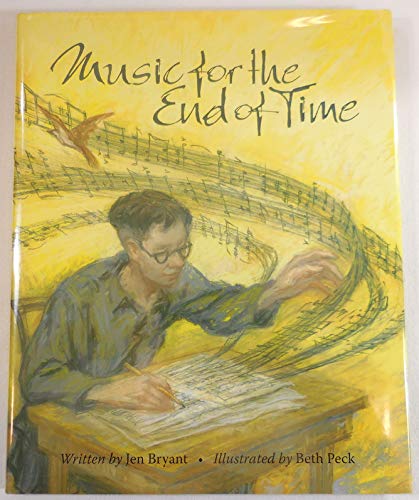
Presents the story of how French composer Olivier Messiaen was able to overcome the desolation of a World War II prison camp through the power of music.
"synopsis" may belong to another edition of this title.
About the Author
Jen Bryant — writer, poet, biographer — has authored several books for young readers, including Thomas Merton: Poet, Prophet, Priest (Eerdmans), which was named to the New York Public Library’s Books for the Teen Age List, and the young adult novel-in-verse The Trial (Knopf), a Junior Library Guild Selection. Jen lives in Uwchland, Pennsylvania.
Beth Peck has illustrated many books for children, including Just Like Josh Gibson written by Angela Johnson (Simon & Schuster); A Picture of Grandmother by Esther Hautzig (Farrar, Straus and Giroux), an Association of Jewish Libraries Sydney Taylor Honor Book; and Bicycle Madness by Jane Kurtz (Henry Holt). Beth Peck lives in Menomonie, Wisconsin.
From the Inside Flap
Eee oh lay! Eee oh lay!
Such a wild and beautiful sound,
Olivier thought.
His eyes followed the bird as it turned
toward the woods, floated over the treetops,
and, at last, disappeared.
Detained in a German prison camp, Olivier misses his family, his friends, and his home but most of all he misses music. A chance encounter with a nightingale and a German officer, however, provides Olivier with a small miracle the opportunity to write music again.
Jen Bryantâ s poetic biography of French composer Olivier Messiaen, coupled with Beth Peckâ s evocative pastel illustrations, captures both the desolation of a World War II prison camp and the transforming power of music. This book will stir readers of all ages to seek hope in the things that inspire them.
Reviews
Grade 3-5–A poignant story of humanity, creativity, and survival. Olivier Messiaen, a well-known French composer, was captured by the Germans during World War II and taken to a prison camp. In her softly flowing watercolor paintings, Peck portrays him as a pale, bespectacled man clutching a pack of sheet music. For an unexplained reason, a German officer allowed the musician to use a small room to continue to write. Although he wondered if anyone would ever hear his work, he pressed on, finally finding inspiration in the song of a nightingale. The illustration shows the notes rising from his pen in a triumphant arch intertwined with songbirds. With the arrival of two new prisoners carrying instrument cases, Messiaen gained hope. Finally, the composition was performed by a quartet in front of 5000 prisoners. Again, this moment is reinforced with a scene that shows the darkness of the winter day and camp enlightened by the music as the notes–presented in bands of yellow and entwined with nightingales–flow above the audience. Use this book with other stories of triumph over suffering, such as Ken Mochizuki's Baseball Saved Us (Lee & Low, 1993) or Louise Borden's The Greatest Skating Race (S & S, 2004). Better yet, play Messiaen's Quartet for the End of Time as you read it.–Jane Marino, Bronxville Public Library, NY
Copyright © Reed Business Information, a division of Reed Elsevier Inc. All rights reserved.
Gr. 4-7. Based on a true World War II incident that took place in 1941, this handsome picture book tells a story of kindness from the enemy and of the power of music. In the German camp Stalag 8A, a young officer allowed a captured French soldier, Olivier Messiaen, to compose music in a small room in the toilets, and then to play what he wrote (the now-famous composition "Quartet for the End of Time") with three other prisoners in a concert attended by 5,000 prisoners in the camp. The Germans found a run-down piano for Messiaen; they found a cello for another prisoner musician; two others were allowed to keep the instruments they brought with them. Bryant tells the fictionalized biography in clear poetic prose, and Peck's beautiful charcoal-and-pastel double-page spreads never downplay the harshness of the crowded barracks and the desolate lines of sad, sometimes wounded prisoners, even as they show the composer close up and the nightingales whose calls inspire the wild and beautiful music. Hazel Rochman
Copyright © American Library Association. All rights reserved
"About this title" may belong to another edition of this title.
Search results for Music for the End of Time

Stock Image
Music for the End of Time
Published by
Eerdmans Publishing Company, William B., 2005
ISBN 10: 0802852297
ISBN 13: 9780802852298
Used
Hardcover
Seller: Better World Books, Mishawaka, IN, U.S.A.
Seller rating 5 out of 5 stars

Condition: Good. Tra. Former library copy. Pages intact with minimal writing/highlighting. The binding may be loose and creased. Dust jackets/supplements are not included. Includes library markings. Stock photo provided. Product includes identifying sticker. Better World Books: Buy Books. Do Good. Seller Inventory # GRP94002667
Seller Image
Music for the End of Time
Published by
Eerdmans Books for Young Readers, 2005
ISBN 10: 0802852297
ISBN 13: 9780802852298
Used
Hardcover
Seller: Greenworld Books, Arlington, TX, U.S.A.
Seller rating 5 out of 5 stars
Condition: very_good. Fast Free Shipping â" Very Good condition book with a firm cover and clean pages. Shows normal use and some light wear or limited notes markings. A solid, nice copy to enjoy. Seller Inventory # GWV.0802852297.VG
Stock Image
Music for the End of Time
Published by
Eerdmans Books for Young Readers, 2005
ISBN 10: 0802852297
ISBN 13: 9780802852298
Used
Hardcover
Seller: ThriftBooks-Atlanta, AUSTELL, GA, U.S.A.
Seller rating 5 out of 5 stars
Hardcover. Condition: Very Good. No Jacket. Former library book; May have limited writing in cover pages. Pages are unmarked. ~ ThriftBooks: Read More, Spend Less. Seller Inventory # G0802852297I4N10
Stock Image
Music for the End of Time
Published by
Eerdmans Books for Young Readers, 2005
ISBN 10: 0802852297
ISBN 13: 9780802852298
Used
Hardcover
Seller: ThriftBooks-Atlanta, AUSTELL, GA, U.S.A.
Seller rating 5 out of 5 stars
Hardcover. Condition: Good. No Jacket. Former library book; Pages can have notes/highlighting. Spine may show signs of wear. ~ ThriftBooks: Read More, Spend Less. Seller Inventory # G0802852297I3N10
Stock Image
Music for the End of Time
Published by
Eerdmans Books for Young Readers, 2005
ISBN 10: 0802852297
ISBN 13: 9780802852298
Used
Hardcover
Seller: ThriftBooks-Dallas, Dallas, TX, U.S.A.
Seller rating 5 out of 5 stars
Hardcover. Condition: Very Good. No Jacket. May have limited writing in cover pages. Pages are unmarked. ~ ThriftBooks: Read More, Spend Less. Seller Inventory # G0802852297I4N00
Stock Image
Music for the End of Time
Published by
Eerdmans Books for Young Readers, 2005
ISBN 10: 0802852297
ISBN 13: 9780802852298
Used
Hardcover
Seller: ABC Books, Springfield, MO, U.S.A.
Seller rating 5 out of 5 stars
Hardcover. Condition: Acceptable. Standard used acceptable condition. Wear and creasing to cover and spine. Tracking available on most domestic orders. Seller Inventory # mon0000371355
Stock Image
Music for the End of Time
Published by
Eerdmans Books for Young Readers, 2005
ISBN 10: 0802852297
ISBN 13: 9780802852298
Used
Hardcover
Seller: Symbilbooks, Longwood, FL, U.S.A.
Seller rating 4 out of 5 stars

Condition: Used: Very Good. Very good, with very good jacket. Seller Inventory # Molly-AR1
Stock Image
Music for the End of Time
Published by
Eerdmans Books for Young Readers, 2005
ISBN 10: 0802852297
ISBN 13: 9780802852298
New
Hardcover
Seller: Your Online Bookstore, Houston, TX, U.S.A.
Seller rating 5 out of 5 stars
hardcover. Condition: New. Seller Inventory # 0802852297-11-36330258
Seller Image
Music for the End of Time
Published by
Eerdmans Books for Young Readers, Grand Rapids, MI, 2005
ISBN 10: 0802852297
ISBN 13: 9780802852298
Used
Hardcover
First Edition
Signed
Seller: Resource Books, LLC, East Granby, CT, U.S.A.
Seller rating 5 out of 5 stars
Hardcover. Condition: Fine. Dust Jacket Condition: Fine. First Edition. Grand Rapids, MI: Eerdmans Books for Young Readers, 2005. First edition, first printing, with a personalized inscription signed by the author on the title page. Glazed pictorial hardcover with matching dustjacket. Fine condition looks and feels new and unread, tight binding, clean pages, no other markings. The mylar protected dustjacket is not priceclipped [17.00] and is also fine with no chips or tears. Inscribed by The Author. First Edition. Hard Cover. Fine/Fine. 4to - over 9¾" - 12" tall. Seller Inventory # 042296
Stock Image
Music for the End of Time
Published by
Eerdmans Books for Young Readers, 2005
ISBN 10: 0802852297
ISBN 13: 9780802852298
Used
Hardcover
First Edition
Signed
Seller: Autumn Leaves, Allentown, PA, U.S.A.
Seller rating 5 out of 5 stars
Hardcover. Condition: Fine. Dust Jacket Condition: Fine. Illustrated by Beth Peck (illustrator). First Edition; First Printing. Clean and pristine, with no signs of prior use. The author has inscribed the title page, but has not personalized it, which makes this quite appropriate as a gift. The jacket is protected by a mylar Brodart cover. Fast shipping, with tracking number provided. ; 11.60 X 9.40 X 0.50 inches; 32 pages; Author Signed by Author. Seller Inventory # 38620