
Items related to Voices of the American West, Volume 2: The Settler...
Voices of the American West, Volume 2: The Settler and Soldier Interviews of Eli S. Ricker, 1903-1919 - Hardcover
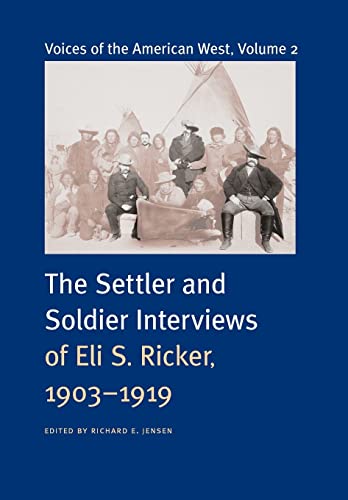
Synopsis
In this second volume of interviews conducted by Nebraska judge Eli S. Ricker, he focuses on white eyewitnesses and participants in the occupying and settling of the American West in the nineteenth century.
In the first decade of the twentieth century, as the Old West became increasingly distant and romanticized in popular consciousness, Eli S. Ricker (1842–1926) began interviewing those who had experienced it firsthand, hoping to write a multivolume series about its last days, centering on the conflicts between Natives and outsiders. For years Ricker traveled across the northern Plains, gathering information on and off reservations, in winter and in summer. Judge Ricker never wrote his book, but his interviews are priceless sources of information about that time and place, and they offer more balanced perspectives on events than were accepted at the time.
Richard E. Jensen brings together all of Ricker’s interviews with those men and women who came to the American West from elsewhere—settlers, homesteaders, and veterans. These interviews shed light on such key events as the massacre at Wounded Knee, the Little Bighorn battle, Beecher Island, Lightning Creek, the Mormon cow incident, and the Washita massacre. Also of interest are glimpses of everyday life at different agencies, including Pine Ridge, Yellow Medicine, and Fort Sill School; brief though revealing memoirs; and snapshots of cattle drives, conflicts with Natives, and the construction of the Union Pacific Railroad.
"synopsis" may belong to another edition of this title.
About the Author
Richard E. Jensen retired as a senior research anthropologist at the Nebraska State Historical Society. He is the editor of Charles Allen’s From Fort Laramie to Wounded Knee: In the West That Was and Rolf Johnson’s Happy As a Big Sunflower: Adventures in the West, 1876-1880, both available in Bison Books editions.
Excerpt. © Reprinted by permission. All rights reserved.
Voices of the American West, Volume 2
The Settler and Soldier Interviews of Eli S. Ricker, 1903-1919By Eli S. RickerUniversity of Nebraska Press
Copyright © 2005 University of Nebraska PressAll right reserved.
ISBN: 978-0-8032-3967-8
Contents
List of Illustrations.............................................................................................................................................................ixIntroduction......................................................................................................................................................................xiMap: The West of Eli S. Ricker....................................................................................................................................................xivChapter One: Wounded Knee.........................................................................................................................................................11. Peter McFarland. Wounded Knee..................................................................................................................................................12. Charles W. Allen. Wounded Knee.................................................................................................................................................103. Meded Swigert. Wounded Knee....................................................................................................................................................164. Guy Vaughn. Wounded Knee.......................................................................................................................................................215. Francis M. J. Craft. Wounded Knee..............................................................................................................................................226. John W. Butler. Wounded Knee...................................................................................................................................................237. James R. Walker. Wounded Knee..................................................................................................................................................248. George E. Bartlett. Biography, Wounded Knee....................................................................................................................................279. George A. Stannard. Wounded Knee...............................................................................................................................................3810. Joseph Kocer. Wounded Knee....................................................................................................................................................4011. W. F. Clark. Wounded Knee.....................................................................................................................................................4312. E. C. Swigert. Wounded Knee...................................................................................................................................................4413. W. A. Birdsall. Wounded Knee..................................................................................................................................................4514. Cornelius A. Craven. Wounded Knee.............................................................................................................................................4815. James White. Wounded Knee.....................................................................................................................................................5016. John H. Dixon. Wounded Knee...................................................................................................................................................5117. T. L. Williams. Wounded Knee..................................................................................................................................................5218. W. A. Ballou. Wounded Knee....................................................................................................................................................5319. Elbert Mead. Wounded Knee.....................................................................................................................................................5520. Eli S. Ricker. Wounded Knee...................................................................................................................................................55Chapter Two: Agents and Agencies..................................................................................................................................................631. Mr. and Mrs. E. M. Keith. Wounded Knee, Pine Ridge agents......................................................................................................................632. Robert O. Pugh. Pine Ridge agents, Ghost Dance, Sioux Customs..................................................................................................................673. H. A. Mossman. Pine Ridge agents...............................................................................................................................................744. A. F. Johnson. Pine Ridge missions.............................................................................................................................................755. William J. Cleveland. Sioux missions...........................................................................................................................................766. Edmund Thickstun. Sioux customs, Indian-white relations........................................................................................................................787. John R. Brennan. Pine Ridge reservation........................................................................................................................................818. George Stover. Biography, Frank Grouard, Pine Ridge Reservation, Pine Ridge agents.............................................................................................829. John B. Sanborn. Sioux reservation boundaries..................................................................................................................................8810. Ollufine Nelson. Yellow Medicine Agency.......................................................................................................................................8911. Peter B. Nelson. American Horse, Yellow Medicine Agency.......................................................................................................................9312. Mabel M. Dawson. Fort Sill Indian School, Geronimo............................................................................................................................100Chapter Three: Little Bighorn.....................................................................................................................................................1151. A. F. Ward. Little Bighorn.....................................................................................................................................................1152. Charles Clifford. Little Bighorn, Yellow Horse's account.......................................................................................................................1233. Edward H. Allison. Little Bighorn, Lieutenant Harrington's death, Gall.........................................................................................................1274. Edward S. Godfrey. Little Bighorn..............................................................................................................................................1385. F. E. Server. Little Bighorn, Frank Grouard, Lame Deer fight, Crow agencies, Jim Bridger.......................................................................................1416. Walter Q. Tucker. Little Bighorn...............................................................................................................................................1487. Archie Smith. Little Bighorn...................................................................................................................................................148Chapter Four: Beecher Island......................................................................................................................................................1501. Allison J. Pliley. Beecher Island fight........................................................................................................................................1502. John J. Donovan. Beecher Island fight..........................................................................................................................................1533. Beecher Island Veterans. Beecher Island fight..................................................................................................................................156Chapter Five: Lightning Creek Incident............................................................................................................................................1651. Eli S. Ricker. Lightning Creek incident........................................................................................................................................1652. Hugh Houghton. Lightning Creek incident........................................................................................................................................1693. Roy Lemons. Lightning Creek incident...........................................................................................................................................1704. Isaac Robbins. Lightning Creek incident........................................................................................................................................172Chapter Six: Biographical Sketches................................................................................................................................................1741. W. R. Jones. Connor, Bissonette, Little Big Man, Crook, Sechler, Salaway, Little Bat, Pine Ridge Agency, Fort Mitchell, Red Cloud..............................................1742. L. B. Lessert. Fort Casper, the Bakers, Bridger, Yellow Medicine Agency, Pine Ridge agents, Beckwourth.........................................................................1793. Alexander Baxter. Scouts and interpreters, agents, Indian leaders, 1868 Fort Laramie treaty....................................................................................1834. Harry Dean. Wild Bill Hickok...................................................................................................................................................1875. JohnW. Brafford. William F. Drannan............................................................................................................................................1886. Marion Spencer. Bridger and Vasquez............................................................................................................................................188Chapter Seven: The OldWest........................................................................................................................................................1901. Magloire Mousseau. American Fur Company, Ash Hollow fight, Fort Casper, Fort Laramie, Kelly, Larimer, and Wakefield, scouts, traders, officers, and agents.....................1902. George W. Colhoff. Galvanized Yankess, treaties and reservations, the Richards, Frank Grouard, Bridger, Little Bat, Pine Ridge agents, Red Cloud...............................2103. Carter P. Johnson. Cheyenne outbreak, Sidney-Deadwood stagecoach robberies, Apache Kid.........................................................................................2244. Baptiste Pourier. Biography, the Richards, Bozeman Trail forts, Rosebud fight, Slim Buttes fight, Crazy Horse, Sibley Scout....................................................2555. Richard C. Stirk. Flagpole at Red Cloud Agency, Slim Buttes fight, Wounded Knee................................................................................................2826. Ben Tibbits. Washita fight, Flagpole at Red Cloud Agency, Wounded Knee.........................................................................................................2907. Heber M. Creel. Cheyenne outbreak..............................................................................................................................................2938. William L. Judkins. Mackenzie-Dull Knife fight.................................................................................................................................2979. David Y. Mears. Sibley Scout, Cheyenne outbreak................................................................................................................................30010. Jacob A. Augur. Cheyenne outbreak.............................................................................................................................................30111. A. G. Shaw. Eleventh Ohio Cavalry, Platte Bridge fight, Rush Creek fight, Horse Creek fight, Custer's dead, Spotted Tail, Crazy Horse.........................................30212. Peter Abraham Deon. American Fur Company, Father DeSmet, Horse Creek treaty, Red Cloud........................................................................................31013. John Russell. The Richards, Kelly, Larimer, and Wakefield, scouts, traders and officers, Wounded Knee.........................................................................31714. Augustus W. Corliss. Biography, Wounded Knee, officers and Indians............................................................................................................32315. John C. Whalen. Powder River campaign, Platte Bridge fight, Wounded Knee......................................................................................................32716. John W. Irion. Rawhide Creek legend, Masonry and Indians, Sand Creek..........................................................................................................33317. A.W. Means. Sand Creek........................................................................................................................................................33818. John M. Comegys. Scouts and officers..........................................................................................................................................33819. William H. Taylor. Crook's 1876 campaign......................................................................................................................................34020. Mr. and Mrs. William H. Robertson. Grattan fight..............................................................................................................................34121. Allison J. Pliley. Prairie Dog Creek fight....................................................................................................................................34222. William Holdaway. U.P. Railroad construction..................................................................................................................................34523. John Burdick. Custer..........................................................................................................................................................34624. William A. Coffield. Telegraph at Fort Robinson...............................................................................................................................34725. James H. Cook. William F. Cody, The Texas Trail...............................................................................................................................34726. Donald Brown. Warbonnet fight, Slim Buttes fight..............................................................................................................................36027. Winfield S. Ake. Camp Lyon, Paiutes...........................................................................................................................................36128. Josephus Bingaman. Washita fight..............................................................................................................................................36429. George A. Leclere. Whitestone Hill fight, Badlands campaign...................................................................................................................36830. Mr. and Mrs. John Farnham. Red Cloud..........................................................................................................................................37131. Charles J. Brown. Treaties with the Sissetons, Wahpetons, Medewakantons, and Wapecootahs......................................................................................371Appendix A: Forts.................................................................................................................................................................375Notes.............................................................................................................................................................................379Bibliography......................................................................................................................................................................433Index.............................................................................................................................................................................445
Chapter One
Wounded Knee
Peter McFarland's Interview]
[Tablet 31]
Personal Sketch of Peter McFarland who is (April 20, 1905) 35 years old and was 21 at W. Knee battle. He was teamster for the Indian scouts under Capt. Taylor. Was at W.K. fight and all through it and in the center of it. He came back from W.K. & was ambulance driver for Col. Biddle. In January, 1896, he began service in the Pack Train at Camp Carlin, near Cheyenne, Wyo. and in 1898 went with pack train to Alaska where he was three months and then shipped from Dyea, Alaska, to Tampa, Florida, via Seattle and St. Louis, and reached Cuba June 22, 1898, and was there four years, barring one trip back to the states which lasted three months. Was in the pack train service from the time he went in January, 1896.
Was first employed by the gov't. as ambulance driver in 1888.
Shipped from Cuba in 1902 and arrived at Fort Riley, Kansas, May 6, 1902, and came to Fort Robinson in August, 1904.
April 18, 1905. Wounded Knee
Peter McFarland, Packmaster at Fort Robinson, of Pack Train No. 3, says: He was a gov't. employee driving team for the Quartermaster Colonel Humphreys who was in charge of all the teams at Pine Ridge. (He is General Humphreys now.) Humphreys was the Quartermaster at P. Ridge then. McFarland was assigned to Capt. Chas. W. Taylor, Chief of Scouts, and served under him and Lieut. Guy Preston.
McFarland went out from the Agency after Christmas (probably the 27th) with a four-line team which was in charge of Capt. Taylor, hauling grain, ammunition tents, etc; went with 7th Cavalry. Camped that night at Wounded Knee where the battle came off. Baptiste Garnier with some of the Indian scouts went out on the morning of the 28th and captured 2 or 3 of Big Foot's scouts who were watching the troops. He brought them in and they were kept in McFarland's tent. Baptiste sawon the night of arrival at W.K. some of Big Foot's scouts hovering around. Next morning he went out and got behind these scouts and captured them. He discovered the location of Big Foot's camp on the Porcupine and on his return he conducted the 7th Cavalry out to the camp and Big Foot's band was brought in, arriving about, as it seems to him, as late as 2 or 3 in the afternoon. Tents had been put up by a detachment which had been left behind in the camp of the 7th at W.K., for the Indians to occupy, but on their arrival they would not occupy them for they seemed to want to camp near the dry gulch. They pitched their tepees in an irregular half moon. About 10 or 12 Indians sat up all night manifesting no desire to lie down; they stayed over by McFarland's tent where Big Foot was lying therein on Mc's buffalo overcoat which I have seen at Fort Robinson. Big Foot was very sick with pneumonia and had a white cloth tied around his head as though he was in pain. Little Bat [Baptiste Garnier] was at Mc's tent also and he sat up all night talking with the Indians in a low tone; they seemed to be discussing and talking over affairs. Bat told Mc that as Mc was lying in the tent asleep & was 20 yrs. old, that he himself stayed up all night to watch, saying that if the Indians had broke out that they would have killed Mc, & Bat was keeping them engaged in conversation to keep them quiet. Big Foot and Mc slept together in same tent. Big Foot was a man of large stature. A close chain guard was placed around the Indians and it encompassed the scouts. That is, the tent occupied by the scouts and Bat and Mc was in the enclosure.
Following is a description of McFarland's map of the W.K. field: [Figure 1]
1. House on Hill. There was a small shack on this hill and some hay was stacked there. Mc and Lt. Preston went up there and got some hay for their horses. Here were planted the Hotchkiss cannon. He thinks there might have been 3 or 4 of these. Cannot tell the number.
2. Is where the hospital was. The wounded were brought and laid around this wagon. It was not a tent. They were laid on 2 stretchers and on blankets & anything else at hand. This is what he calls the Red Cross Ambulance, but it was handled by the military. It has a white flag with a red cross.
(There were some pack mules on the field with the wagon train.)
3.Troops and Transportation. The Transportation was parked in rear of the troops and close to the hospital wagon. The dots just above the words "Troops and Transportation" mark the "Kitchen wagons." The dots between the troop quarters and the "Officers" tents are the First Sergeants' tents.
4. Officers Tents.
5. Close Chain Guard. On the east side of the ground enclosed by the chain guard are tents put up by the troops for the Indians to occupy when they came in, but which they would not use. He says it was understood that there were 319 Indians of all kinds in Big Foot's band brought in; this is what Bat told him.
About 8 o'clock in the morning four dismounted troops were formed in a circle within the enclosure formerly made by the chain guard which had now been taken up. This circle is marked 5 and was an oblong & not a circle.
The night or day before, word was dispatched to the Agency stating that Big Foot's band was captured and more troops were wanted to help disarm them. Four troops came out in the night accompanied by Col. Forsythe. Before his arrival Capt. Whiteside had been in command of the 4 troops and transportation of the 7th. These four troops which came in the night were camped behind the hill at the north and out of sight of the Indians. About the time the battle started Mc saw these 4 mounted troops dispersed to the southwest of the camp up on the high land evidently to prevent the Indians, if they should break away, from gaining the hills in that direction.
The Indian warriors were ordered to come into the oblong "circle" and to bring their arms and turn them over. They showed reluctance, looked downcast - mad - but finally 60 or 70 or more out of 129 warriors came straggling in. They were asked to give up their guns, but none had any. Then they returned to their tepees. They all had on ghost shirts, which were covered up by their blankets. All had on the war paint; their faces painted green striped with yellow many had on their war feathers; some of the ponies were decorated with feathers in their tails and striped with the paint of battle. After awhile they began to come back; this time they sat down on the ground. Now 2 or 3 were taken at a time from the main body to the west end of the oblong "circle," the guns were received there by a soldier who carried them out through the guard and piled them on the ground 30 or 40 feet away and beside the wagon to which the team was attached ready to haul them at once to the Agency. Lieut. Preston was sitting down on the pile of guns when the fight began. The search produced only 8 or 10 old firelocks [flintlocks].
When the warriors collected the second time Big Foot, assisted by another, came out into the "circle" and in the center kneeled down and remained there and in that position until he was killed. Shortly after the search began the medicine man began to chant his war (?) song. The Indians had their arms concealed under their blankets. When the search began to bring out the good weapons the medicine man still singing facing the rising sun, his back to the Indians, waving his arms, he stooped down and with both hands grasped some soil and threw both arms outwardly scattering the dust. Instantly came an Indian volley. The fight was on with deadly effect. It was at close quarters and hand to hand. The Indians used guns, knives and war clubs. The women fired from the Indian tents. Philip Wells was wounded early in the action. Capt. Wallace was also killed near the east end of the "circle." Lieut. Preston, at the beginning of the action, mounted his horse and within an hour was at the Agency with word of what had happened. (It was safer than staying there.)
(The scouts were Indians and Little Bat was the chief. There were 24 or about that number. Excepting 4 or 5 of these scouts they all disappeared the first night that the 7th arrived at W.K. Nothing more was seen of them until two or three weeks afterwards they returned to the Agency.)
The center of the fight was at the "circle." One of the Indian scouts was High Back Bone who was thought to be half crazy. Early in the action he was seen by a soldier to flourish his revolver and whether it was excitement or a bad heart which was his incitement is not known, but his actions being seen, his running around was interpreted to mean that he had turned against the whites, and when he got down by the officers' tents a soldier shot him down.
Where the center of the fight was were 50 or more Indians killed.
After the fight had continued awhile and the smoke rose so the field could be seen and the soldiers had been formed in line at 6, and some soldiers were formed in line on the top of the hill by the artillery, the Hotchkiss guns on the hill fired into an Indian wagon standing at 7. Several Indians were firing on the soldiers from behind this wagon. The shell sent into it knocked it into pieces and killed a number of warriors.
During the progress of the fighting an Indian slipped into the tent belonging to the scouts and occupied by Bat and McFarland, and he got Bat's gun and shot 2 soldiers. McFarland saw the smoke from Bat's rifle coming out of the scouts' tent at 8. Mc was standing behind his wagon at 9 which had been overturned; one of his mules was shot and the others, when the mule fell, cramped around and tipped the wagon over. When Mc saw what this Indian was doing (he saw two men fall when the shots were heard from the tent) he ran forward and notified some soldiers in the line at 6, and as they could not fire from that position without striking the tents of troops nor without hitting some of the horses, they ran back to the first tent in the officers' row at 10 and from here they fired 2 or 3 volleys into the scouts' tent. An officer with the men who were firing on this tent told a trooper to go up to the tent and fire it; he said he would fix it, and he ran up and cut it open whereupon the Indian on the inside shot him in the breast and killed him instantly. This firing party continued to shoot into the tent while Mc ran up to the top of the hill where the cannons were and told the officer in command of the artillery that a Hotchkiss gun was wanted down on the bottom to shell the tent. One cannon was brought down and planted at 10 and a few shells were thrown into the tent. Then a soldier ran up and set the tent on fire and it was quickly burned down, and his [the Indian's] clothing took fire and he was burned and bloated up 2 feet high. He was found to have a bullet hole through his body and it is not known whether he had been killed by a rifle shot before the cannon was brought into requisition. Bat's gun which he had been using was burned "a little" on the stock. It was his best gun, the Hotchkiss rifle.
Dr. Seward Webb of N.Y. who used to come out on hunting trips gave Batteesse a fine breech-loading arm which Bat called his Hotchkiss rifle.
All the foregoing occurred in about three-quarters of an hour.
The Indians were pushed back into the gulch; some crossed it, others went up the gulch. Those who crossed fell back one by one going up the rising ground to the southwest where they made a stand at 11; the mounted cavalry above their position had before this time disappeared and he does not know where they went moved around to the west to get out of line of fire and here they found something to do in pursuing Indians who had escaped by running out of the gulch at the upper end or head. A lot of Indians were killed by these mounted men who had one of their number shot through the body. The fight of the Indians at 11 was kept up till the last one was killed. A Hotchkiss gun was run out on the flat in front of the Indian tepes and towards the gulch. From here a searching fire was kept up on the Indians who were lying low in the gulch; whenever and wherever one was seen to move, as they often did in shooting at the troops, a shell would be dropped where he was which either killed him or hunted and chased him out; he would spring right up and march toward the soldiers singing the death song, and was quickly killed by the watchful soldiers.
A straggling fire was kept up till the middle of the afternoon. This was due to the fact that the gulch was occupied by Indians who did not show themselves, but when a soldier got exposed a concealed Indian would pick him off. So it was not only extremely hazardous but was almost certain death to advance towards or along the gulch, and this Hotchkiss gun was kept in action to drive them out whenever the position of an Indian was discovered or from any sign suspected. The gun was moved from position to position as was found necessary. A lieutenant with this Hotchkiss was wounded while the gun was doing its work against the Indians in this protected part of the field.
Mc says he saw one Indian who was scalped. He was lying in the gulch on his back.
McFarland went around by the road and got up where the Indians had all been killed at 11, and there he found a little girl about three years old, had light hair, she was standing and holding on to her dead mother's hair. He took the child and carried it to the Red Cross ambulance and it was received by an attendant. What became of the child afterwards is not known.
Wounded Indians got down to the creek in some manner (supposed to have crawled down the gulch) and many were found there afterwards both dead and wounded, some of them frozen.
A rumor got in circulation that a large force of Indians was coming from among the hostiles at the Agency. This was late in the afternoon. Troops began making breastworks out of the bags of oats in the supply wagons, by carrying them up and putting them down on the hill north of the flat. This work had not gone far when there came an order to load up and start for the Agency. The dead and wounded soldiers and the wounded Indian women and children and the train and troops moved in and arrived at the Agency about one o'clock next morning. The Agency was all excitement, nobody being in bed.
Peter McFarland's Pine Ridge story continued: He says:
About Sept. 1889, Capt. Gilfoyle took an escort from Fort Robinson (McFarland was with him) and met General Miles at Rushville and took him to Pine Ridge Agency where Miles remained 2 or 3 days and was having some kind of a conference with the dissatisfied Indians. The party brought back four Indian chiefs who went with General Miles to Washington.
He further says:
That after he came back from W. Knee to the Agency on the night of Dec. 29, arriving about 1 o'clock on the morning of the 30th.
Early on the morning of the 30th the 9th Cavalry came into the Agency, having left their wagon train abt. 5 miles north of Agency in charge of D troop under command of Capt. Loud. When the wagon train or transportation was within about 2 1/2 miles of Agency just at break of day, they had an advance guard out, a party of 2 Indians advanced toward the advance guard & were mistaken for friendly Indians because they were wearing one wore U.S. Soldier overcoats with yellow cape lining, & when close to the ad. guard he shot one of the guard dead. The other advance guard then broke for the Agency and the other two Indians tried to head him off but he escaped from them and gave the alarm at the Agency. The wagon train then parked for protection till reinforcements could be brought out. The 9th came right out and dispersed the Indians and the train came in.
(Continues...)
Excerpted from Voices of the American West, Volume 2by Eli S. Ricker Copyright © 2005 by University of Nebraska Press. Excerpted by permission.
All rights reserved. No part of this excerpt may be reproduced or reprinted without permission in writing from the publisher.
Excerpts are provided by Dial-A-Book Inc. solely for the personal use of visitors to this web site.
"About this title" may belong to another edition of this title.
Search results for Voices of the American West, Volume 2: The Settler...

Stock Image
Voices of the American West, Volume 2: The Settler and Soldier Interviews of Eli S. Ricker, 1903-1919
Published by
University of Nebraska Press, 2005
ISBN 10: 080323967X
ISBN 13: 9780803239678
Used
Hardcover
Seller: ThriftBooks-Atlanta, AUSTELL, GA, U.S.A.
Seller rating 5 out of 5 stars

Hardcover. Condition: Fair. No Jacket. Former library book; Readable copy. Pages may have considerable notes/highlighting. ~ ThriftBooks: Read More, Spend Less. Seller Inventory # G080323967XI5N10
Stock Image
Voices of the American West, Volume 1: The Indian Interviews of Eli S. Ricker, 1903-1919
Published by
University of Nebraska Press, Lincoln, NE, 2005
ISBN 10: 080323967X
ISBN 13: 9780803239678
Used
Hardcover
Seller: Xochi's Bookstore & Gallery, Truth or consequences, NM, U.S.A.
Seller rating 2 out of 5 stars

Hardcover. Condition: Fine. Dust Jacket Condition: Near Fine. 1st. 495pp.incl.index; HB paletan w/blk.; fine condition w/clean,tight pgs. DJ green w/white&tan-photocover; slight rub. Interviews w/Indian eyewitnesses to Wounded Knee, the Little Big Horn, the Grattan incident, and other events and people. Seller Inventory # 053786
Seller Image
Voices of the American West : The Settler And Soldier Interviews of Eli S. Ricker, 1903-1919
Published by
University of Nebraska Press, 2005
ISBN 10: 080323967X
ISBN 13: 9780803239678
New
Hardcover
Seller: GreatBookPrices, Columbia, MD, U.S.A.
Seller rating 5 out of 5 stars
Condition: New. Seller Inventory # 3514706-n
Stock Image
Voices of the American West, Volume 2: The Settler and Soldier Interviews of Eli S. Ricker, 1903-1919
Published by
University of Nebraska Press, 2005
ISBN 10: 080323967X
ISBN 13: 9780803239678
New
Hardcover
Seller: Lakeside Books, Benton Harbor, MI, U.S.A.
Seller rating 5 out of 5 stars
Condition: New. Brand New! Not Overstocks or Low Quality Book Club Editions! Direct From the Publisher! We're not a giant, faceless warehouse organization! We're a small town bookstore that loves books and loves it's customers! Buy from Lakeside Books! Seller Inventory # OTF-S-9780803239678
Seller Image
Voices of the American West : The Settler And Soldier Interviews of Eli S. Ricker, 1903-1919
Published by
University of Nebraska Press, 2005
ISBN 10: 080323967X
ISBN 13: 9780803239678
Used
Hardcover
Seller: GreatBookPrices, Columbia, MD, U.S.A.
Seller rating 5 out of 5 stars
Condition: As New. Unread book in perfect condition. Seller Inventory # 3514706
Stock Image
Voices of the American West, Volume 2 The Settler and Soldier Interviews of Eli S. Ricker, 1903-1919
Published by
Cornell Maritime Press, Lincoln, NE, 2005
ISBN 10: 080323967X
ISBN 13: 9780803239678
Used
Hardcover
Seller: Treehorn Books, Santa Rosa, CA, U.S.A.
Seller rating 4 out of 5 stars

Hardcover. Condition: Very Good+. Dust Jacket Condition: Very Good+. Covered in plastic; 16mo 6" - 7" tall; 472 pages. Seller Inventory # 7849
Stock Image
Voices of the American West, Volume 2: The Settler and Soldier Interviews of Eli S. Ricker, 1903-1919
Published by
University of Nebraska Press, 2005
ISBN 10: 080323967X
ISBN 13: 9780803239678
New
Hardcover
Seller: California Books, Miami, FL, U.S.A.
Seller rating 5 out of 5 stars
Condition: New. Seller Inventory # I-9780803239678
Seller Image
Voices of the American West, Volume 2: The Settler and Soldier Interviews of Eli S. Ricker, 1903-1919
Published by
University of Nebraska Press, Lima, Peru, 2005
ISBN 10: 080323967X
ISBN 13: 9780803239678
Used
Hardcover
First Edition
Seller: Dorley House Books, Inc., Hagerstown, MD, U.S.A.
Seller rating 4 out of 5 stars
Hardcover. Condition: Near Fine. Dust Jacket Condition: Near Fine. Map; b/w Illus (illustrator). 1st. 1st printing; dj in mylar; 495 clean, unmarked pages/index. Seller Inventory # 122535
Stock Image
Voices of the American West, Volume 2
Seller: PBShop.store UK, Fairford, GLOS, United Kingdom
Seller rating 5 out of 5 stars
HRD. Condition: New. New Book. Shipped from UK. Established seller since 2000. Seller Inventory # FW-9780803239678
Buy New
US$ 58.24
US$ 7.77 shipping
Ships from United Kingdom to U.S.A.
Ships from United Kingdom to U.S.A.
Quantity: 1 available
Seller Image
Voices of the American West : The Settler And Soldier Interviews of Eli S. Ricker, 1903-1919
Published by
University of Nebraska Press, 2005
ISBN 10: 080323967X
ISBN 13: 9780803239678
Used
Hardcover
Seller: GreatBookPricesUK, Woodford Green, United Kingdom
Seller rating 5 out of 5 stars
Condition: As New. Unread book in perfect condition. Seller Inventory # 3514706
Buy Used
US$ 53.83
US$ 19.87 shipping
Ships from United Kingdom to U.S.A.
Ships from United Kingdom to U.S.A.
Quantity: Over 20 available