
Items related to The Secret of the Stones (Phyllis Fogelman Books)
Synopsis
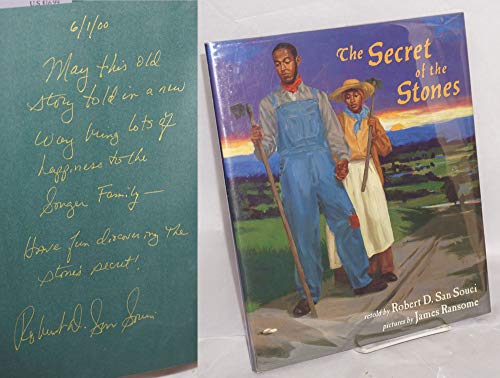
When John and Clara return to their cabin from working in the fields one evening, they are startled to discover that all of their household chores have been done. The mysterious, magical Aunt Easter tells the couple the identity of these unknown benefactors and their connection to the two white stones that Clara keeps in the house. Armed solely with Aunt Easter's advice and their own affectionate, courageous hearts, John and Clara must confront the evil conjure man. Only then will they solve the secret of the stones and fill the void in their childless home.
Robert San Souci has drawn again from the rich legacy of African-American folklore, as he did in his acclaimed The Hired Hand and The Talking Eggs. And the deep, jewel-like colors of James Ransome's paintings carry the reader into the majestic Ozark mountains and inside this marvelously dramatic and touching story of love and courage.
"synopsis" may belong to another edition of this title.
Reviews
Grade 2-5-A childless, hardworking couple finds two beautiful white stones while walking home from the cotton fields one evening. Clara takes them to their cabin, thinking to use them to sharpen knives, but they are quickly forgotten in the round of continual work. The next few evenings, however, upon their return from work, they find all their chores done and everything set out to cook supper. When the mysterious Aunt Easter informs them that the stones are really two orphaned siblings under the power of an evil "conjure-man," they become determined to release the children and adopt them. San Souci's retelling of a story from both the African and African-American traditions has verve and style, using heavy dialect and chant effectively and maintaining tension right up to the satisfying ending. Ransome's oil-on-paper illustrations are big, bold, and arresting. They have an accomplished kinetic sense that complements the vivid narrative to a tee. A perfectly magical offering.
Ann Welton, Terminal Park Elementary School, Auburn, WA
Copyright 2000 Reed Business Information, Inc.
Ransome's (Uncle Jed's Barbershop) strikingly realistic oil paintings form the backbone for San Souci's (The Talking Eggs) retelling of a folktale from Virginia Holladay's Bantu Tales and based on African-American Arkansas lore. As a childless couple walks home after a long day in the cotton fields, Clara finds two white stones that "shone as pale and round and smooth as twin moons in her cinnamon-colored palm." Though John questions their usefulness ("What yo' gonna do with dose li'l rocks?"), his wife brings the stones home. In a rather abrupt transition, the duo returns home from work the next day to discover their chores mysteriously completed. After a clairvoyant neighbor reveals her dream--that the rocks are actually an orphaned boy and girl--she bids John and Clara to visit the "conjure-man" who transformed the children. Though the pacing here is not as fluid as in some of San Souci's retellings, he skillfully blends dialect and atmospheric description (the villain's eyes "were two narrow slits that made him look mean as a rattlesnake"). Ransome's close-up portraits convey the range of emotions for the couple as well as the liberated children, and his rendering of a white conjure-man delivers a strong underlying message. Ages 4-8. (Dec.)
Copyright 1999 Reed Business Information, Inc.
From San Souci, an artful blend of magic and courage in a cheering tale that is stunningly depicted in Ransome's resplendent artwork. Clara and John, two African-Americans from ``back in the olden times,'' are husband and wife, and toilers in the fields. Returning home one day, Clara picks up two little white stones. Shortly thereafter, when they return home after a day of work, they find the house neat, dinner made, and a fire blazing on the hearth. A neighbor, Aunt Easter, ``who could see `hants' and knew healing secrets and could work charms and sometimes had `prophesyin' dreams,'' tells them the stones are orphans. John and Clara learn that they can see the children, but only by hiding; as soon as the children see them they return to stone. Aunt Easter tells John and Clara that they will have to thwart the conjurer who put the spell on the children if they are to gain the children's freedom. This they do, in a bit of cleverness that takes a few unexpected and gratifying turns, and they end up with two fine young children to raise. San Souci's note places the story's origins in Bantu folktales that made it all the way into Arkansas folklore virtually unscathed. That's almost as much of a miracle as the story itself. (Picture book. 4-8) -- Copyright ©1999, Kirkus Associates, LP. All rights reserved.
San Souci elaborates on a tale with roots in folklore from both Arkansas and Zaire, involving a childless couple, an evil conjure-man, and two orphans who have been turned into pebbles. After bringing home two white stones they found on their way home from the fields, John and Clara return each day from work to find their house cleaned and a meal ready. A wise woman explains: the stones are children, who can only be freed by milk, eggs, and corn taken from the conjure-man who bewitched them. Ransome depicts his serious-looking (American) characters and their verdant rural setting with dignified, richly colored, uncluttered realism. Although San Souci's characters speak in dialect ("`Tell us how to fine dat conjure-man.'"), his language and pacing combine for a strong, direct telling that stands up to the stately illustrations. Children will be riveted and delighted by the tale's suspense, its see-saw climax, and the scary conjure-man's squishy demise. Source notes are appended. John Peters
"About this title" may belong to another edition of this title.
Search results for The Secret of the Stones (Phyllis Fogelman Books)

Stock Image
The Secret of the Stones (Phyllis Fogelman Books)
Seller: Your Online Bookstore, Houston, TX, U.S.A.
Seller rating 5 out of 5 stars

hardcover. Condition: Very Good. Ransome, James (illustrator). Seller Inventory # 0803716400-2-36443706
Stock Image
The Secret of the Stones
Published by
Penguin Publishing Group, 2000
ISBN 10: 0803716400
ISBN 13: 9780803716407
Used
Hardcover
First Edition
Seller: Better World Books, Mishawaka, IN, U.S.A.
Seller rating 5 out of 5 stars
Condition: Good. Ransome, James (illustrator). 1st Edition. Pages intact with minimal writing/highlighting. The binding may be loose and creased. Dust jackets/supplements are not included. Stock photo provided. Product includes identifying sticker. Better World Books: Buy Books. Do Good. Seller Inventory # 8076194-6
Stock Image
The Secret of the Stones
Published by
Penguin Publishing Group, 2000
ISBN 10: 0803716400
ISBN 13: 9780803716407
Used
Hardcover
First Edition
Seller: Better World Books, Mishawaka, IN, U.S.A.
Seller rating 5 out of 5 stars
Condition: Good. Ransome, James (illustrator). 1st Edition. Former library copy. Pages intact with minimal writing/highlighting. The binding may be loose and creased. Dust jackets/supplements are not included. Includes library markings. Stock photo provided. Product includes identifying sticker. Better World Books: Buy Books. Do Good. Seller Inventory # 3499586-6
Stock Image
A Secret of the Stones: A Folktale
Seller: World of Books (was SecondSale), Montgomery, IL, U.S.A.
Seller rating 5 out of 5 stars
Hardback. Condition: Good. Ransome, James (illustrator). Seller Inventory # 00107866790
Stock Image
A Secret of the Stones: A Folktale
Seller: World of Books (was SecondSale), Montgomery, IL, U.S.A.
Seller rating 5 out of 5 stars
Hardback. Condition: Fair. Ransome, James (illustrator). Seller Inventory # 00100480760
Stock Image
The Secret of the Stones (Phyllis Fogelman Books)
Seller: HPB-Diamond, Dallas, TX, U.S.A.
Seller rating 5 out of 5 stars
hardcover. Condition: Very Good. Ransome, James (illustrator). Connecting readers with great books since 1972! Used books may not include companion materials, and may have some shelf wear or limited writing. We ship orders daily and Customer Service is our top priority! Seller Inventory # S_478525834
Stock Image
A Secret of the Stones: A Folktale
Seller: World of Books Inc, Montgomery, IL, U.S.A.
Seller rating 4 out of 5 stars

Hardback. Condition: Good. Ransome, James (illustrator). Seller Inventory # CIN0803716400G
Stock Image
A Secret of the Stones: A Folktale
Seller: World of Books Inc, Montgomery, IL, U.S.A.
Seller rating 4 out of 5 stars
Hardback. Condition: Fair. Ransome, James (illustrator). Seller Inventory # CIN0803716400A
Stock Image
The Secret of the Stones (Phyllis Fogelman Books)
Seller: Library House Internet Sales, Grand Rapids, OH, U.S.A.
Seller rating 5 out of 5 stars
Hardcover. Condition: Good. No Jacket. Ransome, James (illustrator). When they try to find out who is doing their chores while they are working in the field, a childless couple discovers that the two stones they have brought home are actually two bewitched orphans. Former library book. Minimal shelfwear. Please note the image in this listing is a stock photo and may not match the covers of the actual item. Ex-Library. Seller Inventory # 123462145
Stock Image
The Secret of the Stones (Phyllis Fogelman Books)
Published by
Phyllis Fogelman Books, 2000
ISBN 10: 0803716400
ISBN 13: 9780803716407
Used
Hardcover
First Edition
Signed
Seller: Acme Books, Alton, NH, U.S.A.
Seller rating 4 out of 5 stars
Hardcover. Condition: Very Good. Dust Jacket Condition: Very Good. Illustrated by James Ransome (illustrator). 1st Edition. Scant wear to book and dust jacket. Illustrator signed with an inscription on fep, no other writing, no stamps. Dust jacket illustration matches glossy book cover. Slight rubbing to rear of dust jacket - now in a protective mylar cover. Size: 11 1/4" X 9 1/4". Inscribed by Illustrator(s). Book. Seller Inventory # 014249