
Items related to The Mottled Screen: Reading Proust Visually
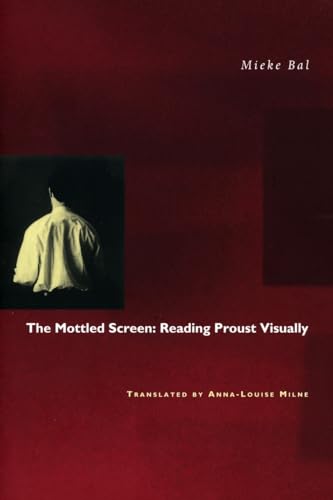
Synopsis
The clear-cut distinction between texts (literature) and images (art) has been challenged by a culture saturated with television and by an increased emphasis on interdisciplinary studies. From the viewpoint of our present culture, the author suggests, we can now see how some of the great writers and artists of the past overstepped the boundaries of the media in which they worked. The Mottled Screen studies as an example of this process a great literary work that cannot be confined to language alone, even though it consists exclusively of words: Proust's Remembrance of Things Past.
The author of Reading Rembrandt: Beyond the Word-Image Opposition, a widely acclaimed study of Rembrandt's discursive, rhetorical, and narrative painting, now offers a symmetrical counterpart to that study with this sustained "visual" reading of Proust's masterpiece, pointing out its visual strategies of representation, fantasy, and poetic thought. She focuses on the narrative and descriptive passages, examining how they make us "see," arguing that this visual writing is by no means a derivative writing that uses visual imagery as an inspiration or model. Instead, it is the writing of a true vision.
Beginning with the attempts to emulate painting, the book develops a Proust à la Chardin, working around Chardin's painting The Skate, but only after first reading Chardin through Proust. Viewing a Chardin with anxieties and emulation, Proust writes in Chardin's mood when he sets up the mottled screen as the metaphor of reading. Chardin's appeal to a wavering, roving eye is matched by Proust's uncertain perceptions, and the nervous quality of The Skate is matched by the famous passages recording Proust's disgust at the debris of the breakfast table.
The second part of the book is devoted to Proust's use of optical instruments―such as the magnifying glass, the eyeglass, the telescope―to produce or enhance the visions that constitute the raw material of his poetic imagination. These optical instruments guide the probing of the paradoxes of seeing close-up or at a distance, the latter flattening out, the former blinding.
The final part reads the specifically "photographic" writing that permeates Remembrance as a highly original and astonishing contemporary, almost postmodern, poetics. The photographic shows in the way Proust's narrator frames what he sees, contrasts light and dark, zooms in and out, and represents "contact sheets" of snapshots rapidly taken so as to capture the most fleeting sensations and visions.
"synopsis" may belong to another edition of this title.
About the Author
Mieke Bal is Director of the Amsterdam School for Cultural Analysis. She is the author, most recently, of Double Exposures: The Subject of Cultural Analysis.
From the Back Cover
The clear-cut distinction between texts (literature) and images (art) has been challenged by a culture saturated with television and by an increased emphasis on interdisciplinary studies. From the viewpoint of our present culture, the author suggests, we can now see how some of the great writers and artists of the past overstepped the boundaries of the media in which they worked. The Mottled Screen studies as an example of this process a great literary work that cannot be confined to language alone, even though it consists exclusively of words: Proust’s Remembrance of Things Past.
The author of Reading Rembrandt: Beyond the Word-Image Opposition, a widely acclaimed study of Rembrandt’s discursive, rhetorical, and narrative painting, now offers a symmetrical counterpart to that study with this sustained “visual” reading of Proust’s masterpiece, pointing out its visual strategies of representation, fantasy, and poetic thought. She focuses on the narrative and descriptive passages, examining how they make us “see,” arguing that this visual writing is by no means a derivative writing that uses visual imagery as an inspiration or model. Instead, it is the writing of a true vision.
Beginning with the attempts to emulate painting, the book develops a Proust à la Chardin, working around Chardin’s painting The Skate, but only after first reading Chardin through Proust. Viewing a Chardin with anxieties and emulation, Proust writes in Chardin’s mood when he sets up the mottled screen as the metaphor of reading. Chardin’s appeal to a wavering, roving eye is matched by Proust’s uncertain perceptions, and the nervous quality of The Skate is matched by the famous passages recording Proust’s disgust at the debris of the breakfast table.
The second part of the book is devoted to Proust’s use of optical instruments—such as the magnifying glass, the eyeglass, the telescope—to produce or enhance the visions that constitute the raw material of his poetic imagination. These optical instruments guide the probing of the paradoxes of seeing close-up or at a distance, the latter flattening out, the former blinding.
The final part reads the specifically “photographic” writing that permeates Remembrance as a highly original and astonishing contemporary, almost postmodern, poetics. The photographic shows in the way Proust’s narrator frames what he sees, contrasts light and dark, zooms in and out, and represents “contact sheets” of snapshots rapidly taken so as to capture the most fleeting sensations and visions.
From the Inside Flap
The clear-cut distinction between texts (literature) and images (art) has been challenged by a culture saturated with television and by an increased emphasis on interdisciplinary studies. From the viewpoint of our present culture, the author suggests, we can now see how some of the great writers and artists of the past overstepped the boundaries of the media in which they worked. The Mottled Screen studies as an example of this process a great literary work that cannot be confined to language alone, even though it consists exclusively of words: Proust’s Remembrance of Things Past.
The author of Reading Rembrandt: Beyond the Word-Image Opposition, a widely acclaimed study of Rembrandt’s discursive, rhetorical, and narrative painting, now offers a symmetrical counterpart to that study with this sustained “visual” reading of Proust’s masterpiece, pointing out its visual strategies of representation, fantasy, and poetic thought. She focuses on the narrative and descriptive passages, examining how they make us “see,” arguing that this visual writing is by no means a derivative writing that uses visual imagery as an inspiration or model. Instead, it is the writing of a true vision.
Beginning with the attempts to emulate painting, the book develops a Proust à la Chardin, working around Chardin’s painting The Skate, but only after first reading Chardin through Proust. Viewing a Chardin with anxieties and emulation, Proust writes in Chardin’s mood when he sets up the mottled screen as the metaphor of reading. Chardin’s appeal to a wavering, roving eye is matched by Proust’s uncertain perceptions, and the nervous quality of The Skate is matched by the famous passages recording Proust’s disgust at the debris of the breakfast table.
The second part of the book is devoted to Proust’s use of optical instruments—such as the magnifying glass, the eyeglass, the telescope—to produce or enhance the visions that constitute the raw material of his poetic imagination. These optical instruments guide the probing of the paradoxes of seeing close-up or at a distance, the latter flattening out, the former blinding.
The final part reads the specifically “photographic” writing that permeates Remembrance as a highly original and astonishing contemporary, almost postmodern, poetics. The photographic shows in the way Proust’s narrator frames what he sees, contrasts light and dark, zooms in and out, and represents “contact sheets” of snapshots rapidly taken so as to capture the most fleeting sensations and visions.
The author of Reading Rembrandt: Beyond the Word-Image Opposition, a widely acclaimed study of Rembrandt’s discursive, rhetorical, and narrative painting, now offers a symmetrical counterpart to that study with this sustained “visual” reading of Proust’s masterpiece, pointing out its visual strategies of representation, fantasy, and poetic thought. She focuses on the narrative and descriptive passages, examining how they make us “see,” arguing that this visual writing is by no means a derivative writing that uses visual imagery as an inspiration or model. Instead, it is the writing of a true vision.
Beginning with the attempts to emulate painting, the book develops a Proust à la Chardin, working around Chardin’s painting The Skate, but only after first reading Chardin through Proust. Viewing a Chardin with anxieties and emulation, Proust writes in Chardin’s mood when he sets up the mottled screen as the metaphor of reading. Chardin’s appeal to a wavering, roving eye is matched by Proust’s uncertain perceptions, and the nervous quality of The Skate is matched by the famous passages recording Proust’s disgust at the debris of the breakfast table.
The second part of the book is devoted to Proust’s use of optical instruments—such as the magnifying glass, the eyeglass, the telescope—to produce or enhance the visions that constitute the raw material of his poetic imagination. These optical instruments guide the probing of the paradoxes of seeing close-up or at a distance, the latter flattening out, the former blinding.
The final part reads the specifically “photographic” writing that permeates Remembrance as a highly original and astonishing contemporary, almost postmodern, poetics. The photographic shows in the way Proust’s narrator frames what he sees, contrasts light and dark, zooms in and out, and represents “contact sheets” of snapshots rapidly taken so as to capture the most fleeting sensations and visions.
"About this title" may belong to another edition of this title.
Search results for The Mottled Screen: Reading Proust Visually

Stock Image
The Mottled Screen: Reading Proust Visually
Published by
Stanford University Press, 1997
ISBN 10: 0804728070
ISBN 13: 9780804728072
Used
Hardcover
Seller: Midtown Scholar Bookstore, Harrisburg, PA, U.S.A.
Seller rating 5 out of 5 stars

Hardcover. Condition: Very Good. Very Good - Crisp, clean, unread book with some shelfwear/edgewear, may have a remainder mark - NICE Standard-sized. Seller Inventory # M0804728070Z2
Stock Image
The Mottled Screen: Reading Proust Visually
Published by
Stanford University Press, 1997
ISBN 10: 0804728070
ISBN 13: 9780804728072
Used
Hardcover
Seller: Midtown Scholar Bookstore, Harrisburg, PA, U.S.A.
Seller rating 5 out of 5 stars
Hardcover. Condition: Good. HARDCOVER Good - Bumped and creased book with tears to the extremities, but not affecting the text block, may have remainder mark or previous owner's name - GOOD Standard-sized. Seller Inventory # M0804728070Z3
Stock Image
The Mottled Screen: Reading Proust Visually
Published by
Stanford University Press, 1997
ISBN 10: 0804728070
ISBN 13: 9780804728072
Used
Hardcover
Seller: Phatpocket Limited, Waltham Abbey, HERTS, United Kingdom
Seller rating 5 out of 5 stars
Condition: Good. Your purchase helps support Sri Lankan Children's Charity 'The Rainbow Centre'. Ex-library, so some stamps and wear, but in good overall condition. Our donations to The Rainbow Centre have helped provide an education and a safe haven to hundreds of children who live in appalling conditions. Seller Inventory # Z1-F-031-01772
Buy Used
US$ 55.15
US$ 14.26 shipping
Ships from United Kingdom to U.S.A.
Ships from United Kingdom to U.S.A.
Quantity: 1 available
Stock Image
The Mottled Screen: Reading Proust Visually
Published by
Stanford University Press, 1997
ISBN 10: 0804728070
ISBN 13: 9780804728072
Used
Hardcover
Seller: Anybook.com, Lincoln, United Kingdom
Seller rating 5 out of 5 stars
Condition: Good. This is an ex-library book and may have the usual library/used-book markings inside.This book has hardback covers. In good all round condition. Dust jacket in good condition. Please note the Image in this listing is a stock photo and may not match the covers of the actual item,700grams, ISBN:9780804728072. Seller Inventory # 5782715
Buy Used
US$ 53.49
US$ 17.48 shipping
Ships from United Kingdom to U.S.A.
Ships from United Kingdom to U.S.A.
Quantity: 1 available
Seller Image
Mottled Screen : Reading Proust Visually
Published by
Stanford University Press, 1997
ISBN 10: 0804728070
ISBN 13: 9780804728072
Used
Hardcover
Seller: GreatBookPrices, Columbia, MD, U.S.A.
Seller rating 5 out of 5 stars
Condition: As New. Unread book in perfect condition. Seller Inventory # 15813824
Seller Image
Mottled Screen : Reading Proust Visually
Published by
Stanford University Press, 1997
ISBN 10: 0804728070
ISBN 13: 9780804728072
Used
Hardcover
Seller: GreatBookPricesUK, Woodford Green, United Kingdom
Seller rating 5 out of 5 stars
Condition: As New. Unread book in perfect condition. Seller Inventory # 15813824
Buy Used
US$ 205.76
US$ 20.11 shipping
Ships from United Kingdom to U.S.A.
Ships from United Kingdom to U.S.A.
Quantity: Over 20 available
Seller Image
Mottled Screen : Reading Proust Visually
Published by
Stanford University Press, 1997
ISBN 10: 0804728070
ISBN 13: 9780804728072
New
Hardcover
Seller: GreatBookPricesUK, Woodford Green, United Kingdom
Seller rating 5 out of 5 stars
Condition: New. Seller Inventory # 15813824-n
Buy New
US$ 212.39
US$ 20.11 shipping
Ships from United Kingdom to U.S.A.
Ships from United Kingdom to U.S.A.
Quantity: Over 20 available
Seller Image
The Mottled Screen: Reading Proust Visually
Seller: moluna, Greven, Germany
Seller rating 5 out of 5 stars
Condition: New. The author challenges the view that literary texts cannot be examined by words alone, arguing that images also play a role in the interpretation process.Über den AutorrnrnMieke Bal is Director of the Amsterdam School for Cultural Analys. Seller Inventory # 595014034
Buy New
US$ 177.61
US$ 54.97 shipping
Ships from Germany to U.S.A.
Ships from Germany to U.S.A.
Quantity: Over 20 available
Seller Image
Mottled Screen : Reading Proust Visually
Published by
Stanford University Press, 1997
ISBN 10: 0804728070
ISBN 13: 9780804728072
New
Hardcover
Seller: GreatBookPrices, Columbia, MD, U.S.A.
Seller rating 5 out of 5 stars
Condition: New. Seller Inventory # 15813824-n
Seller Image
The Mottled Screen
Published by
Stanford University Press, US, 1997
ISBN 10: 0804728070
ISBN 13: 9780804728072
New
Hardcover
Seller: Rarewaves USA, HEBRON, KY, U.S.A.
Seller rating 5 out of 5 stars
Hardback. Condition: New. The clear-cut distinction between texts (literature) and images (art) has been challenged by a culture saturated with television and by an increased emphasis on interdisciplinary studies. From the viewpoint of our present culture, the author suggests, we can now see how some of the great writers and artists of the past overstepped the boundaries of the media in which they worked. The Mottled Screen studies as an example of this process a great literary work that cannot be confined to language alone, even though it consists exclusively of words: Proust's Remembrance of Things Past. The author of Reading Rembrandt: Beyond the Word-Image Opposition, a widely acclaimed study of Rembrandt's discursive, rhetorical, and narrative painting, now offers a symmetrical counterpart to that study with this sustained "visual" reading of Proust's masterpiece, pointing out its visual strategies of representation, fantasy, and poetic thought. She focuses on the narrative and descriptive passages, examining how they make us "see," arguing that this visual writing is by no means a derivative writing that uses visual imagery as an inspiration or model. Instead, it is the writing of a true vision. Beginning with the attempts to emulate painting, the book develops a Proust à la Chardin, working around Chardin's painting The Skate, but only after first reading Chardin through Proust. Viewing a Chardin with anxieties and emulation, Proust writes in Chardin's mood when he sets up the mottled screen as the metaphor of reading. Chardin's appeal to a wavering, roving eye is matched by Proust's uncertain perceptions, and the nervous quality of The Skate is matched by the famous passages recording Proust's disgust at the debris of the breakfast table. The second part of the book is devoted to Proust's use of optical instruments-such as the magnifying glass, the eyeglass, the telescope-to produce or enhance the visions that constitute the raw material of his poetic imagination. These optical instruments guide the probing of the paradoxes of seeing close-up or at a distance, the latter flattening out, the former blinding. The final part reads the specifically "photographic" writing that permeates Remembrance as a highly original and astonishing contemporary, almost postmodern, poetics. The photographic shows in the way Proust's narrator frames what he sees, contrasts light and dark, zooms in and out, and represents "contact sheets" of snapshots rapidly taken so as to capture the most fleeting sensations and visions. Seller Inventory # LU-9780804728072