Synopsis
One of the biggest problems with modern democracy is that most of the public is usually ignorant of politics and government. Often, many people understand that their votes are unlikely to change the outcome of an election and don't see the point in learning much about politics. This may be rational, but it creates a nation of people with little political knowledge and little ability to objectively evaluate what they do know.
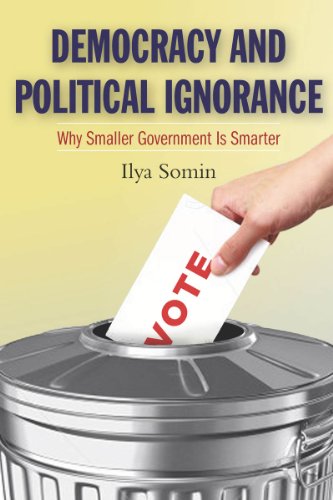
In Democracy and Political Ignorance, Ilya Somin mines the depths of ignorance in America and reveals the extent to which it is a major problem for democracy. Somin weighs various options for solving this problem, arguing that political ignorance is best mitigated and its effects lessened by decentralizing and limiting government. Somin provocatively argues that people make better decisions when they choose what to purchase in the market or which state or local government to live under, than when they vote at the ballot box, because they have stronger incentives to acquire relevant information and to use it wisely.
In Democracy and Political Ignorance, Ilya Somin mines the depths of ignorance in America and reveals the extent to which it is a major problem for democracy. Somin weighs various options for solving this problem, arguing that political ignorance is best mitigated and its effects lessened by decentralizing and limiting government. Somin provocatively argues that people make better decisions when they choose what to purchase in the market or which state or local government to live under, than when they vote at the ballot box, because they have stronger incentives to acquire relevant information and to use it wisely.
"synopsis" may belong to another edition of this title.
About the Author
Ilya Somin is Professor of Law at George Mason University School of Law. Somin's work has appeared in numerous academic journals, including the Yale Law Journal and Stanford Law Review. He has also published widely in popular press outlets, such as the Los Angeles Times, USA Today, and the Wall Street Journal OpinionJournal.com. Somin has twice testified before the United States Senate Judiciary Committee, including at the confirmation hearings for Supreme Court Justice Sonia Sotomayor. He writes regularly for the Volokh Conspiracy blog.
Excerpt. © Reprinted by permission. All rights reserved.
DEMOCRACY AND POLITICAL IGNORANCE
WHY SMALLER GOVERNMENT IS SMARTER
By Ilya SominStanford University Press
Copyright © 2013 Board of Trustees of the Leland Stanford Junior University
All rights reserved.
ISBN: 978-0-8047-8661-4All rights reserved.
Contents
| Acknowledgments............................................................ | ix |
| Introduction............................................................... | 1 |
| CHAPTER ONE The Extent of Political Ignorance............................. | 17 |
| CHAPTER TWO Do Voters Know Enough?........................................ | 38 |
| CHAPTER THREE The Rationality of Political Ignorance...................... | 62 |
| CHAPTER FOUR The Shortcomings of Shortcuts................................ | 90 |
| CHAPTER FIVE Foot voting vs. Ballot Box Voting............................ | 119 |
| CHAPTER SIX Political Ignorance and Judicial Review....................... | 155 |
| CHAPTER SEVEN Can voter Knowledge Be Increased?........................... | 170 |
| Conclusion................................................................. | 192 |
| Appendix................................................................... | 203 |
| Notes...................................................................... | 205 |
| Index...................................................................... | 255 |
CHAPTER 1
The Extent of Political Ignorance
Nothing strikes the student of public opinion anddemocracy more forcefully than the paucity ofinformation most people possess about politics.
—POLITICAL SCIENTIST JOHN FEREJOHN
THE REALITY THAT MOST voters are often ignorant of even very basicpolitical information is one of the better-established findings of socialscience. Decades of accumulated evidence reinforces this conclusion.
THE PERVASIVENESS OF IGNORANCE
the sheer depth of most individual voters' ignorance may be shocking toreaders not familiar with the research. Rarely if ever is any one piece ofknowledge absolutely essential to voters. It may not matter much if mostAmericans are ignorant of one or another particular fact about politics.But the pervasiveness of ignorance about a wide range of political issuesand leaders is far more troubling.
Many examples help illustrate the point. A series of polls conductedjust before the Republican Party chose Representative Paul Ryan to betheir vice-presidential nominee in August 2012 found that 43 percentof Americans had never heard of Ryan and only 32 percent knew thathe was a member of the House of Representatives. Unlike GovernorSarah Palin in 2008, Ryan was not a relative unknown catapulted ontothe national stage by a vice-presidential nomination. As his party's leadingspokesman on budgetary and fiscal issues, he had been a prominentfigure in American politics for several years.
One of the key policy positions staked out by President Barack Obamain his successful 2012 reelection campaign was his plan to raise incometaxes for persons earning over $250,000 per year, an idea much discussedduring the campaign and supported by a large majority of the public—69percent in a December 2012 Pew Research Center poll. A February 2012survey conducted for the political newspaper The Hill actually askedrespondents what tax rates people with different income levels shouldpay. It found that 75 percent of likely voters wanted the highest-incomeearners to pay taxes lower than 30 percent of income, the top rate at thetime of the 2012 election. this inconsistency suggests that many peoplesupported increasing the tax rates of high earners because they did notrealize how high taxes were already.
Despite years of controversy over the War on terror, the Iraq War,and American relations with the Muslim world, only 32 percent ofAmericans in a 2007 survey could name "Sunni" or "Sunnis" as one of"the two major branches of Islam" whose adherents "are seeking politicalcontrol in Iraq," even though the question prompted them with thename of the other major branch (the Shiites). Such basic knowledge isnot, perhaps, essential to evaluation of U.S. policy toward the Muslimworld. But it would at least be useful.
Equally striking is the fact that in late 2003, over 60 percent of Americansdid not realize that a massive increase in domestic spending had madea substantial contribution to the recent explosion in the federal deficit.Most of the public is unaware of a wide range of important governmentprograms structured as tax deductions and payments for services. Asa result, they are also unaware of the massive extent to which most ofthese programs transfer benefits primarily to the relatively affluent.
A survey taken immediately after the closely contested November2002 congressional elections found that only about 32 percent ofrespondents knew that the Republicans had held control of the Houseof Representatives prior to the election. this result is consistent withresearch showing widespread ignorance of congressional party controlin previous elections, though usually knowledge levels were higher thanin 2002.
Such widespread ignorance is not of recent origin. As of December1994, a month after the takeover of Congress by Newt Gingrich's Republicans,57 percent of Americans had never even heard of Gingrich, whosecampaign strategy and policy stances had received massive publicity inthe immediately preceding weeks. In 1964, in the midst of the ColdWar, only 38 percent were aware that the Soviet Union was not a memberof the U.S.-led Nato alliance. Later, in 1986, the majority could notidentify Mikhail Gorbachev, the controversial new leader of the SovietUnion, by name. Much of the time, only a bare majority know whichparty has control of the Senate, some 70 percent cannot name both oftheir state's senators, and the majority cannot name any congressionalcandidate in their district at the height of a campaign.
Three aspects of voter ignorance deserve particular attention. First,many voters are ignorant not just about specific policy issues but aboutthe basic structure of government and how it operates. Majorities areignorant of such basic aspects of the U.S. political system as who has thepower to declare war, the respective functions of the three branches ofgovernment, and who controls monetary policy. A 2006 Zogby poll foundthat only 42 percent of Americans could even name the three branchesof the federal government: executive, legislative, and judicial. Another2006 survey found that only 28 percent could name two or more of thefive rights guaranteed by the First Amendment to the Constitution. A2002 Columbia University study indicated that 35 percent believed thatKarl Marx's dictum "From each according to his ability to each accordingto his need" is in the Constitution (34 percent said they did not know),and only one-third understood that a Supreme Court decision overrulingRoe v. Wade would not make abortion illegal throughout the country.
Ignorance of the structure of government suggests that voters oftennot only cannot choose between specific competing policy programs butalso cannot easily assign credit and blame for policy outcomes to theright office-holders. Ignorance of the constraints imposed on governmentby the Constitution may also give voters an inaccurate picture ofthe scope of elected officials' powers.
the second salient aspect of ignorance is that most voters lack an"ideological" view of politics capable of integrating multiple issues intoa single analytical framework derived from a few basic principles; ordinaryvoters rarely exhibit the kind of ideological consistency in issuestances that are evident in surveys of political elites. Some scholarsfollow Anthony Downs in emphasizing the usefulness of ideology as a"shortcut" to predicting the likely policies of opposing parties competingfor office. At least equally important is the comparative inabilityof non-ideological voters to spot interconnections among issues. Thesmall minority of well-informed voters are much better able to processnew political information and more resistant to manipulation than isthe less-informed mass public.
Finally, and important, the level of political knowledge in the Americanelectorate has increased only modestly, if at all, since the beginningof mass survey research in the late 1930s. A relatively stable level ofignorance has persisted even in the face of massive increases in educationalattainment and an unprecedented expansion in the quantity andquality of information available to the general public at little cost.
For the most part, the spread of new information technology, such astelevision and the Internet, seems not to have increased political knowledge.The rise of broadcast television in the 1950s and 1960s somewhatincreased political knowledge among the poorest and least-informedsegments of the population. But more recent advances, such as cabletelevision and the Internet, have actually diverted the attention of thesegroups away from political information by providing attractive alternativesources of entertainment. For the most part, new information technologiesseem to have been utilized to acquire political knowledge primarilyby those who were already well-informed. This record throws doubton the expectation of political theorists from John Stuart Mill onwardthat an increased availability of information and formal education cancreate the informed electorate that the democratic ideal requires.
RECENT EVIDENCE OF POLITICAL IGNORANCE
Data from the time of the recent 2010, 2008, and 2004 elections reaffirmthe existence of widespread political ignorance, as does more extensivedata from the time of the 2000 election derived from the 2000 AmericanNational Election Studies (ANES). Unfortunately, the manuscript forthis book was completed too soon to take much account of data from the2012 presidential election. But, so far, there is no indication of a majorincrease in political knowledge in that election cycle relative to previousones, and at least some evidence of persistent ignorance.
Political Ignorance and the 2010 Election
The 2010 election was arguably one of the most important midtermelections in recent American history. the issues at stake included thefederal government's handling of the worst recession and financial crisisin decades, the enactment of the Obama administration's historic 2010health reform bill, and the conduct of ongoing conflicts in Afghanistanand Iraq. The Republican Party gained sixty-two seats in the House ofRepresentatives—the largest swing in the House since 1948, and six inthe Senate. In view of the importance of the issues at stake, one mightexpect voters to have paid closer attention to politics than usual. Nonetheless,survey data show extensive ignorance and confusion even aboutbasic issues.
Table 1.1 compiles data on political knowledge from a variety of surveysconducted during 2010, while the election campaign was ongoingor immediately afterward. The data show that the majority of the publicwere well informed about a few very basic points. For example, 77percent knew that the federal budget deficit was larger in 2010 than inthe 1990s, and 73 percent knew that Congress had enacted a health carereform bill in 2010. A bare majority of 53 percent knew that the unemploymentrate was around 10 percent, rather than 5 percent, 15, or 20.
On many other basic questions related to key issues in the election,the majority of Americans were strikingly uninformed. Perhaps thebiggest issue in the election was the state of the economy, which wasbeginning to come out of the deepest recession in decades. A CNN polltaken just before the election found that 52 percent of Americans identified"the economy" as the most important issue facing the nation.Yet an October 2010 survey showed that 67 percent of Americans wereunaware that the economy had grown during the previous year, with 61percent wrongly believing that it had shrunk. It is certainly true that theeconomy was in relatively poor shape in 2010. But knowing whether itwas growing or shrinking was surely a relevant consideration for votersseeking to evaluate incumbent political leaders' performance on whatmost of them believed to be the single most important issue. It was notthe only information that could have been useful to voters, but it wasclearly important nonetheless.
Perhaps the most important measure that the federal governmentadopted to try to end the recession that began in 2008 was PresidentObama's 2009 stimulus bill. Yet 57 percent of the public did not realizethat the bill included tax cuts, even though tax cuts in fact accountedfor some $275 billion of the total $819 billion in stimulus spending in thebill.35 Similarly, only 34 percent of the public realized that the TroubledAssets Relief Program bank bailout bill had been enacted under PresidentGeorge W. Bush, with 47 percent wrongly believing that it wasenacted under President Obama. Controversy over the effectiveness orlack thereof of the TARP was one of the biggest points at issue betweenthe parties in the 2010 election, with many Republicans criticizing thebill and blaming the Democrats for it.
The Republicans also focused heavily on federal spending as a crucialissue in the campaign. But a November poll taken just after theelection found that only 39 percent of the public was aware of the basicfact that defense spending was a larger proportion of the federal budgetthan education, the Medicare health care program, and interest on thenational debt. Understanding the current distribution of federal spendingcan help voters evaluate what changes should be made in the future.
There was also extensive public ignorance about non-economic issuesat stake in the campaign. The majority of the public did not know thatthe United States suffered more combat casualties in Afghanistan than inIraq during 2009, which perhaps indicates a failure to fully understandthe Obama administration's strategy of shifting U.S. military effortsaway from Iraq to Afghanistan. Knowing the relative numbers of casualtiesmight also be useful information for voters seeking to weigh thepotential benefits of these wars against their costs.
The 2010 campaign also saw extensive controversy over the role ofthe conservative majority on the Supreme Court, especially the Court'smuch-debated decision in Citizens United v. Federal Election Commission,which struck down legislation limiting the use of corporateand union funds for election advertising. President Obama and otherDemocrats repeatedly attacked the Court during the campaign. Therole of the Court was also extensively discussed during the summer 2010confirmation hearings for Elena Kagan, the president's second nomineeto the Supreme Court. But a July survey found that only 28 percentof Americans could identify John Roberts—leader of the conservativemajority on the Court—as the chief justice of the United States. It istheoretically possible for voters to have a good knowledge of the Court'sdecisions without knowing the names of any of the justices, and someprobably do have such knowledge. However, a citizen who paid morethan minimal attention to the extensive press coverage of the Court wouldbe likely to run across the chief justice's name multiple times. Moreover,the performance of the conservative majority led by Roberts was one ofthe key points at issue in the political debate over the Court's role.
Over 60 percent of the public was unable to identify Senate MajorityLeader Harry Reid, a key player in the enactment of the stimulus and healthcare bills that had been at the heart of the Democrats' legislative agendain 2009 and 2010. Great Britain continued to be the United States's mostimportant ally in the escalating fighting in Afghanistan, as well as a crucialpartner on other foreign policy issues and on coordinating economic policyin the midst of a global recession. But only 15 percent of Americans couldidentify David Cameron as the prime minister of Great Britain. Knowingthe names of Reid and Cameron is not essential for informed voting.In theory, a voter can be highly knowledgeable about policy issues butignorant of the names of individual political leaders. However, citizenswho paid more than minimal attention to domestic policy issues werelikely to run across Reid's name on numerous occasions, and those whopay attention to foreign policy could hardly avoid Cameron's.
In the aftermath of the election, only 46 percent of the public realizedthat the Republicans had won control of the House of Representativesbut not the Senate, and only 38 percent could identify John Boehner asthe new speaker of the House of Representatives.
All of the questions above were posed as multiple-choice items. As aresult, they likely understate the true degree of ignorance, because somesurvey respondents prefer to guess on questions when they don't knowthe right answer rather than admit that they don't know it. Even purelyrandom guessing has a substantial probability of arriving at the rightanswer on a survey question with only three or four choices.
Political Ignorance and the 2008 Election
Perhaps to an even greater extent than the 2010 midterm election, the2008 election was an unusually important one. The issues at stakeincluded the conduct of the wars in Afghanistan and Iraq, the future ofthe health care system, a mortgage default crisis, and the government'sdeveloping response to the financial crisis that hit in September 2008—inthe middle of the campaign.
As in 2010, a majority of the public did display impressive knowledgeabout some of the very basic issues at stake in the campaign. Forexample, by the summer of 2008, some 76 percent of Americans recognizedthat Democratic nominee Barack Obama supported a timetablefor the withdrawal of U.S. troops from Iraq, and 62 percent knew thatRepublican candidate John McCain opposed it (Table 1.2). By October,some 66 percent knew that Nancy Pelosi was the speaker of the Houseof Representatives, an increase from several months earlier and an indicationthat the public was paying some attention to congressional races.Similarly, 61 percent knew that the Democratic Party controlled theHouse of Representatives before the election.
(Continues...)
Excerpted from DEMOCRACY AND POLITICAL IGNORANCE by Ilya Somin. Copyright © 2013 Board of Trustees of the Leland Stanford Junior University. Excerpted by permission of Stanford University Press.
All rights reserved. No part of this excerpt may be reproduced or reprinted without permission in writing from the publisher.
Excerpts are provided by Dial-A-Book Inc. solely for the personal use of visitors to this web site.
"About this title" may belong to another edition of this title.
Other Popular Editions of the Same Title

Search results for Democracy and Political Ignorance: Why Smaller Government...

Stock Image
Democracy and Political Ignorance: Why Smaller Government Is Smarter
Seller: ThriftBooks-Phoenix, Phoenix, AZ, U.S.A.
Seller rating 5 out of 5 stars

Paperback. Condition: Very Good. No Jacket. May have limited writing in cover pages. Pages are unmarked. ~ ThriftBooks: Read More, Spend Less. Seller Inventory # G0804786615I4N00
Stock Image
Democracy and Political Ignorance: Why Smaller Government Is Smarter
Seller: ThriftBooks-Reno, Reno, NV, U.S.A.
Seller rating 5 out of 5 stars
Paperback. Condition: Very Good. No Jacket. May have limited writing in cover pages. Pages are unmarked. ~ ThriftBooks: Read More, Spend Less. Seller Inventory # G0804786615I4N00
Stock Image
Democracy and Political Ignorance: Why Smaller Government Is Smarter
Seller: ThriftBooks-Dallas, Dallas, TX, U.S.A.
Seller rating 5 out of 5 stars
Paperback. Condition: Very Good. No Jacket. May have limited writing in cover pages. Pages are unmarked. ~ ThriftBooks: Read More, Spend Less. Seller Inventory # G0804786615I4N00
Stock Image
Democracy and Political Ignorance : Why Smaller Government Is Smarter
Published by
Stanford University Press, 2013
ISBN 10: 0804786615
ISBN 13: 9780804786614
Used
Softcover
Seller: Better World Books, Mishawaka, IN, U.S.A.
Seller rating 5 out of 5 stars
Condition: Very Good. Former library book; may include library markings. Used book that is in excellent condition. May show signs of wear or have minor defects. Seller Inventory # 10224215-6
Stock Image
Democracy and Political Ignorance : Why Smaller Government Is Smarter
Published by
Stanford University Press, 2013
ISBN 10: 0804786615
ISBN 13: 9780804786614
Used
Softcover
Seller: Better World Books, Mishawaka, IN, U.S.A.
Seller rating 5 out of 5 stars
Condition: Good. Used book that is in clean, average condition without any missing pages. Seller Inventory # 15904383-6
Stock Image
Democracy and Political Ignorance : Why Smaller Government Is Smarter
Published by
Stanford University Press, 2013
ISBN 10: 0804786615
ISBN 13: 9780804786614
Used
Softcover
Seller: Better World Books, Mishawaka, IN, U.S.A.
Seller rating 5 out of 5 stars
Condition: Very Good. Used book that is in excellent condition. May show signs of wear or have minor defects. Seller Inventory # 7906191-6
Stock Image
Democracy and Political Ignorance: Why Smaller Government Is Smarter
Published by
Stanford University Press, 2013
ISBN 10: 0804786615
ISBN 13: 9780804786614
Used
paperback
Seller: HPB Inc., Dallas, TX, U.S.A.
Seller rating 5 out of 5 stars
paperback. Condition: Very Good. Connecting readers with great books since 1972! Used books may not include companion materials, and may have some shelf wear or limited writing. We ship orders daily and Customer Service is our top priority! Seller Inventory # S_438444172
Stock Image
Democracy and Political Ignorance: Why Smaller Government Is Smarter
Published by
Stanford University Press, 2013
ISBN 10: 0804786615
ISBN 13: 9780804786614
Used
Paperback
Seller: Midtown Scholar Bookstore, Harrisburg, PA, U.S.A.
Seller rating 5 out of 5 stars
Paperback. Condition: Acceptable. Acceptable - This is a significantly damaged book. It should be considered a reading copy only. Please order this book only if you are interested in the content and not the condition. May be ex-library. PAPERBACK Standard-sized. Seller Inventory # M0804786615Z4
Stock Image
Democracy and Political Ignorance: Why Smaller Government Is Smarter
Published by
Stanford University Press, 2013
ISBN 10: 0804786615
ISBN 13: 9780804786614
Used
paperback
Seller: Books From California, Simi Valley, CA, U.S.A.
Seller rating 5 out of 5 stars
paperback. Condition: Very Good. Seller Inventory # mon0003539628
Stock Image
Democracy and Political Ignorance: Why Smaller Government Is Smarter
Published by
Stanford University Press, 2013
ISBN 10: 0804786615
ISBN 13: 9780804786614
Used
paperback
Seller: Ezekial Books, LLC, Manchester, NH, U.S.A.
Seller rating 5 out of 5 stars
paperback. Condition: LikeNew. Only minor cover wear. Otherwise, book is in Excellent Condition. 100% Satisfaction Guaranteed. Seller Inventory # 51UTKD000382