
Items related to Lords of Sipan: A Tale of Pre-Inca Tombs, Archaeology,...
Synopsis
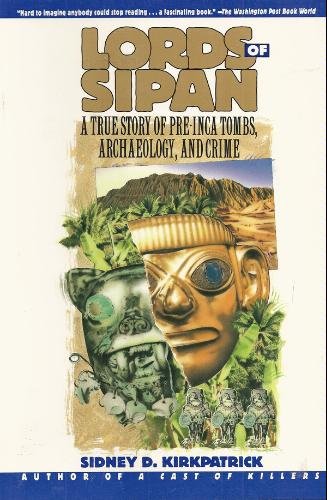
In February 1987, archaeologist and museum curator Dr. Walter Alva was asked to examine a collection of strange artifacts found in the home of a poor grave robber on Peru's remote north coast. The subsequent police inquiry traced the cache to an ancient pyramid at Sipan, where looters had plundered a royal tomb of a little known civilization called the Moche. This ransacking of the New World's richest archaeological discovery would set off an undercover investigation that would send shock waves through the international art world, culminating in the most comprehensive seizure of pre-Columbian antiquities in U.S. and European history. It would also trigger the excavation of the greatest archaeological discovery since Howard Carter opened Tutankhamun's tomb. In the kind of chase usually reserved for fictional crime thrillers, Alva and his intrepid team of excavators would put down their shovels and pick-up guns, confronting the looters and ultimately winning their support and cooperation. The pyramid at Sipan, they would discover, was not the burial place of a single Moche lord, but a Valley of the Kings of ancient Peru.
"synopsis" may belong to another edition of this title.
About the Author
Sidney D. Kirkpatrick, the critically acclaimed author of A CAST OF KILLERS, TURNING THE TIDE, THE REVENGE OF THOMAS EAKINS, and EDGAR CAYCE, AN AMERICAN PROPHET, is a graduate of the Kent School, in Kent Connecticut, Hampshire College, and New York University. He and his wife live in Huntsville, Ontario, Canada, and Pasadena, California.
From the Inside Flap
In February 1987, archaeologist and museum curator Walter Alva was asked to examine a collection of strange artifacts found in the home of a poor grave robber on Peru's remote north coast. The subsequent police inquiry traced the cache to an ancient pyramid at Sipan, where looters had plundered a royal tomb of a little-known civilization called the Moche. This ransacking of the New World's richest archaeological discovery devastated Alva, who had been conducting a ten-year crusade to protect Peru's monuments of the past. What he did not know was that the looted artifacts had already been smuggled out of Peru and into England for re-transport to Los Angeles, where they would be sold to wealthy art collectors and dealers.
At Sipan itself, the police, fearing for his safety, were demanding that Alva abandon his search for objects the looters might have missed. His own colleagues were also urging him to leave, believing he was wasting precious resources on an excavation doomed to failure. In the midst of this crisis, Christopher Donnan, the world's most respected Moche scholar, arrived with much-needed cash, supplies, and encouragement, along with the news that precious artifacts were already in the hands of collectors and dealers. Donnan's information proved correct, for in the months to come, looted artifacts reached the hands of Los Angeles Museum of Art trustee Ben Johnson and Nobel Prize-winning physicist Murray Gell-Man. In fact, many of the objects would soon go on display at the prestigious Santa Barbara Art Museum.
Meanwhile, U.S. Customs agents had begun an investigation into the smuggling operation, and in March 1988, their unprecedented seizure of pre-Columbian antiquities sent shock waves through the art world. When reports of the raid reached Peru, Alva was having a celebration of his own. The pyramid at Sipan was not the burial place of a single Moche lord but was, like the Valley of the Kings of ancient Egypt, a necropolis containing many lords. At least three tombs, richer in gold and silver than any other site excavated in the Americas, remained intact. To protect their discovery, Alva and his men put down their shovels and picked-up guns, confronting the looters and winning their support.
Police and Customs agents, however, were much less successful in their efforts to gain the return o the stolen artifacts. A controversial U.S. court decision resulted in the forfeiture to Peru of only 250 of the nearly 3,000 precious objects seized by the police. But an important precedent was set, serious questions were raised about private ownership of national treasures, and the first conviction in U.S. history for smuggling pre-Columbian art was obtained.
"About this title" may belong to another edition of this title.
Other Popular Editions of the Same Title

Search results for Lords of Sipan: A Tale of Pre-Inca Tombs, Archaeology,...

Stock Image
Lords of Sipan: A Tale of Pre-Inca Tombs, Archaeology, and Crime
Seller: ThriftBooks-Atlanta, AUSTELL, GA, U.S.A.
Seller rating 5 out of 5 stars

Paperback. Condition: Very Good. No Jacket. May have limited writing in cover pages. Pages are unmarked. ~ ThriftBooks: Read More, Spend Less. Seller Inventory # G080502817XI4N00
Stock Image
Lords of Sipan: A Tale of Pre-Inca Tombs, Archaeology, and Crime
Seller: ThriftBooks-Atlanta, AUSTELL, GA, U.S.A.
Seller rating 5 out of 5 stars
Paperback. Condition: Good. No Jacket. Pages can have notes/highlighting. Spine may show signs of wear. ~ ThriftBooks: Read More, Spend Less. Seller Inventory # G080502817XI3N00
Stock Image
Lords of Sipan: A Tale of Pre-Inca Tombs, Archaeology, and Crime
Seller: Evergreen Goodwill, Seattle, WA, U.S.A.
Seller rating 5 out of 5 stars
paperback. Condition: Good. Seller Inventory # mon0000741127
Stock Image
Lords of Sipan: A Tale of Pre-Inca Tombs, Archaeology, and Crime
Seller: Dunaway Books, St. Louis, MO, U.S.A.
Seller rating 5 out of 5 stars
Paper Back. Condition: Good. Seller Inventory # 103552
Stock Image
Lords of Sipan : True Story of Pre-Inca Tombs
Seller: Better World Books, Mishawaka, IN, U.S.A.
Seller rating 5 out of 5 stars
Condition: Good. Pages intact with minimal writing/highlighting. The binding may be loose and creased. Dust jackets/supplements are not included. Stock photo provided. Product includes identifying sticker. Better World Books: Buy Books. Do Good. Seller Inventory # 16280101-75
Stock Image
Lords of Sipan: A Tale of Pre-Inca Tombs, Archaeology, and Crime
Seller: Bank of Books, Ventura, CA, U.S.A.
Seller rating 5 out of 5 stars
paperback. Condition: Very Good. We have 75,000 books to choose from -- Ship within 24 hours -- Satisfaction Guaranteed! Seller Inventory # mon0000979916
Seller Image
Lords of Sipan: A Tale of Pre-Inca Tombs, Archaeology, and Crime
Seller: Hektor Dantes History, Lubbock, TX, U.S.A.
Seller rating 5 out of 5 stars
Soft cover. Condition: Very Good. The book has a slight amount of shelf wear. Seller Inventory # JUL26118
Stock Image
Lords of Sipan: A Tale of Pre-Inca Tombs, Archaeology, and Crime
Published by
Owlet, New York, New York, U.S.A., 1993
ISBN 10: 080502817X
ISBN 13: 9780805028171
Used
Soft cover
Seller: beat book shop, Boulder, CO, U.S.A.
Seller rating 4 out of 5 stars

Soft cover. Condition: Very Good. First Edition, First Printing. Seller Inventory # 103613