
Items related to The Seasons of Rome: A Journal
Synopsis
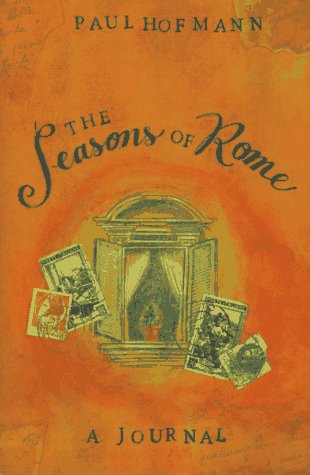
In the Seasons of Rome, beloved travel writer Paul Hofmann - a resident of Rome for more than thirty years - delves into the daily life of a city that is in so many ways larger than life. Over the course of a year, his journal navigates beyond the simple images of the tourist board and paints a rich portrait of place, revealing a fetish for Vatican gossip, the comings and goings of the gattare ("cat women" who care for the city's troops of stray felines), and the vagaries of the ever-volatile Roman government. In the eloquent style his readers have come to expect, Hofmann reflects upon the art of being Roman - the arte di arrangiarsi - which Romans themselves define as a knack for "arranging" things, finessing problems, coping with adversity by astute maneuver or simple procrastination, and evading difficulties through ambiguity. Nothing, their philosophy holds, is as serious as it may seem.
Hofmann knows his territory, and as he wends his way through the city streets, stopping to chat with mail carriers and construction workers, or lingers over a cappuccino, letting his thoughts wander back into the city's history and half a century of personal experience there, one follows closely behind and listens to the voices of the city - past and present - rise up in his lucid prose. Hofmann speaks from the very heart of Rome.
"synopsis" may belong to another edition of this title.
Reviews
A 30-year residence in Rome has given Hofmann, a former New York Times bureau chief, a special intimacy with the Eternal City. He writes about his adopted home with sophisticated humor and warmth and, with the adroitness of a seasoned travel writer (That Fine Italian Hand), he records the sorts of fine points of daily life in the city, its ambiance and the quirks of its inhabitants that bring it to life for both armchair travelers and visitors. This year-long journal interweaves his broad knowledge of the city's history and culture with gossip about the Vatican, the trials of parking a car, the preference of the elite for Filipino maids and nannies over Eritreans and his own pleasure in hot Roman summers, when most other good Romans flee, leaving the sweltering streets to the tourists?a time when the pope, from his cool aerie at Castel Gandolfo, offers prayers for those condemned to endure the city's heat. Having lived in the city off and on since 1938, when he fled his native Austria, Hofmann can recall life in Rome under the somewhat lesser evil of Mussolini, and he relates homely details of the city's trials then as well as tragic events. Throughout this entertaining and informative account, the author offers a uniquely personal appreciation of the colors, tastes and textures of everyday life in the city, and of the charm of living in an atmosphere where nothing seems so urgent that it cannot be surmounted by procrastination.
Copyright 1996 Reed Business Information, Inc.
Delightful insights into the Eternal City. Fleeing Hitler's invasion and arriving in Rome from his native Vienna in 1938, Hofmann made Italy his home for the rest of his life. Former bureau chief for the New York Times, he is a prolific travel writer, best known to Italianists as the author of Rome: The Sweet Tempestuous Life (1982), O Vatican (1983), Cento Citt… (1988), and That Fine Italian Hand (1990). Like these previous works, The Seasons of Rome is a light, breezy account of a year in that bewildering, beguiling, and often exasperating city. Like most travel literature--and like the Romans themselves--Hofmann's book refuses to take itself too seriously, and therein lies its charm. At times he sounds like the neighborhood curmudgeon, complaining about left-wing students, motor-scooters, and the Democratic Party of the Left (the former Communist Party). Tellingly, Hofmann confesses that he does not consider himself a Roman by adoption- -even after more than half a century in the city. Rather, he is ``still a foreign observer with my inevitable prejudices. . . .'' But it's precisely this distance that allows him to reveal the foibles, folly, and even nobility of that ancient/modern Roman race. Each chapter is devoted to a month of the year, and we realize how intimately tied the Romans are to their climate, whether that wind that dumps sand from the Sahara on their city or the late summer rains that bring relief from the heat. Above all else, the author reveals how the Romans define the Italian arte di arrangiarsi, or the art of ``arranging'' things; from avoiding paying their utility bills to dealing with local politics. The next best thing to actually being in Rome. (b&w line drawings) -- Copyright ©1996, Kirkus Associates, LP. All rights reserved.
Hofmann, a former New York Times bureau chief and an experienced travel writer, has lived in Rome for many years; and he selects what is apparently an exemplary year for him, September 1994 to the following August, to record for envious readers the various ways by which he absorbs the heady atmosphere of his adopted city. In prose that correlates so perfectly with the sunlight and joy from which Rome seems to have been spun, Hofmann, in discussing such topics as weather, politics, cafes, mail delivery, police, and opera, identifies the city's idiosyncrasies with an affecting blend of honesty and fondness. For travel and history lovers, a treat. Brad Hooper
Living more than 30 years in Rome should give anyone a colorful perspective on life. Viennese-born Hofmann, long-time resident and chronicler of Italy and its people, uses his acquired point of view to create a delightful description of the Eternal City. Written much like Peter Mayle's popular A Year in Provence (LJ 4/1/90), the book records unusual characters and interesting situations in monthly diary entries from September 1994 through August 1995. This journal is about the urbane and gritty, giving the reader a sense of place not found in most guidebooks. The author of several books, including Roma (LJ 1/94) and That Fine Italian Hand (Holt, 1991), Hofmann offers much insight into this city and "the art of being Roman," which is its citizens' knack for dealing with a uniquely chaotic, anarchistic, and beautiful place.?David Nudo, "Library Journal"
Copyright 1996 Reed Business Information, Inc.
"About this title" may belong to another edition of this title.
Search results for The Seasons of Rome: A Journal

Stock Image
The Seasons of Rome: A Journal
Seller: World of Books (was SecondSale), Montgomery, IL, U.S.A.
Seller rating 5 out of 5 stars

Condition: Acceptable. Morgante, Joanne (illustrator). Item in acceptable condition! Textbooks may not include supplemental items i.e. CDs, access codes etc. Seller Inventory # 00054905465
Stock Image
The Seasons of Rome: A Journal
Seller: World of Books (was SecondSale), Montgomery, IL, U.S.A.
Seller rating 5 out of 5 stars
Condition: Good. Morgante, Joanne (illustrator). Item in good condition. Textbooks may not include supplemental items i.e. CDs, access codes etc. Seller Inventory # 00054940574
Stock Image
The Seasons of Rome: A Journal
Published by
Henry Holt & Co (edition First Edition), 1997
ISBN 10: 0805038906
ISBN 13: 9780805038903
Used
Hardcover
First Edition
Seller: BooksRun, Philadelphia, PA, U.S.A.
Seller rating 5 out of 5 stars
Hardcover. Condition: Very Good. Morgante, Joanne (illustrator). First Edition. With dust jacket. It's a well-cared-for item that has seen limited use. The item may show minor signs of wear. All the text is legible, with all pages included. It may have slight markings and/or highlighting. Seller Inventory # 0805038906-11-1-29
Stock Image
The Seasons of Rome: A Journal
Seller: ThriftBooks-Dallas, Dallas, TX, U.S.A.
Seller rating 5 out of 5 stars
Hardcover. Condition: Very Good. No Jacket. Morgante, Joanne (illustrator). May have limited writing in cover pages. Pages are unmarked. ~ ThriftBooks: Read More, Spend Less. Seller Inventory # G0805038906I4N00
Stock Image
The Seasons of Rome: A Journal
Seller: ThriftBooks-Atlanta, AUSTELL, GA, U.S.A.
Seller rating 5 out of 5 stars
Hardcover. Condition: Very Good. No Jacket. Morgante, Joanne (illustrator). May have limited writing in cover pages. Pages are unmarked. ~ ThriftBooks: Read More, Spend Less. Seller Inventory # G0805038906I4N00
Stock Image
The Seasons of Rome: A Journal
Seller: ThriftBooks-Atlanta, AUSTELL, GA, U.S.A.
Seller rating 5 out of 5 stars
Hardcover. Condition: As New. No Jacket. Morgante, Joanne (illustrator). Pages are clean and are not marred by notes or folds of any kind. ~ ThriftBooks: Read More, Spend Less. Seller Inventory # G0805038906I2N00
Stock Image
The Seasons of Rome: A Journal
Seller: ThriftBooks-Dallas, Dallas, TX, U.S.A.
Seller rating 5 out of 5 stars
Hardcover. Condition: Good. No Jacket. Morgante, Joanne (illustrator). Pages can have notes/highlighting. Spine may show signs of wear. ~ ThriftBooks: Read More, Spend Less. Seller Inventory # G0805038906I3N00
Stock Image
The Seasons of Rome: A Journal
Seller: Wonder Book, Frederick, MD, U.S.A.
Seller rating 5 out of 5 stars
Condition: Very Good. Morgante, Joanne (illustrator). Very Good condition. Very Good dust jacket. A copy that may have a few cosmetic defects. May also contain light spine creasing or a few markings such as an owner's name, short gifter's inscription or light stamp. Seller Inventory # B03B-01246
Stock Image
The Seasons of Rome: A Journal
Seller: Cathy's Half Price Books, Havertown, PA, U.S.A.
Seller rating 4 out of 5 stars

hardcover. Condition: Good. Morgante, Joanne (illustrator). Shows some light wear from age and use. Interior is good with sound binding and no marks, damage or labels. Seller Inventory # 231767
Stock Image
The Seasons of Rome
Published by
Holt & Company, Henry, 1997
ISBN 10: 0805038906
ISBN 13: 9780805038903
Used
Hardcover
First Edition
Seller: Better World Books: West, Reno, NV, U.S.A.
Seller rating 5 out of 5 stars
Condition: Very Good. Morgante, Joanne (illustrator). 1st. Former library copy. Pages intact with possible writing/highlighting. Binding strong with minor wear. Dust jackets/supplements may not be included. Includes library markings. Stock photo provided. Product includes identifying sticker. Better World Books: Buy Books. Do Good. Seller Inventory # 15765832-20