
Items related to Plague: A Story of Rivalry, Science, and the Scourge...
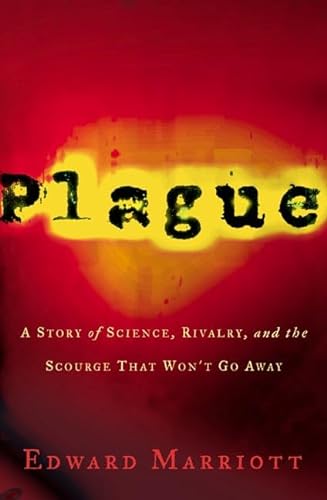
Synopsis
A riveting account, at once a reconstruction of the race to find a cure, a history of bubonic plague, and an investigation into the threat of plague today
Plague. The very word carries an unholy resonance. No other disease can claim its apocalyptic or mythological power. It can lie dormant for centuries, only to resurface with ferocious, nation-killing force. Here, with the high drama of a great adventure tale, Edward Marriott unravels the story of this lethal disease: the historic battle to identify its source, the devastating effects of pandemics, and the prospects for the next outbreak.
Through a range of primary sources, Marriott takes us back to Hong Kong in the summer of 1894, when a diagnosis of plague brought two top scientists to the island-Alexandre Yersin, a lone, maverick Frenchman, and his eminent rival, the Japanese Shibasaburo Kitasato. Marriott interweaves his narrative of their fierce competition to discover the plague's source with vivid scenes of the scourge's persistence: California in 1900, when plague arrived in the United States; Surat, India, in 1994, where torrential floods drowned millions of rats, causing the worst epidemic in seventy years; and New York City, some time in the future, where there is a rat for every human being, a diminishing budget for pest control, and an emerging strain of plague that is resistant to antibiotics.
A masterly recounting of medical and human history, Plague is an instructive warning, a gripping account of history, and a chilling read.
Plague. The very word carries an unholy resonance. No other disease can claim its apocalyptic or mythological power. It can lie dormant for centuries, only to resurface with ferocious, nation-killing force. Here, with the high drama of a great adventure tale, Edward Marriott unravels the story of this lethal disease: the historic battle to identify its source, the devastating effects of pandemics, and the prospects for the next outbreak.
Through a range of primary sources, Marriott takes us back to Hong Kong in the summer of 1894, when a diagnosis of plague brought two top scientists to the island-Alexandre Yersin, a lone, maverick Frenchman, and his eminent rival, the Japanese Shibasaburo Kitasato. Marriott interweaves his narrative of their fierce competition to discover the plague's source with vivid scenes of the scourge's persistence: California in 1900, when plague arrived in the United States; Surat, India, in 1994, where torrential floods drowned millions of rats, causing the worst epidemic in seventy years; and New York City, some time in the future, where there is a rat for every human being, a diminishing budget for pest control, and an emerging strain of plague that is resistant to antibiotics.
A masterly recounting of medical and human history, Plague is an instructive warning, a gripping account of history, and a chilling read.
"synopsis" may belong to another edition of this title.
About the Author
Edward Marriott is the author of Savage Shore (0-8050-5556-8) and The Lost Tribe (0-8050-6449-4), a New York Times Best Travel Book. A recipient of the Thomas Cook and Banff Awards, he lives in London, where he contributes regularly to the BBC, the Times, and Esquire magazine.
Reviews
A scourge of epic proportions, the plague raced through medieval Europe and Asia, killing millions. By the early 20th century, medical science confidently considered the rapacious disease under control. In 1996, however, the World Health Organization-which had recorded 24,000 plague cases over the previous 15 years-reclassified the plague as a "re-emerging disease." Various cultures in the past explained the pestilence as punishment from the gods, but it was not until the late 19th century in Hong Kong that two scientists isolated the bacteriological causes of the disease. Marriott's thrilling medical detective story re-creates vividly the challenges that the Japanese researcher Shibasaburo Kitasato and French bacteriologist Alexandre Yersin faced in Hong Kong in their race for an explanation and a cure. In 1894, Kitasato arrived first to find that the island's colonial authority had refused to accept the first signs of the plague that now ravaged Hong Kong. Kitasato was world-renowned for his research skills, and the British government allowed him unrestricted access to patients and to supplies. Although Yersin discovered the bacillus causing the plague, Kitasato published his findings (which turned out to be incorrect) first in the medical journals. Yersin went on to discover a vaccine for the plague, which he began administering in India in 1898. Later scientists discovered that rats carried plague, and subsequent campaigns to rid cities of rats followed. Marriott weaves an engrossing story of a 1994 plague outbreak in India into the chronicle of Yersin and Kitasato as an indication of how plague sits on our doorsteps waiting for the right opportunity to strike, in spite of the great advances of medicine.
Copyright 2003 Reed Business Information, Inc.
This is a tale of two outbreaks of plague. In 1894, the malady spread from Canton, China, to Hong Kong. Out-of-their-depths colonial authorities called in two infectious disease experts sharply different in personality and procedure. Koch-trained Shibasaburo Kitasato came with a team, was effusively welcomed, and announced he had discovered the blameworthy bacillus within a week. Pasteur protege Alexandre Yersin arrived and worked alone, was snubbed and obstructed, and found the real microbial culprit. The scientists' competition is the stuff of movies, gripping even though Marriott reveals the ending early. From 1890s Hong Kong, Marriott regularly flashes forward to Surat, India, in 1994, where casualties were slight, but popular reaction was brutal, including looting, arson, and assault on refugees from the panicked city. Marriott's focal character in Surat is a journalist whose wife flees with their infant daughter--another should-be-filmed scenario. Marriott adds punch with bits of old plague history and consideration of the state of plague (un)readiness in a potential hotspot--New York--that could make anyone rethink that Manhattan weekend getaway. Ray Olson
Copyright © American Library Association. All rights reserved
A contemporary history of the plague, from 1894, when top scientists Alexandre Yersin and Shibasaburo Kitasato vied to discover the source of a Hong Kong outbreak, to contemporary New York, which has as many rats as peopleDeven as a strain of the disease is becoming resistant to antibiotics.
Copyright 2002 Reed Business Information, Inc.
Excerpt. © Reprinted by permission. All rights reserved.
From Plague:
By Wednesday evening eight people were suddenly dead, although speculation had pumped this figure to nearer one hundred. To every death there was a common theme: the afflicted were all young, or at least in early middle-age. Soon there was a growing crowd outside Surat's New Civil Hospital. Wards were close to capacity, the wail of ambulance sirens was audible across town. In the main lobby a huge concrete concourse, with rusty splashes of betel phlegm along the walls—crowds were fighting to get to the drug counters. From the balcony above, a line of doctors scanned the melee: dressed head to toe in white, their faces masked, only their dark eyes visible. "As if the deaths were not bad enough," said Dr. Shailendra Vajpeyee, "no one had any idea of the cause." An emergency meeting was called. Senior doctors, surgeons and administrators argued furiously. One said it was dengue fever, another a mutant strain of malaria. A third carried news from a nearby hospital, where two more people had died, both with the same symptoms. Finally, into a room suddenly silent, one of the doctors spoke softly, with certainty. "It's the plague."
By Wednesday evening eight people were suddenly dead, although speculation had pumped this figure to nearer one hundred. To every death there was a common theme: the afflicted were all young, or at least in early middle-age. Soon there was a growing crowd outside Surat's New Civil Hospital. Wards were close to capacity, the wail of ambulance sirens was audible across town. In the main lobby a huge concrete concourse, with rusty splashes of betel phlegm along the walls—crowds were fighting to get to the drug counters. From the balcony above, a line of doctors scanned the melee: dressed head to toe in white, their faces masked, only their dark eyes visible. "As if the deaths were not bad enough," said Dr. Shailendra Vajpeyee, "no one had any idea of the cause." An emergency meeting was called. Senior doctors, surgeons and administrators argued furiously. One said it was dengue fever, another a mutant strain of malaria. A third carried news from a nearby hospital, where two more people had died, both with the same symptoms. Finally, into a room suddenly silent, one of the doctors spoke softly, with certainty. "It's the plague."
"About this title" may belong to another edition of this title.
Search results for Plague: A Story of Rivalry, Science, and the Scourge...

Stock Image
Plague: A Story of Rivalry, Science, and the Scourge That Won't Go Away
Seller: ThriftBooks-Atlanta, AUSTELL, GA, U.S.A.
Seller rating 5 out of 5 stars

Hardcover. Condition: Good. No Jacket. Pages can have notes/highlighting. Spine may show signs of wear. ~ ThriftBooks: Read More, Spend Less. Seller Inventory # G0805066802I3N00
Stock Image
Plague: A Story of Rivalry, Science, and the Scourge That Won't Go Away
Seller: World of Books (was SecondSale), Montgomery, IL, U.S.A.
Seller rating 5 out of 5 stars
Condition: Good. Item in good condition and has highlighting/writing on text. Used texts may not contain supplemental items such as CDs, info-trac etc. Seller Inventory # 00080669101
Stock Image
Plague: A Story of Rivalry, Science, and the Scourge That Won't Go Away
Seller: HPB-Ruby, Dallas, TX, U.S.A.
Seller rating 5 out of 5 stars
hardcover. Condition: Very Good. Connecting readers with great books since 1972! Used books may not include companion materials, and may have some shelf wear or limited writing. We ship orders daily and Customer Service is our top priority! Seller Inventory # S_462481355
Stock Image
Plague: A Story of Science, Rivalry, and the Scourge That Won't Go Away
Seller: World of Books Inc, Montgomery, IL, U.S.A.
Seller rating 2 out of 5 stars

Hardback. Condition: Good. Seller Inventory # CIN0805066802G
Stock Image
Plague: A Story of Rivalry, Science, and the Scourge That Won't Go Away
Seller: HPB Inc., Dallas, TX, U.S.A.
Seller rating 5 out of 5 stars
hardcover. Condition: Very Good. Connecting readers with great books since 1972! Used books may not include companion materials, and may have some shelf wear or limited writing. We ship orders daily and Customer Service is our top priority! Seller Inventory # S_479848872
Stock Image
Plague: A Story of Science, Rivalry, and the Scourge That Won't Go Away
Published by
Metropolitan Books, New York, New York, U.S.A., 2003
ISBN 10: 0805066802
ISBN 13: 9780805066807
Used
Hardcover
First Edition
Seller: Renaissance Books, Riverside, CA, U.S.A.
Seller rating 2 out of 5 stars
Hardcover. Condition: Fine. Dust Jacket Condition: Fine. First US Edition. A study of the scientific investigations of several modern outbreaks of Bubonic Plague, beginning with an 1894 outbreak in Hong Kong. Looks at the continuing threat of Plague in the United States since it arrived in California in 1900. Also tells the story of the 1994 outbreak in India. 303 pages, photos. Seller Inventory # 12474
Stock Image
Plague: A Story of Science, Rivalry, and the Scourge That Won't Go Away
Published by
Henry Holt & Company, New York, New York, 2003
ISBN 10: 0805066802
ISBN 13: 9780805066807
Used
Hardcover
Seller: James Lasseter, Jr, Brooksville, FL, U.S.A.
Seller rating 5 out of 5 stars
Hardcover. Condition: Near Fine. Dust Jacket Condition: Fine. Volume itself has brown covers with gilt lettering on the spine. The bottom of the covers of the book shows a bit of wear probably from just sitting on a shelf. 303 pages, interior of book is clean and binding is tight. The work is a interesting recounting of medical and human history, told with clarity, Plague is a gripping story of scientific intrigue, a chilling read and an instructive warning. Dust jacket is protected in an archival quality cover. DJ is not price-clipped. A very nice copy. Seller Inventory # 0007762
Seller Image
Plague : a Story of Science, Rivalry, and the Scourge That Won't Go Away / Edward Marriott
Published by
New York : Metropolitan Books, 2003
ISBN 10: 0805066802
ISBN 13: 9780805066807
Used
Hardcover
First Edition
Seller: MW Books, New York, NY, U.S.A.
Seller rating 5 out of 5 stars
First Edition. Fine cloth copy in a fine dw. Particularly and surprisingly well-preserved; tight, bright, clean and especially sharp-cornered. Literally as new. ; 303 pages; Description: 302 p. , [8] p. Of plates : ill. ; 24 cm. Originally published: The plague race : United Kingdom : Picador, 2002. Subjects: Plague --History. Plague --China --Hong Kong (Special Administrative Region) --History --19th century. Summary: A riveting account, at once a thrilling story of scientific rivalry, a dramatic history of bubonic plague, and a cautionary investigation into the threat of plague today. 1 Kg. Seller Inventory # 17663
Seller Image
Plague : a Story of Science, Rivalry, and the Scourge That Won't Go Away / Edward Marriott
Published by
New York : Metropolitan Books, 2003
ISBN 10: 0805066802
ISBN 13: 9780805066807
Used
Hardcover
First Edition
Seller: MW Books Ltd., Galway, Ireland
Seller rating 5 out of 5 stars
First Edition. Fine cloth copy in a fine dw. Particularly and surprisingly well-preserved; tight, bright, clean and especially sharp-cornered. Literally as new. ; 303 pages; Description: 302 p. , [8] p. Of plates : ill. ; 24 cm. Originally published: The plague race : United Kingdom : Picador, 2002. Subjects: Plague --History. Plague --China --Hong Kong (Special Administrative Region) --History --19th century. Summary: A riveting account, at once a thrilling story of scientific rivalry, a dramatic history of bubonic plague, and a cautionary investigation into the threat of plague today. 1 Kg. Seller Inventory # 17663
Buy Used
US$ 11.90
US$ 16.20 shipping
Ships from Ireland to U.S.A.
Ships from Ireland to U.S.A.
Quantity: 3 available