
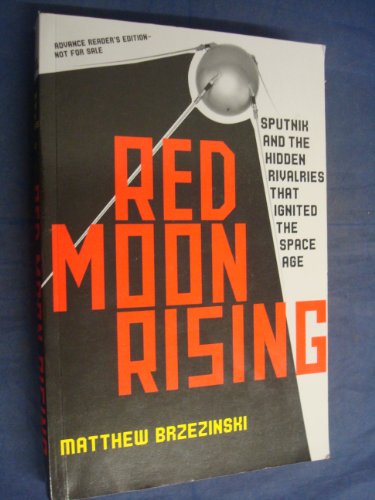
Items related to Red Moon Rising: Sputnik and the Hidden Rivalries that...
Synopsis
For the fiftieth anniversary of Sputnik, the behind-the-scenes story of the fierce battles on earth that launched the superpowers into space
The spy planes were driving Nikita Khrushchev mad. Whenever America wanted to peer inside the Soviet Union, it launched a U-2, which flew too high to be shot down. But Sergei Korolev, Russia's chief rocket designer, had a riposte: an artificial satellite that would orbit the earth and cross American skies at will. On October 4, 1957, the launch of Korolev's satellite, Sputnik, stunned the world.
In Red Moon Rising, Matthew Brzezinski takes us inside the Kremlin, the White House, secret military facilities, and the halls of Congress to bring to life the Russians and Americans who feared and distrusted their compatriots as much as their superpower rivals. Drawing on original interviews and new documentary sources from both sides of the Cold War divide, he shows how Khrushchev and Dwight Eisenhower were buffeted by crises of their own creation, leaving the door open to ambitious politicians and scientists to squabble over the heavens and the earth. It is a story rich in the paranoia of the time, with combatants that included two future presidents, survivors of the gulag, corporate chieftains, rehabilitated Nazis, and a general who won the day by refusing to follow orders.
Sputnik set in motion events that led not only to the moon landing but also to cell phones, federally guaranteed student loans, and the wireless Internet. Red Moon Rising recounts the true story of the birth of the space age in dramatic detail, bringing it to life as never before.
"synopsis" may belong to another edition of this title.
About the Author
Matthew Brzezinski is a former Moscow correspondent for The Wall Street Journal and has reported extensively on homeland-security issues for The New York Times Magazine and other publications. He is the author of Casino Moscow: A Tale of Greed and Adventure on Capitalism's Wildest Frontier and Fortress America: On the Front Lines of Homeland Security. He lives in Washington, D.C.
Reviews
Reviewed by Bryan Burrough
Let's face it: No one cares about space. NASA long ago became the governmental equivalent of NASCAR. The only time non-fans even notice it exists is when something crashes or explodes -- or when an addled astronaut dons space diapers in a bizarro cross-country bid to mace a romantic rival. (These things happen.) Ask any magazine editor: Nothing sells worse than a space cover. And space books? Oh, the horror. Mine sold 17 copies. And that counts my wife's book group.
The latest author to sink his pitons into this Everest of apathy is Matthew Brzezinski, a former Moscow correspondent for the Wall Street Journal. His Red Moon Rising chronicles the Russo-American space race of the mid-1950s. Authors of popular history tend to rise from two schools: those who seek to hook the reader with new information, and those who rely on storytelling skills. Brzezinski, no doubt aware of the challenge before him, springs with vigor from the latter camp. He is a storyteller on steroids, a savvy young cowboy who seizes the narrative bull by the horns, wrestles it to the dirt and furiously ropes up an energetic tale that owes less to F. Scott Fitzgerald than to F. Murray Abraham.
To say his prose is cinematic is an understatement. At times Red Moon Rising feels more like a screenplay than conventional nonfiction; all that's missing is camera instructions. The story opens on a chill Dutch dawn, 1944. A German V-2 rocket rises into the gloaming, arcs toward London and vaporizes a suburban street. Cut to: a Soviet scientist poking through a secret German rocket facility outside the ruins of Berlin, lifting its secrets. Cut to: a lonely GI stumbling upon a Nazi rocket factory deep in a German mountainside. Think I'm exaggerating? In his acknowledgments, Brzezinski thanks one old Russian for memories that form "some of the book's best action scenes."
When Brzezinski reaches the meat of his tale, you'd swear you were reading Francis Ford Coppola. He tells the entire story of postwar Soviet political and missile development during a single visit Nikita Khrushchev and other Politburo members make to a Russian missile base in 1956. It's a device straight out of "The Godfather," only instead of all the players being introduced during a festive Italian wedding, they're shown smoothing their goatees and bickering as they inspect rockets. Amid all the digressions and asides, you half expect Luca Brazzi to slink into the frame. Or Enzo the Baker.
In time, Brzezinski calms down, settling into a kind of pop-eyed, neo-Wolfean style. The characters parade by on brightly painted floats: Khrushchev, unlettered but unfettered, soiling the odd Polish toilet; Sergei Korolev, the Soviets' supersecret Chief Designer, pining for his daughter's love even as he samples his sister-in-law's; Wernher von Braun, the German aristocrat reborn in rural Alabama, sniffing at the stupid Americans. In spots Brzezinski overdoes it, his prose growing a tad ripe. The U.S. secretary of defense, Charles Wilson, is repeatedly referred to by his nickname, "Engine Charlie." Rockets "fling" nuclear warheads. Scientists don't work. They "beaver away."
Yet, however broad Brzezinski's strokes, one comes away not only entertained but informed, with a clear sense of why the pennywise Soviets leapt ahead in missile technology while the Americans, focused on developing bombers to reach Russian soil, failed to realize the importance of space until they woke beneath a communist moon. What interests Brzezinski most, aside from his characters' myriad foibles, is the bureaucratic struggles leading up to Sputnik's launch -- the internecine squabbles between arms of the Soviet bureaucracy as well as those between the Army and Air Force. Few officials on either side, it appears, had any clue what a very big deal Sputnik was until the Western press learned of it, declaring the Russians had won the first heat in a race no one had quite understood they were running.
Throughout, Brzezinski remains in firm control, carving a fast-moving narrative from his own interviews and the research of others, bringing the story to a close when von Braun matches the Soviets by launching a U.S. satellite. Some of the book's set pieces -- er, action scenes -- show real promise, especially Sputnik's nail-biting launch from a Central Asian spaceport. In the end, what you think of Red Moon Rising probably depends on what you expect from popular history. Want a fun, easy read, something you can gulp down while idling in the after-school pickup line? Buy it. Want something comprehensive, authoritative, Caro-like? Pass. Whatever your preference, keep in mind the name Matthew Brzezinski. This book feels like a practice run from a young author destined for big things.
Copyright 2007, The Washington Post. All Rights Reserved.
Starred Review. The writing is fast-paced and crisp, the stakes high and the tension palpable from the first pages of this high-flying account of the early days of the space race between the U.S. and U.S.S.R., a race ignited by the Soviet launch of the first satellite, Sputnik, in 1957. Brzezinski (Fortress America), a contributor to the New York Times Magazine, says this battle for military and technological control of space, part of the larger Cold War, had lasting consequences. Brzezinski illuminates how the space race divided Americans: for instance, then Sen. Lyndon Johnson wanted to aggressively pursue the race, but President Eisenhower thought the ambitious senator was merely seeking publicity. The author also dissects the failed American spin: despite White House claims that Sputnik was no big deal, the media knew it was huge. Sputnik II, launched a month later, was even more unsettling for Americans, causing them to question their way of life. The principals—Khrushchev, Eisenhower, John Foster Dulles, rocket scientist Werner von Braun—are vividly realized. Yet even more than his absorbing narrative, Brzezinski's final analysis has staying power: although the U.S. caught up to the U.S.S.R., it was the Russians' early dominance in space that established the Soviet Union as a superpower equal to America. (Sept.)
Copyright © Reed Business Information, a division of Reed Elsevier Inc. All rights reserved.
Comparable to Paul Dickson's Sputnik: Shock of the Century (2001), Brzezinski's speedy narrative of the first satellite slings readers from launch pads to conference rooms. Beyond the storied facts of the Sputnik event, Brzezinski integrates a theme of Eisenhower and Khrushchev's initially dim understanding of Sputnik's significance. They soon sensed the extraordinary societal reaction of pride in the USSR and panic in the U.S., but their adjustments were quite different. Brzezinski dramatizes Khrushchev's personally shaky grip on power in 1957, when Stalinists attempted to oust him, connecting the satellite spectacular to a reinforcement of his political position. Ike, on the other hand, his eye on expenses, tried to resist the do-something stampede but was overwhelmed. From the domestic politics of the cold-war rivals, Brzezinski shifts to the technically temperamental missiles with which the Soviet Union's secret "Chief Designer" (Sergei Korolev) and his counterparts on rival U.S. Army and Navy teams strove to heave an orbiting orb. A kinetic rendition of Sputnik, this will score with spaceflight buffs. Taylor, Gilbert
"About this title" may belong to another edition of this title.
Search results for Red Moon Rising: Sputnik and the Hidden Rivalries that...

Stock Image
Red Moon Rising: Sputnik and the Hidden Rivalries That Ignited the Space Age
Seller: World of Books (was SecondSale), Montgomery, IL, U.S.A.
Seller rating 5 out of 5 stars

Hardback. Condition: Good. For the fiftieth anniversary of Sputnik, the behind-the-scenes story of the fierce battles on Earth that launched the superpowers into space Matthew Brzezinski explores both sides of this hardboiled Cold War conflict in a taut chronicle . . . that] reads more like a spy thriller than a history book. Kirkus Reviews THE SPY PLANES WERE DRIVING NIKITA KHRUSHCHEV MAD. Whenever America wanted to peer inside the Soviet Union, it launched a U-2, which flew too high to be shot down. But Sergei Korolev, Russias chief rocket designer, had a solution. On October 4, 1957, the launch of Korolevs satellite, Sputnik, stunned the world. In Red Moon Rising, Matthew Brzezinski draws on original interviews and new documentary sources from both sides of the Cold War divide. He shows how Khrushchev and U.S. president Dwight Eisenhower were buffeted by crises of their own creation, leaving the door open to ambitious politicians and scientists to squabble over the heavens and the earth.The true story of the birth of the space age has never been told in such dramatic detail, and Red Moon Rising brings it vividly and memorably to life. Seller Inventory # 00107161211
Stock Image
Red Moon Rising: Sputnik and the Hidden Rivalries That Ignited the Space Age
Seller: World of Books Inc, Montgomery, IL, U.S.A.
Seller rating 4 out of 5 stars

Hardback. Condition: Good. For the fiftieth anniversary of Sputnik, the behind-the-scenes story of the fierce battles on Earth that launched the superpowers into space Matthew Brzezinski explores both sides of this hardboiled Cold War conflict in a taut chronicle . . . that] reads more like a spy thriller than a history book. Kirkus Reviews THE SPY PLANES WERE DRIVING NIKITA KHRUSHCHEV MAD. Whenever America wanted to peer inside the Soviet Union, it launched a U-2, which flew too high to be shot down. But Sergei Korolev, Russias chief rocket designer, had a solution. On October 4, 1957, the launch of Korolevs satellite, Sputnik, stunned the world. In Red Moon Rising, Matthew Brzezinski draws on original interviews and new documentary sources from both sides of the Cold War divide. He shows how Khrushchev and U.S. president Dwight Eisenhower were buffeted by crises of their own creation, leaving the door open to ambitious politicians and scientists to squabble over the heavens and the earth.The true story of the birth of the space age has never been told in such dramatic detail, and Red Moon Rising brings it vividly and memorably to life. Seller Inventory # CIN080508147XG
Stock Image
Red Moon Rising: Sputnik and the Hidden Rivalries that Ignited the Space Age
Seller: HPB-Ruby, Dallas, TX, U.S.A.
Seller rating 5 out of 5 stars
hardcover. Condition: Very Good. Connecting readers with great books since 1972! Used books may not include companion materials, and may have some shelf wear or limited writing. We ship orders daily and Customer Service is our top priority! Seller Inventory # S_466629863
Stock Image
Red Moon Rising: Sputnik and the Hidden Rivalries that Ignited the Space Age
Published by
Times Books, 2007
ISBN 10: 080508147X
ISBN 13: 9780805081473
Used
Hardcover
First Edition
Seller: The Maryland Book Bank, Baltimore, MD, U.S.A.
Seller rating 5 out of 5 stars
hardcover. Condition: Very Good. First Edition. Used - Very Good. Seller Inventory # 7-D-5-0225
Stock Image
Red Moon Rising: Sputnik and the Hidden Rivalries that Ignited the Space Age
Seller: Wonder Book, Frederick, MD, U.S.A.
Seller rating 5 out of 5 stars
Condition: Very Good. Very Good condition. Very Good dust jacket. A copy that may have a few cosmetic defects. May also contain light spine creasing or a few markings such as an owner's name, short gifter's inscription or light stamp. Seller Inventory # G10K-01526
Stock Image
Red Moon Rising : Sputnik and the Hidden Rivalries That Ignited the Space Age
Seller: Better World Books, Mishawaka, IN, U.S.A.
Seller rating 5 out of 5 stars
Condition: Good. Former library copy. Pages intact with minimal writing/highlighting. The binding may be loose and creased. Dust jackets/supplements are not included. Includes library markings. Stock photo provided. Product includes identifying sticker. Better World Books: Buy Books. Do Good. Seller Inventory # 2045938-75
Stock Image
Red Moon Rising : Sputnik and the Hidden Rivalries That Ignited the Space Age
Seller: Better World Books, Mishawaka, IN, U.S.A.
Seller rating 5 out of 5 stars
Condition: Very Good. Pages intact with possible writing/highlighting. Binding strong with minor wear. Dust jackets/supplements may not be included. Stock photo provided. Product includes identifying sticker. Better World Books: Buy Books. Do Good. Seller Inventory # 4376719-75
Stock Image
Red Moon Rising: Sputnik and the Hidden Rivalries that Ignited the Space Age
Seller: ThriftBooks-Reno, Reno, NV, U.S.A.
Seller rating 5 out of 5 stars
Hardcover. Condition: Good. No Jacket. Former library book; Pages can have notes/highlighting. Spine may show signs of wear. ~ ThriftBooks: Read More, Spend Less. Seller Inventory # G080508147XI3N10
Stock Image
Red Moon Rising: Sputnik and the Hidden Rivalries that Ignited the Space Age
Seller: ThriftBooks-Atlanta, AUSTELL, GA, U.S.A.
Seller rating 5 out of 5 stars
Hardcover. Condition: Good. No Jacket. Former library book; Pages can have notes/highlighting. Spine may show signs of wear. ~ ThriftBooks: Read More, Spend Less. Seller Inventory # G080508147XI3N10
Stock Image
Red Moon Rising: Sputnik and the Hidden Rivalries that Ignited the Space Age
Seller: ThriftBooks-Dallas, Dallas, TX, U.S.A.
Seller rating 5 out of 5 stars
Hardcover. Condition: Good. No Jacket. Former library book; Pages can have notes/highlighting. Spine may show signs of wear. ~ ThriftBooks: Read More, Spend Less. Seller Inventory # G080508147XI3N10