
Items related to Invisible (Rough Cut)
Synopsis
“One of America’s greatest novelists” dazzlingly reinvents the coming-of-age story in his most passionate and surprising book to date
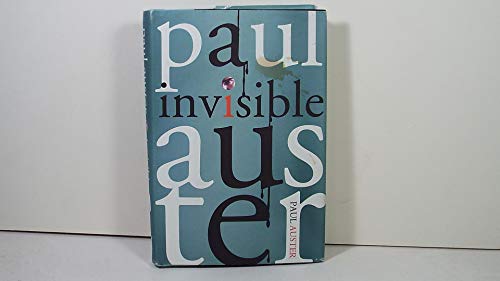
Sinuously constructed in four interlocking parts, Paul Auster’s fifteenth novel opens in New York City in the spring of 1967, when twenty-year-old Adam Walker, an aspiring poet and student at Columbia University, meets the enigmatic Frenchman Rudolf Born and his silent and seductive girfriend, Margot. Before long, Walker finds himself caught in a perverse triangle that leads to a sudden, shocking act of violence that will alter the course of his life.
Three different narrators tell the story of Invisible, a novel that travels in time from 1967 to 2007 and moves from Morningside Heights, to the Left Bank of Paris, to a remote island in the Caribbean. It is a book of youthful rage, unbridled sexual hunger, and a relentless quest for justice. With uncompromising insight, Auster takes us into the shadowy borderland between truth and memory, between authorship and identity, to produce a work of unforgettable power that confirms his reputation as “one of America’s most spectacularly inventive writers.”
"synopsis" may belong to another edition of this title.
About the Author
Paul Auster is the bestselling author of Sunset Park, Man in the Dark, Travels in the Scriptorium, The Brooklyn Follies, and Oracle Night. I Thought My Father Was God, the NPR National Story Project anthology, which he edited, was also a national bestseller. In 2006, he was elected to the American Academy of Arts and Letters for Literature. His work has been translated into thirty-five languages. He lives in Brooklyn, New York.
Reviews
Invisible contains many of the hallmarks of Auster's trade: formal literary devices and stylistic high jinks, psychological depth, elegant prose, and the manipulation of information, voices, and stories. Told against the background of 40 years of history, with shame and colonial guilt ever present, Invisible feels "warmer and more human than the stuff he's famous for" (San Francisco Chronicle) as well as less contrived and more hopeful. Indeed, notes the New York Times Book Review, it's "a love story, or a series of intertwined love stories," with Walker at the core. A few critics thought that Auster's technique overwhelms the story, and one thought the characters uninteresting. But most agreed that Invisible is Auster's finest—and perhaps most accessible—novel to date.
In his latest, Auster is in classic form, perhaps too perfectly satisfying the contention of his wearied protagonist: there is far more poetry in the world than justice. Adam Walker, a poetry student at Columbia in the spring of 1967, is Auster's latest everyman, revealed in four parts through the diary entries of a onetime admirer, the confessions of his once-close friend, the denials of his sister and Walker's own self-made frame. With crisp, taut prose, Auster pushes the tension and his characters' peculiar self-awareness to their limits, giving Walker a fractured, knowing quality that doesn't always hold. The best moments from Walker's disparate, disturbing coming-of-age come in lush passages detailing Walker's conflicted, incestuous love life (paramount to his education as a human being, but a violation of his self-made promise to live as an ethical human being). As the plot moves toward a Heart of Darkness–style journey into madness, the limits of Auster's formalism become more apparent, but this study of a young poet doomed to life as a manifestation of poetry carries startling weight. (Nov.)
Copyright © Reed Business Information, a division of Reed Elsevier Inc. All rights reserved.
From The Washington Post's Book World/washingtonpost.com Reviewed by by Jeff Turrentine Paul Auster is best known as a writer of lean, genre-tinged novels whose unaffected prose belies their philosophical complexity. But he's also one of our most playful novelists, a lover of narrative labyrinths on par with Borges, to whom he has often been compared. For some, Auster's penchant for romantic irony is a distracting tic; for others, it's why they enjoy reading him in the first place. His latest novel, "Invisible," finds him returning to the same thematic territory he has long occupied -- the four-way intersection of memory, language, fate and self-discovery -- with that playfulness very much intact. His subject here is the memoirist's subjective truth, and his object is to get us thinking about the ways in which it is constructed, edited and processed into what we think of as objective reality. In the first of the novel's four sections we meet Adam Walker, an undergraduate at Columbia University with writerly aspirations who likes to translate French verse in his free time. Already we think we can hear the hum of the metafictional machinery starting up: Walker reminds us not only of Marco Fogg, the hero of Auster's 1989 novel "Moon Palace" (same university, same proclivities) but also of Auster himself, who attended Columbia during the late 1960s and translated French poetry as he dreamed of becoming a writer. If we also happen to know that Auster has written novels in which characters from his previous books make appearances ("Travels in the Scriptorium"), as well as novels in which he interpolates himself into the plot ("City of Glass"), then we suspect we may be headed once again into the hall of mirrors. Are we? Of course we are. As we learn of Adam's relationship with Rudolf Born, a supercilious Columbia professor, and Margot, Born's lover, everything reinforces our belief that we are reading a tale narrated in the first person by Adam, about events that have taken place in his past. In fact, as we learn in the next section, we have actually been reading a fragment of Adam's unpublished memoir -- a fragment that is being shared with us by a successful novelist named James Freeman, who knew Adam when they attended Columbia together 40 years ago. Adam, now sick and dying, has asked his old friend to look at the chapter and share his opinion. When Freeman writes back encouragingly, Adam admits to him that he's having trouble continuing. Freeman responds by suggesting that Adam try writing the next section in a different narrative voice -- the bifurcation of voices being a trick that had liberated Freeman from his own writer's block when composing his own memoir years earlier. Do I even need to mention that Auster's first book was a memoir ("The Invention of Solitude") divided into two parts, with the first part employing the first-person voice and the second part employing the third-person voice? By this point in "Invisible," we have traveled so deep into the hall of mirrors that we may be feeling dizzy. "If I hadn't been told it was a true story, I probably would have plunged in and taken those sixty-plus pages for the beginning of a novel," Freeman tells us, before adding parenthetically that "writers do, after all, sometimes inject characters who bear their own names into works of fiction." (Auster must have taken the rest of the day off after typing those words, and he deserved to.) Later in the novel, Freeman becomes the editorial custodian of his old friend's uncompleted memoir. Auster's final bit of mischief is to make Freeman himself unsure as to what he's holding in his hands. Was Adam telling the truth about Rudolf Born? Was he making things up, projecting his own skittering subjective truth onto the stone tablet of objective reality? Freeman's only choice, he decides after consulting with Adam's sister and the other women in his life, is to publish the memoir under his own name, as a hybrid of fiction and memoir. (And his own name, it will come as no surprise, is not really James Freeman.) "I sometimes confuse my thoughts about the world with the world itself," says one character at the end of "Invisible." "I'm sorry if I offended you." Some undoubtedly will be offended; you either enjoy the dizzy feeling you get from being lost in the funhouse, or you feel queasy and head for the exit. One hopes that, in this case, readers will stay for the duration. The pleasures found inside are well worth the labor required to uncover them. For good measure, Auster ends his novel with an image that seems borrowed from his 1990 novel "The Music of Chance": people hard at work chiseling large stones into smaller ones -- laboring, like readers, like writers, to reduce unwieldy, monolithic life into memories and stories that can be passed around and shared. bookworld@washpost.com
Copyright 2009, The Washington Post. All Rights Reserved.
"About this title" may belong to another edition of this title.
Search results for Invisible (Rough Cut)

Stock Image
Invisible
Seller: World of Books (was SecondSale), Montgomery, IL, U.S.A.
Seller rating 5 out of 5 stars

Hardback. Condition: Fair. Cinder meets The Dark Knight in this riveting sequel to the darkly suspenseful, reimagined superhero story The Brokenhearted.Since Gavin's death, Anthem has tried to forget the heartache and betrayal, to feel normal once more. She doesn't want to be the crime-fighting vigilante that Bedlam City needs. She just wants to go to school, practice ballet, and help nurse Ford back to health. But while he is recovering from his life-saving surgery, the Ford she knew is slipping away.Then a new subversive group, whose mysterious leader calls himself the Invisible, starts attacking the North Side. The danger has never been closer to home, and Anthem can't sit idly by. Using her new strength, she begins to fight back, and be the hero she was meant to be. Soon, she is the Invisible's most sought-after enemy, and he is using everything at his disposal to have her found and captured. Will Anthem survive the biggest fight of her life? Seller Inventory # 00096912246
Stock Image
Invisible
Seller: World of Books (was SecondSale), Montgomery, IL, U.S.A.
Seller rating 5 out of 5 stars
Hardback. Condition: Good. Cinder meets The Dark Knight in this riveting sequel to the darkly suspenseful, reimagined superhero story The Brokenhearted.Since Gavin's death, Anthem has tried to forget the heartache and betrayal, to feel normal once more. She doesn't want to be the crime-fighting vigilante that Bedlam City needs. She just wants to go to school, practice ballet, and help nurse Ford back to health. But while he is recovering from his life-saving surgery, the Ford she knew is slipping away.Then a new subversive group, whose mysterious leader calls himself the Invisible, starts attacking the North Side. The danger has never been closer to home, and Anthem can't sit idly by. Using her new strength, she begins to fight back, and be the hero she was meant to be. Soon, she is the Invisible's most sought-after enemy, and he is using everything at his disposal to have her found and captured. Will Anthem survive the biggest fight of her life? Seller Inventory # 00092596691
Stock Image
Invisible (Rough Cut)
Seller: Gulf Coast Books, Cypress, TX, U.S.A.
Seller rating 5 out of 5 stars
hardcover. Condition: Very Good. Seller Inventory # 0805090800-2-37411869
Stock Image
Invisible (Rough Cut)
Published by
Henry Holt and Co. (edition First Edition), 2009
ISBN 10: 0805090800
ISBN 13: 9780805090802
Used
Hardcover
First Edition
Seller: BooksRun, Philadelphia, PA, U.S.A.
Seller rating 5 out of 5 stars
Hardcover. Condition: Very Good. First Edition. With dust jacket. It's a well-cared-for item that has seen limited use. The item may show minor signs of wear. All the text is legible, with all pages included. It may have slight markings and/or highlighting. Seller Inventory # 0805090800-8-1-29
Stock Image
Invisible (Rough Cut)
Seller: ThriftBooks-Dallas, Dallas, TX, U.S.A.
Seller rating 5 out of 5 stars
Hardcover. Condition: Very Good. No Jacket. May have limited writing in cover pages. Pages are unmarked. ~ ThriftBooks: Read More, Spend Less. Seller Inventory # G0805090800I4N00
Stock Image
Invisible (Rough Cut)
Seller: ThriftBooks-Dallas, Dallas, TX, U.S.A.
Seller rating 5 out of 5 stars
Hardcover. Condition: Good. No Jacket. Pages can have notes/highlighting. Spine may show signs of wear. ~ ThriftBooks: Read More, Spend Less. Seller Inventory # G0805090800I3N00
Stock Image
Invisible (Rough Cut)
Seller: ThriftBooks-Atlanta, AUSTELL, GA, U.S.A.
Seller rating 5 out of 5 stars
Hardcover. Condition: Good. No Jacket. Pages can have notes/highlighting. Spine may show signs of wear. ~ ThriftBooks: Read More, Spend Less. Seller Inventory # G0805090800I3N00
Stock Image
Invisible (Rough Cut)
Seller: ThriftBooks-Atlanta, AUSTELL, GA, U.S.A.
Seller rating 5 out of 5 stars
Hardcover. Condition: Good. No Jacket. Former library book; Pages can have notes/highlighting. Spine may show signs of wear. ~ ThriftBooks: Read More, Spend Less. Seller Inventory # G0805090800I3N10
Stock Image
Invisible (Rough Cut)
Seller: ThriftBooks-Reno, Reno, NV, U.S.A.
Seller rating 5 out of 5 stars
Hardcover. Condition: Good. No Jacket. Former library book; Pages can have notes/highlighting. Spine may show signs of wear. ~ ThriftBooks: Read More, Spend Less. Seller Inventory # G0805090800I3N10
Stock Image
Invisible (Rough Cut)
Seller: ThriftBooks-Dallas, Dallas, TX, U.S.A.
Seller rating 5 out of 5 stars
Hardcover. Condition: Good. No Jacket. Former library book; Pages can have notes/highlighting. Spine may show signs of wear. ~ ThriftBooks: Read More, Spend Less. Seller Inventory # G0805090800I3N10