
Items related to Poetry for Young People: Edward Lear
Synopsis
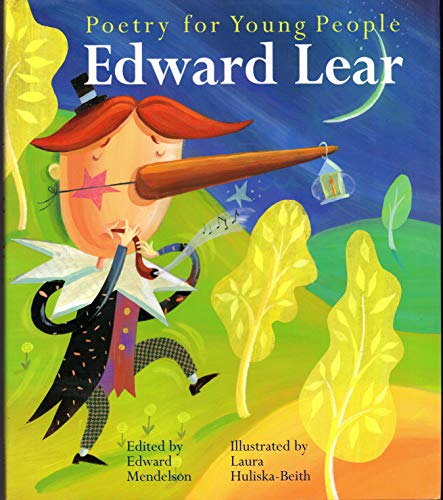
Utterly delightful to read aloud, and for parent and child to share, Edward Lear's humorous verses shine with irrepressible joy and rhythm. Filled with exuberantly nonsensical made-up words (like "Scroobius Pip" and "pobble"!) that tickle the funny bone, his work gives free rein to youthful imaginations. What better to foster a love of poetry than the immediately appealing The Owl and the Pussy-Cat, with its effortless rhymes, songlike beat, and charming animal characters? Or The Quangle Wangle's Hat, which tells the tale of a creature who warmly welcomes everyone--and so makes everyone cheerful. In Dingle Bank, even some young and mischievous boys punished by their schoolmaster make the best of their situation and succeed in having a good time. Bright and fanciful paintings--all as wildly energetic and unrestrained as the language itself--add to the enjoyment. 20 examples of Lear's finest poems will entice children over and over again--and, as always, this acclaimed series features fascinating biographical information, introductions to each verse, and full annotations that define difficult vocabulary.
"synopsis" may belong to another edition of this title.
Reviews
Edward Lear (1812-1888), ed. by Edward Mendelson, illus. by Laura Huliska-Beit, joins the well-conceived Poetry for Young People series. Misunderstood by his peers and plagued by loneliness and low self-esteem, the 19th-century wordsmith and painter spent much of his time in the company of children, composing poems and songs for their amusement. Mendelson here compiles 35 of the author's efforts, introduced by comments that place each in the context of his oeuvre ("Many of Lear's poems are about people who become happy by doing what they think they should do, not what other people think they should do"). Definitions of unfamiliar words and the poet's signature nonsense phrases (such as the Owl and Pussy-Cat's "runcible spoon") follow; Huliska-Beit's swirling spreads and vignettes play up the eccentric scenarios.
Copyright 2002 Cahners Business Information, Inc.
Gr. 3-5. In an analytical introduction, Mendelson looks at Lear's serious and silly sides before selecting 15 limericks and 18 longer poems, all of which feature odd creatures adapting to, or reveling in, their differences. Sporting conical noses or other physical peculiarities, Huliska-Beit's smiling, rubber-limbed figures dance through vertiginously tilted, brightly colored minimalist settings. Though some notes are provided, the awkward gap in "Scroobious Pip" is not explained (Lear left it unfinished), and the small type size gives some pages a jam-packed look. Still, as a presentation of Lear's better-known poems, this makes a thought- and laugh-provoking bridge between the many picture-book editions of single poems and such extended collections as The Nonsense Poems of Edward Lear (1991). John Peters
Copyright © American Library Association. All rights reserved
"About this title" may belong to another edition of this title.
Search results for Poetry for Young People: Edward Lear

Stock Image
Poetry for Young People: Edward Lear
Seller: More Than Words, Waltham, MA, U.S.A.
Seller rating 5 out of 5 stars

Condition: Very Good. Huliska-Beith, Laura (illustrator). 9780979264429. goodFormer Library book. All orders guaranteed and ship within 24 hours. Before placing your order for please contact us for confirmation on the book's binding. Check out our other listings to add to your order for discounted shipping. Seller Inventory # WAL-T-4a-01477
Stock Image
Edward Lear
Seller: World of Books (was SecondSale), Montgomery, IL, U.S.A.
Seller rating 5 out of 5 stars
Hardback. Condition: Good. Huliska-Beith, Laura (illustrator). Seller Inventory # 00109069811
Stock Image
Poetry for Young People: Edward Lear
Published by
Sterling (edition 2nd Print), 2001
ISBN 10: 0806930772
ISBN 13: 9780806930770
Used
Hardcover
Seller: BooksRun, Philadelphia, PA, U.S.A.
Seller rating 5 out of 5 stars
Hardcover. Condition: Very Good. Huliska-Beith, Laura (illustrator). 2nd Print. With dust jacket. It's a well-cared-for item that has seen limited use. The item may show minor signs of wear. All the text is legible, with all pages included. It may have slight markings and/or highlighting. Seller Inventory # 0806930772-11-1-29
Stock Image
Poetry for Young People: Edward Lear
Seller: HPB-Ruby, Dallas, TX, U.S.A.
Seller rating 5 out of 5 stars
hardcover. Condition: Very Good. Huliska-Beith, Laura (illustrator). Connecting readers with great books since 1972! Used books may not include companion materials, and may have some shelf wear or limited writing. We ship orders daily and Customer Service is our top priority! Seller Inventory # S_419711503
Stock Image
Poetry for Young People: Edward Lear
Seller: ThriftBooks-Dallas, Dallas, TX, U.S.A.
Seller rating 5 out of 5 stars
Hardcover. Condition: Good. No Jacket. Huliska-Beith, Laura (illustrator). Former library book; Pages can have notes/highlighting. Spine may show signs of wear. ~ ThriftBooks: Read More, Spend Less. Seller Inventory # G0806930772I3N10
Stock Image
Poetry for Young People: Edward Lear
Seller: ThriftBooks-Atlanta, AUSTELL, GA, U.S.A.
Seller rating 5 out of 5 stars
Hardcover. Condition: Fair. No Jacket. Huliska-Beith, Laura (illustrator). Former library book; Readable copy. Pages may have considerable notes/highlighting. ~ ThriftBooks: Read More, Spend Less. Seller Inventory # G0806930772I5N10
Stock Image
Edward Lear
Published by
Sterling Publishing Co., Inc., 2001
ISBN 10: 0806930772
ISBN 13: 9780806930770
Used
Hardcover
Seller: Better World Books, Mishawaka, IN, U.S.A.
Seller rating 5 out of 5 stars
Condition: Good. Huliska-Beith, Laura (illustrator). 2nd prt. Former library copy. Pages intact with minimal writing/highlighting. The binding may be loose and creased. Dust jackets/supplements are not included. Includes library markings. Stock photo provided. Product includes identifying sticker. Better World Books: Buy Books. Do Good. Seller Inventory # 4067549-75
Stock Image
Edward Lear
Published by
Sterling Publishing Co., Inc., 2001
ISBN 10: 0806930772
ISBN 13: 9780806930770
Used
Hardcover
Seller: Better World Books, Mishawaka, IN, U.S.A.
Seller rating 5 out of 5 stars
Condition: Very Good. Huliska-Beith, Laura (illustrator). 2nd prt. Pages intact with possible writing/highlighting. Binding strong with minor wear. Dust jackets/supplements may not be included. Stock photo provided. Product includes identifying sticker. Better World Books: Buy Books. Do Good. Seller Inventory # 11388357-6
Stock Image
Edward Lear
Seller: World of Books Inc, Montgomery, IL, U.S.A.
Seller rating 4 out of 5 stars

Hardback. Condition: Good. Huliska-Beith, Laura (illustrator). Seller Inventory # CIN0806930772G
Stock Image
Edward Lear (Poetry for Young People S.)
Seller: WorldofBooks, Goring-By-Sea, WS, United Kingdom
Seller rating 5 out of 5 stars
Hardback. Condition: Good. Huliska-Beith, Laura (illustrator). The book has been read but remains in clean condition. All pages are intact and the cover is intact. Some minor wear to the spine. Seller Inventory # GOR003716722
Buy Used
US$ 3.81
US$ 7.41 shipping
Ships from United Kingdom to U.S.A.
Ships from United Kingdom to U.S.A.
Quantity: 1 available