
Synopsis
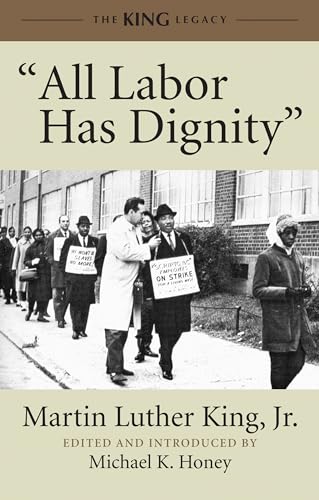
An unprecedented and timely collection of Dr. King’s speeches on labor rights and economic justice People forget that Dr. King was every bit as committed to economic justice as he was to ending racial segregation. He fought throughout his life to connect the labor and civil rights movements, envisioning them as twin pillars for social reform. As we struggle with massive unemployment, a staggering racial wealth gap, and the near collapse of a financial system that puts profits before people, King’s prophetic writings and speeches underscore his relevance for today. They help us imagine King anew: as a human rights leader whose commitment to unions and an end to poverty was a crucial part of his civil rights agenda. Covering all the civil rights movement highlights€”Montgomery, Albany, Birmingham, Selma, Chicago, and Memphis€”award-winning historian Michael K. Honey introduces and traces King’s dream of economic equality. Gathered
"synopsis" may belong to another edition of this title.
About the Author
Dr. Martin Luther King, Jr. (1929-1968), Nobel Peace Prize laureate and architect of the nonviolent civil rights movement, was among the twentieth century's most influential figures. One of the greatest orators in U.S. history, King is the author of several books, including Stride Toward Freedom: The Montgomery Story, The Trumpet of Conscience, Why We Can't Wait, and Where Do We Go from Here: Chaos or Community? His speeches, sermons, and writings are inspirational and timeless. King was assassinated in Memphis, Tennessee, on April 4, 1968.
Michael K. Honey, a former Southern civil rights and civil liberties organizer, is professor of labor ethnic and gender studies and American history, and the Haley Professor of Humanities, at the University of Washington-Tacoma. The author of three books on labor and civil rights history, including Going Down Jericho Road: The Memphis Strike, Martin Luther King's Last Campaign, he lives in Tacoma.
Reviews
King was in the midst of cultivating an alliance between the civil rights movement and labor unions when he was assassinated in 1968. He was in Memphis to support a strike by black sanitation workers and was planning the Poor People’s Campaign, advocating for jobs, unionization, and dignity for all workers. Despite the sometimes prickly relationship between African Americans and unions with members eager to protect jobs by discrimination, King made substantial inroads with many union leaders. Honey, scholar and former civil rights organizer, offers a collection of 15 of King’s speeches (12 previously unpublished) on workers’ rights. Drawing on archival material from the King Center for Nonviolent Social Change, Honey reforms King’s image from civil rights activist to labor activist. In speeches delivered in venues including a 1961 AFL-CIO convention in Miami and a meeting with Teamsters in New York in 1967, King’s words put into perspective the labor movement since the 1930s and its links to the civil rights movement via such similar tactics as sit-ins, boycotts, and strikes. This important collection broadens our perception of King’s vision of social justice. --Vanessa Bush
Excerpt. © Reprinted by permission. All rights reserved.
National Labor Leadership Assembly for Peace
Chicago, Illinois, November 11, 1967
Mr. Chairman, distinguished guests, my brothers and sisters of the labor movement, ladies and gentlemen. I need not pause to say how very delighted I am to be here this afternoon and to be some little part of this extremely significant assembly. . . . I don’t feel that I come among strangers today for I feel that I’m an honorary member of many labor unions all across the country. (Applause) In fact, I think Cleve Robinson and Dave Livingston of District 65 in New York made me an honorary member a long time ago and I’ve been a 65er a long time. . . . I want to try to talk very honestly and frankly about this great problem, this great issue that we face as a result of the war in Vietnam. Some of my words may appear to be rather harsh, but they will be as harsh as truth and as gentle as a nonviolent devotee would be. (Laughter)
I want to use as a subject “The Domestic Impact of the War in America.” This question is historic because it is an authentic expression of the conscience of the labor movement. As has been said already this afternoon, tens of millions of Americans oppose the war in Vietnam. Never in our history has there been such a passionate, popular resistance to a current war. In addition to the millions upon millions of ordinary people, eminent scholars, distinguished senators, journalists, businessmen, professionals, students, and political leaders at all levels have protested the war and offered alternatives with an amazing tenacity and boldness.
But one voice was missing—the loud, clear voice of labor. The absence of that one voice was all the more tragic because it may be the decisive one for tipping the balance toward peace. Labor has been missing. For too long the moral appeal has been flickering, not shining as it did in its dynamic days of growth. This conference, a united expression of varied branches of labor, reaffirms that the trade union movement is part of forward-looking America. (Applause) That no matter what the formal resolutions of higher bodies may be, the troubled conscience of the working people cannot be stilled. This conference speaks for millions. You here today will long be remembered as those who had the courage to speak out and the wisdom to be right.
It is noteworthy that the Labor Party of Great Britain, which, of course, has no responsibility for our actions, nonetheless went on record on October 4 in a formal national resolution calling upon its Labor government to dissociate itself completely from U.S. policy in Vietnam. (Applause) It urged its government to persuade the United States to end the bombing of North Vietnam immediately, permanently, and unconditionally.
Now what are some of the domestic consequences of the war in Vietnam? It has made the Great Society a myth and replaced it with a troubled and confused society. The war has strengthened domestic reaction. It has given the extreme right, the anti-labor, anti-Negro, and antihumanistic forces a weapon of spurious patriotism to galvanize its supporters into reaching for power, right up to the White House. It hopes to use national frustration to take control and restore the America of social insecurity and power for the privileged. When a Hollywood performer, lacking distinction even as an actor [Ronald Reagan], can become a leading war-hawk candidate for the presidency, only the irrationalities induced by a war psychosis can explain such a melancholy turn of events. (Applause)
The war in Vietnam has produced a shameful order of priorities in which the decay, squalor, and pollution of the cities are neglected. And even though 70 percent of our population now lives in them, the war has smothered and nearly extinguished the beginnings of progress toward racial justice. The war has created the bizarre spectacle of armed forces of the United States fighting in ghetto streets in America while they are fighting in jungles in Asia. The war has so increased Negro frustration and despair that urban outbreaks are now an ugly feature of the American scene. How can the administration, with quivering anger, denounce the violence of ghetto Negroes when it has given an example of violence in Asia that shocks the world? (Applause)
"About this title" may belong to another edition of this title.
Other Popular Editions of the Same Title

Search results for All Labor Has Dignity

Stock Image
All Labor Has Dignity
Seller: ThriftBooks-Dallas, Dallas, TX, U.S.A.
Seller rating 5 out of 5 stars

Hardcover. Condition: Good. No Jacket. Pages can have notes/highlighting. Spine may show signs of wear. ~ ThriftBooks: Read More, Spend Less. Seller Inventory # G0807086002I3N00
Stock Image
All Labor Has Dignity
Seller: Better World Books, Mishawaka, IN, U.S.A.
Seller rating 5 out of 5 stars
Condition: Good. Har/Com. Former library copy. Pages intact with minimal writing/highlighting. The binding may be loose and creased. Dust jackets/supplements are not included. Includes library markings. Stock photo provided. Product includes identifying sticker. Better World Books: Buy Books. Do Good. Seller Inventory # 950962-6
Stock Image
All Labor Has Dignity
Seller: Better World Books, Mishawaka, IN, U.S.A.
Seller rating 5 out of 5 stars
Condition: Good. Har/Com. Pages intact with minimal writing/highlighting. The binding may be loose and creased. Dust jackets/supplements are not included. Stock photo provided. Product includes identifying sticker. Better World Books: Buy Books. Do Good. Seller Inventory # 4643187-6
Stock Image
All Labor Has Dignity (King Legacy) [] King Jr., Dr. Martin Luther and Honey, Michael K.
Seller: College Campus, Sturgeon Lake, MN, U.S.A.
Seller rating 4 out of 5 stars

Condition: Good. Used Item. Does not include New Access Codes , Cd's or one time use items that come when New. This item is Used. Seller Inventory # 080708602913122-EM02409427
Seller Image
All Labor Has Dignity (King Legacy) with CD included
Published by
Beacon Press, 2011
ISBN 10: 0807086002
ISBN 13: 9780807086001
Used
Hardcover
First Edition
Seller: Nightshade Booksellers, IOBA member, Atlanta, GA, U.S.A.
Seller rating 5 out of 5 stars
Hardcover. Condition: Fine. Dust Jacket Condition: Fine. 1st Edition. First edition, first printing with full number line. CD included in back slipcase. A fine copy in a fine DJ, protected by a removable mylar cover. See my photos of the book you will receive, not stock photos. More available upon request. This book is in my possession and will be packed in bubble wrap and shipped in a cardboard box. USPS tracking provided. #115. Seller Inventory # 023452
Stock Image
All Labor Has Dignity: On Labor Rights and Economic Justice
Seller: Revaluation Books, Exeter, United Kingdom
Seller rating 5 out of 5 stars
Hardcover. Condition: Brand New. hardback/cd edition. 224 pages. 8.75x5.75x1.25 inches. In Stock. Seller Inventory # 0807086002
Buy New
US$ 47.96
US$ 13.46 shipping
Ships from United Kingdom to U.S.A.
Ships from United Kingdom to U.S.A.
Quantity: 1 available
Stock Image
All Labor Has Dignity (King Legacy)
Seller: BennettBooksLtd, Los Angeles, CA, U.S.A.
Seller rating 5 out of 5 stars
hardcover. Condition: New. In shrink wrap. Looks like an interesting title! Seller Inventory # Q-0807086002