
Items related to On the Form of the American Mind (The Collected Works...
Synopsis
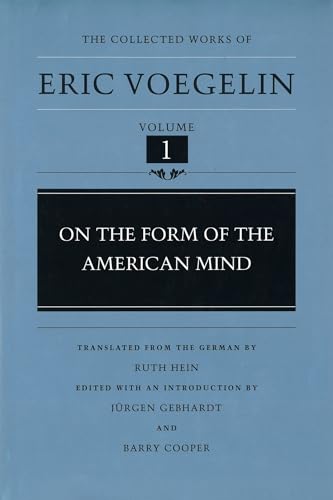
In 1924, not quite two years after receiving his doctorate from the University of Vienna, Eric Voegelin was named a Laura Spelman Rockefeller Memorial Fellow and thus given the opportunity to pursue postdoctoral studies in the United States. For the next twenty-four months, Voegelin worked with some of the most creative scholars in America and at several of the country's great universities, an experience that undoubtedly influenced his scholarly and personal perspectives throughout his life. A more immediate result was the publication in 1928 of On the Form of the American Mind, the young philosopher's first major work, in which his acute perceptions and analyses combine with a conceptual vocabulary struggling to find its own coherence and form.
Voegelin begins his inquiry into the form of the American mind with a complex discussion of the concepts of time and existence in European and American philosophy and continues with an extended interpretation of George Santayana, a study of the Puritan mystic Jonathan Edwards, a presentation on Anglo-American jurisprudence, and a consideration of the historian, economist, and political scientist John R. Commons (Voegelin was particularly interested in Commons' views on the mental, political, social, and economic aspects of democracy in modern urban and industrial America). Although admitting that this diversity of themes seems only loosely connected," Voegelin demonstrates the actual overall unity of these various subjects: each concerns linguistic expressions of a theoretical nature.
Analysis of On the Form of the American Mind indicates that Voegelin integrated the approaches of Lebensphilosophie into what Georg Misch called the "philosophical combination of anthropology and history," which characterized contemporary trends within the discourse of the Geisteswissenschaften and finally resulted in a theoretical paradigm of philosophical anthropology.
Jürgen Gebhardt and Barry Cooper provide access to this brilliant study with their two-part introduction. The first part considers On the Form of the American Mind in the context of methodological debates ongoing in Germany at the time Voegelin was writing the book; the second describes Voegelin's American experience and compares his work with similar studies written during the post-World War I period.
"synopsis" may belong to another edition of this title.
About the Author
About the Author
Eric Voegelin (1901-1985) was one of the most original and influential philosophers of our time. Born in Cologne, Germany, he studied at the University of Vienna, where he became a professor of political science in the Faculty of Law. In 1938, he and his wife, fleeing Hitler, emigrated to the United States. They became American citizens in 1944. Voegelin spent much of his career at Louisiana State University, the University of Munich, and the Hoover Institution at Stanford University. During his lifetime he published many books and more than one hundred articles. The Collected Works of Eric Voegelin will make available in a uniform edition all of Voegelin's major writings. About the Editors
Jürgen Gebhardt is professor of political science at the Institute of Political Science of Friedrich-Alexander University at Erlangen-Nuremberg.
Barry Cooper is professor of political science at the University of Calgary.
From the Back Cover
In 1924, not quite two years after receiving his doctorate from the University of Vienna, Eric Voegelin was named a Laura Spelman Rockefeller Memorial Fellow and thus given the opportunity to pursue postdoctoral studies in the United States. For the next twenty-four months, Voegelin worked with some of the most creative scholars in America and at several of the country's great universities, an experience that undoubtedly influenced his scholarly and personal perspectives throughout his life. A more immediate result was the publication in 1928 of On the Form of the American Mind, the young philosopher's first major work, in which his acute perceptions and analyses combine with a conceptual vocabulary struggling to find its own coherence and form. Voegelin begins his inquiry into the form of the American mind with a complex discussion of the concepts of time and existence in European and American philosophy and continues with an extended interpretation of George Santayana, a study of the Puritan mystic Jonathan Edwards, a presentation on Anglo-American jurisprudence, and a consideration of the historian, economist, and political scientist John R. Commons. Jurgen Gebhardt and Barry Cooper provide access to this brilliant study with their two-part Introduction. The first part considers On the Form of the American Mind in the context of methodological debates ongoing in Germany at the time Voegelin was writing the book; the second describes Voegelin's American experience and compares his work with similar studies written during the post-World War I period.
Reviews
This is the first in a projected series of 34 volumes that will make available in a uniform edition all of Voegelin's major writings. The book was prompted by his two-year stay in America on a fellowship from his native Austria. In America he traveled much, saw much, and studied much, becoming intimately acquainted with the thought of William James, Charles Sanders Peirce, George Santayana, and Jonathan Edwards. The first three chapters deal with metaphysical problems such as time and existence; the last two cover Anglo-American jurisprudence and John R. Commons, a close friend whose thought greatly influenced Voegelin. The breadth of Voegelin's interests?not only the concerns above but American economic theory, class structure, and labor-management relations?is remarkable in so young a person: Voegelin (1901-85) was only in his mid-twenties when he wrote this book. For academic philosophy, political science, and American intellectual history collections.?Leon H. Brody, U.S. Office of Personnel Mgt. Lib., Washington,
Copyright 1995 Reed Business Information, Inc.
"About this title" may belong to another edition of this title.
Search results for On the Form of the American Mind (The Collected Works...

Stock Image
On the Form of the American Mind (CW1)
Published by
University of Missouri Press, 1995
ISBN 10: 0807118265
ISBN 13: 9780807118269
Used
Hardcover
Seller: World of Books (was SecondSale), Montgomery, IL, U.S.A.
Seller rating 5 out of 5 stars

Hardback. Condition: Fair. In 1924, not quite two years after receiving his doctorate from the University of Vienna, Eric Voegelin was named a Laura Spelman Rockefeller Memorial Fellow and thus given the opportunity to pursue postdoctoral studies in the United States. For the next twenty-four months, Voegelin worked with some of the most creative scholars in America and at several of the country's great universities, an experience that undoubtedly influenced his scholarly and personal perspectives throughout his life. A more immediate result was the publication in 1928 of On the Form of the American Mind, the young philosopher's first major work, in which his acute perceptions and analyses combine with a conceptual vocabulary struggling to find its own coherence and form. Voegelin begins his inquiry into the form of the American mind with a complex discussion of the concepts of time and existence in European and American philosophy and continues with an extended interpretation of George Santayana, a study of the Puritan mystic Jonathan Edwards, a presentation on Anglo-American jurisprudence, and a consideration of the historian, economist, and political scientist John R. Commons (Voegelin was particularly interested in Commons' views on the mental, political, social, and economic aspects of democracy in modern urban and industrial America). Although admitting that this diversity of themes seems only loosely connected," Voegelin demonstrates the actual overall unity of these various subjects: each concerns linguistic expressions of a theoretical nature. Analysis of On the Form of the American Mind indicates that Voegelin integrated the approaches of Lebensphilosophie into what Georg Misch called the "philosophical combination of anthropology and history," which characterized contemporary trends within the discourse of the Geisteswissenschaften and finally resulted in a theoretical paradigm of philosophical anthropology. Jürgen Gebhardt and Barry Cooper provide access to this brilliant study with their two-part introduction. The first part considers On the Form of the American Mind in the context of methodological debates ongoing in Germany at the time Voegelin was writing the book; the second describes Voegelin's American experience and compares his work with similar studies written during the post-World War I period. Seller Inventory # 00106870669
Stock Image
On the Form of the American Mind (CW1)
Published by
University of Missouri Press, 1995
ISBN 10: 0807118265
ISBN 13: 9780807118269
Used
Hardcover
Seller: World of Books Inc, Montgomery, IL, U.S.A.
Seller rating 4 out of 5 stars

Hardback. Condition: Fair. In 1924, not quite two years after receiving his doctorate from the University of Vienna, Eric Voegelin was named a Laura Spelman Rockefeller Memorial Fellow and thus given the opportunity to pursue postdoctoral studies in the United States. For the next twenty-four months, Voegelin worked with some of the most creative scholars in America and at several of the country's great universities, an experience that undoubtedly influenced his scholarly and personal perspectives throughout his life. A more immediate result was the publication in 1928 of On the Form of the American Mind, the young philosopher's first major work, in which his acute perceptions and analyses combine with a conceptual vocabulary struggling to find its own coherence and form. Voegelin begins his inquiry into the form of the American mind with a complex discussion of the concepts of time and existence in European and American philosophy and continues with an extended interpretation of George Santayana, a study of the Puritan mystic Jonathan Edwards, a presentation on Anglo-American jurisprudence, and a consideration of the historian, economist, and political scientist John R. Commons (Voegelin was particularly interested in Commons' views on the mental, political, social, and economic aspects of democracy in modern urban and industrial America). Although admitting that this diversity of themes seems only loosely connected," Voegelin demonstrates the actual overall unity of these various subjects: each concerns linguistic expressions of a theoretical nature. Analysis of On the Form of the American Mind indicates that Voegelin integrated the approaches of Lebensphilosophie into what Georg Misch called the "philosophical combination of anthropology and history," which characterized contemporary trends within the discourse of the Geisteswissenschaften and finally resulted in a theoretical paradigm of philosophical anthropology. Jürgen Gebhardt and Barry Cooper provide access to this brilliant study with their two-part introduction. The first part considers On the Form of the American Mind in the context of methodological debates ongoing in Germany at the time Voegelin was writing the book; the second describes Voegelin's American experience and compares his work with similar studies written during the post-World War I period. Seller Inventory # CIN0807118265A
Stock Image
On the Form of the American Mind (The Collected Works of Eric Voegelin, Volume 1)
Seller: The Book Corner, Beaverton, OR, U.S.A.
Seller rating 4 out of 5 stars
hardcover. Condition: Good. Hardback with dust jacket. Dust jacket is in good condition. Cover edges and corners in good shape. Spine is tight. There is underlining and notes on several pages. Ships from Friends bookstore to benefit Beaverton (Oregon) library. Seller Inventory # mon0000090791
Seller Image
On the Form of the American Mind
Published by
University of Missouri Press, 1995
ISBN 10: 0807118265
ISBN 13: 9780807118269
Used
Hardcover
Seller: Optimon Books, Gravesend, KENT, United Kingdom
Seller rating 5 out of 5 stars
Hardcover. Condition: Good. Voegelin begins his inquiry into the form of the American mind with a discussion of the concepts of time and existence in European and American philosophy, interprets the works of George Santayana and the Puritan mystic Jonathan Edwards, and analyses the ideas of historian and political scientist John R. Commons. Seller Inventory # 470781
Buy Used
US$ 56.48
US$ 24.08 shipping
Ships from United Kingdom to U.S.A.
Ships from United Kingdom to U.S.A.
Quantity: 1 available
Stock Image
On the Form of the American Mind (Collected Works of Eric Voegelin): Volume 1
Published by
University of Missouri Press 1994-09-30, 1994
ISBN 10: 0807118265
ISBN 13: 9780807118269
New
Hardcover
Seller: Chiron Media, Wallingford, United Kingdom
Seller rating 5 out of 5 stars
Hardcover. Condition: New. Brand new book, sourced directly from publisher. Dispatch time is 24-48 hours from our warehouse. Book will be sent in robust, secure packaging to ensure it reaches you securely. Seller Inventory # 6666-GRD-9780807118269
Buy New
US$ 80.92
US$ 8.68 shipping
Ships from United Kingdom to U.S.A.
Ships from United Kingdom to U.S.A.
Quantity: 1 available
Stock Image
On the Form of the American Mind (CW1)
Published by
University of Missouri Press, 1995
ISBN 10: 0807118265
ISBN 13: 9780807118269
New
Hardcover
Seller: PBShop.store UK, Fairford, GLOS, United Kingdom
Seller rating 5 out of 5 stars
HRD. Condition: New. New Book. Shipped from UK. Established seller since 2000. Seller Inventory # WG-9780807118269
Buy New
US$ 84.35
US$ 6.72 shipping
Ships from United Kingdom to U.S.A.
Ships from United Kingdom to U.S.A.
Quantity: 1 available
Stock Image
On the Form of the American Mind (The Collected Works of Eric Voegelin, Volume 1)
Seller: Kennys Bookshop and Art Galleries Ltd., Galway, GY, Ireland
Seller rating 5 out of 5 stars
Condition: New. Editor(s): Gebhardt, Jurgen. Translator(s): Hein, Ruth. Series: Collected Works of Eric Voegelin. Num Pages: 312 pages, 3ill. BIC Classification: HPCF; JPA. Category: (G) General (US: Trade); (UP) Postgraduate, Research & Scholarly. Dimension: 152 x 229 x 28. . . 1995. Hardcover. . . . . Seller Inventory # V9780807118269
Buy New
US$ 81.21
US$ 10.66 shipping
Ships from Ireland to U.S.A.
Ships from Ireland to U.S.A.
Quantity: 1 available
Seller Image
On the Form of the American Mind (CW1)
Published by
University of Missouri Press, US, 1995
ISBN 10: 0807118265
ISBN 13: 9780807118269
New
Hardcover
Seller: Rarewaves.com USA, London, LONDO, United Kingdom
Seller rating 5 out of 5 stars
Hardback. Condition: New. Seller Inventory # LU-9780807118269
Buy New
US$ 93.21
Free Shipping
Ships from United Kingdom to U.S.A.
Ships from United Kingdom to U.S.A.
Quantity: 1 available
Stock Image
On the Form of the American Mind: Vol 1
Seller: Revaluation Books, Exeter, United Kingdom
Seller rating 5 out of 5 stars
Hardcover. Condition: Brand New. 312 pages. 9.50x6.50x1.25 inches. In Stock. Seller Inventory # __0807118265
Buy New
US$ 90.04
US$ 16.72 shipping
Ships from United Kingdom to U.S.A.
Ships from United Kingdom to U.S.A.
Quantity: 1 available
Stock Image
On the Form of the American Mind (The Collected Works of Eric Voegelin, Volume 1)
Seller: Ria Christie Collections, Uxbridge, United Kingdom
Seller rating 5 out of 5 stars
Condition: New. In English. Seller Inventory # ria9780807118269_new
Buy New
US$ 93.13
US$ 15.10 shipping
Ships from United Kingdom to U.S.A.
Ships from United Kingdom to U.S.A.
Quantity: 2 available