
Items related to Creatures of Accident: The Rise of the Animal Kingdom
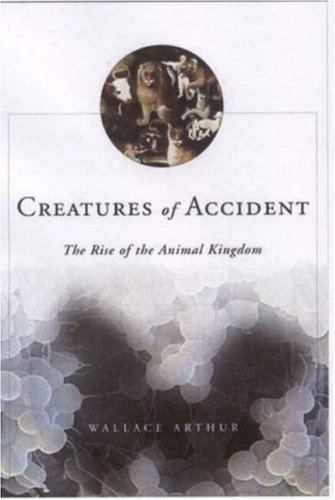
Synopsis
The most important aspect of evolution, from a philosophical viewpoint, is the rise of complex, advanced creatures from simple, primitive ones. This “vertical” dimension of evolution has been downplayed in both the specialist and popular literature on evolution, in large part because it was in the past associated with unsavory political views. The avoidance of evolution’s vertical dimension has, however, left evolutionary biology open to the perception, from outside, that it deals merely with the diversification of rather similar creatures, all at the same level of “advancedness” from a common ancestor—for example, the classic case studies of finches with different beaks or moths of different colors.
The latest incarnation of creationism, dubbed intelligent design (or ID), has taken advantage of this situation. It portrays an evolutionary process that is constantly guided—especially in its upward direction—by the hand of an unseen Creator, who is able to ensure that it ends up producing humans. Creatures of Accident attacks the antiscience ID worldview, mainly by building a persuasive picture of how “unaided” evolution produces advanced creatures from simple ones by an essentially accidental process. Having built this picture, in the final chapter the book reflects on its religious implications.
"synopsis" may belong to another edition of this title.
About the Author
Wallace Arthur is a professor of zoology at the National University of Ireland,
Galway. The author of seven previous books, he also serves as European editor of the journal Evolution and Development.
Reviews
A core tenet of the intelligent design movement is that some organisms are simply too elaborate and complicated to have evolved by chance. Arthur, a professor of zoology at the National University of Ireland, Galway, aims to render this strain of creationism unnecessary by "explaining, in a way that is accessible to a general readership, how the rise of complex creatures can be explained in terms of natural processes." Creatures of Accident makes this case through a series of easily intelligible, chatty chapters, offering a way of understanding the emergence of animals (the most complex life form) without resorting to either the relativist idea that all life is essentially the same (with animals being, as Stephen Jay Gould once put it, "a mere epiphenomenon") or the teleological view that if animals are uniquely complex, then some intelligent designer must have made them so. Drawing ideas and examples from the large (zoology) to the small (cellular biology), Arthur popularizes recent breakthroughs in the field of evolutionary development—the trendily dubbed "evo-devo"—to make the paradoxical case that complexity can, in fact, happen quite simply. (Sept.)
Copyright © Reed Business Information, a division of Reed Elsevier Inc. All rights reserved.
Discussing the evolution of life in this spry work, Wallace advances the argument that the process tends toward greater complexity over time. If the existence of complexity is seemingly self-evident, explaining it often leads to diverging theories, which Arthur, a zoology professor in Ireland, critiques in accessible fashion. He gives short shrift to creationism and so-called intelligent design but tackles at length the view, espoused in the oeuvre of biologist Richard Darwin, that evolution is simply an aimless series of micro- and macro-biological events without any bias toward complexity. Writing in a conversational manner, Arthur sketches out the main structural attributes of complexity in animals, from the cell to organs to embryology to body forms, and when they appeared. In considering these anatomical traits, Arthur inveighs repeatedly against the intrusion of philosophical casts of mind. Championing naturalistic clarity, Arthur's precision about the processes of evolution will benefit serious students of the topic. Gilbert Taylor
Copyright © American Library Association. All rights reserved
Excerpt. © Reprinted by permission. All rights reserved.
Chapter One
HAND LUGGAGE ONLY
Human thinking about the nature of life has been constrained by dogmatic ideological stances, not just religious and political ones, but also adherence to the scientific orthodoxy of the day. Such “philosophical baggage” needs to be jettisoned at the outset of our journey so that we open our minds to the maximum range of possibilities. Science should be all about open-mindedness and questioning. It is an honest search for the truth about the nature of “life, the universe and everything,” to use that famous phrase introduced by Douglas Adams in his book The Hitchhiker’s Guide to the Galaxy.
This book, like the animal kingdom, had an accidental origin. The seed from which it eventually germinated was sown by a newspaper article I read a few years ago. The retention of this seed of information for several years is a bit odd, because newspapers, unlike books, are ephemeral things. If you have already read today’s paper, how many articles can you remember? What about yesterday’s? Or last week’s? We pass our time on trains and planes perusing the papers, but we don’t commit much to memory—or at least to the long-term version of that everyday miracle.
However, occasionally something sticks. The article whose message stuck with me was in the color supplement of one of the Sunday papers. It was about evolution. A particular sentence is all that I retain, and doubtless in imperfect form. But, to an approximation, here it is: “Complex creatures, like humans, are a mere epiphenomenon in the history of Life.”
What did its author mean by describing us as an “epiphenomenon,” that is, a sort of blip on the periphery of something altogether more important? What was the deep philosophical point he was trying to impart? Well, his point was something like this. Since life began about four billion years ago, the vast majority of the creatures that have lived out their lives in every corner of our planetary home have been bacteria. This in itself is hardly surprising, because bacteria are very small, and small creatures tend to be much more numerous than large ones. You and I are both individual humans, but we are also both roving vehicles transporting millions of bacteria from place to place—most of them in our guts and on our skin.
But the point goes further. Not only are there far more bacteria than animals or plants; there are also more different types of bacteria. In other words, species. We all recognize different species of animals, whether very different, like humans and houseflies, or only slightly different, like horses and donkeys. In contrast, different species of bacteria require more than the naked eye to see, let alone distinguish. Indeed, the whole concept of a species—bounded by its members’ inability to breed with other than same-species partners—is hard to apply in the bacterial realm, where reproduction is hardly sex as we know it.
Such difficulties aside, it is probably true that both now and at all other points in evolutionary time the living world has been dominated by bacteria, both in numbers of individual creatures and in numbers of types of creatures. This fact is at odds with a curious human practice—naming particular periods of the earth’s history after a particular kind of animal, as in the Age of Fishes. Such names have a rationale but also serve to mislead. They are normally used to refer to a type of animal that diversified rapidly in the period concerned and consequently contributed much to its fossil record. But unlike fish, most bacteria have no hard parts and rarely fossilize. So fossil frequencies are a poor guide to the dominant creatures of the past. In reality, the whole of evolutionary time could be labeled the Age of Bacteria.
Under this view of life, we humans and our animal allies are indeed a “mere epiphenomenon,” or, in more graphic terms, a tiny molehill on a vast bacterial lawn. A molehill that may one day disappear, whether by self-inflicted nuclear radiation or other means, leaving our simpler but more robust progenitors to go about their bacterial business in a molehill-free manner, as they were doing three billion years ago.
I’m going to call this lawn-with-molehills perspective the left-wing view of life. The reason for this label is that, in this perspective, attention is focused on diversity—that is, creatures being merely different from each other within a level of complexity—rather than on complexity, and on evolutionary increases in this over time. There is a reluctance to think of any local corner of this variety as being better or higher in some sense than another. So it is an egalitarian view of life. We life-forms are all comrades in our struggle for existence, whether we are bacteria, beetles, blue whales, or bus drivers.
So what is the right-wing view? This is where we go from lawn to ladder. A long time ago in Germany—about two centuries back—a group of philosophically minded folk interested in the nature of life came up with the idea that all creatures could be arranged in a line. And the line was a vertical one: it was effectively a sequence of increasing complexity and sophistication. Microbes at the bottom, humans at the top. This is something of a caricature, but it captures these philosophers’ fundamental point.
This vertical line needs a name. It is often referred to by the Latin scala naturae, meaning, as you might expect, “natural scale.” Whatever we call it, any overall view of life based on it is fundamentally at odds with the lawn-with-molehills view. If our central metaphor shifts from horizontal to vertical, we change our focus from diversity to complexity. From humans as molehill to pinnacle. From bacteria as all-dominant life-forms to lowly dwellers on the bottom rung.
Now, each of these views captures an element of truth. It is always unwise to regard thinkers of the past as ignorant or deluded. The further back we go, the less the information at the disposal of the thinkers concerned. But while lack of some kinds of information constrains thinking, it does not necessarily distort it. That is, it does not prevent a rigorous analysis of whatever information was available at the time. So I am not interested in being critical of last decade’s Sunday newspapers or of worthy tomes written in the eighteenth and nineteenth centuries in a language that regrettably I cannot read. Sure, my criticism is implicit, but I will not develop it. Instead, what I will develop is a Middle Way, to borrow that famous Buddhist concept, between the left-wing and the right-wing views—that is, between life’s lawn and life’s ladder. However, it will be a decidedly biased Middle Way—more on that in the following chapter.
Today, the worldview of most Europeans, and many (but not most?) Americans, is sufficiently infused with evolutionary thinking that the idea of evolution in general causes an adverse response only in the creationist movement. There are now many strands of this movement, the most recent being intelligent design, or ID.
If all that phrase implied were an intelligent Creator causing the big bang through which the universe was born some fourteen billion years ago and then standing back to let nature run its course, it would seem no great threat to an evolutionary worldview. But unfortunately it goes further. I will return to this point toward the end of the book (in Chapter 20). Most of the book is not devoted to attacking ID, but rather to building the case that ID is unnecessary by explaining, in a way that is readily accessible to a general readership, how the rise of complex creatures can be explained in terms of natural processes. I will take the view that we should all accept evolution regardless of whether we do or do not see religious implications, because of the mass of accumulated evidence in its favor, some of which we will see in subsequent chapters. But accepting evolution was not so easy in the late eighteenth century.
We need to be careful here. What exactly was the state of human thinking 220 years ago? How uniform or varied were people’s views of life? It is easy to make ill-informed statements about such times that historians of science could disprove in a single sweep of the pen. Belief in evolution did not begin with Charles Darwin and his 1859 masterpiece, On the Origin of Species. That book may indeed have been the biggest single milestone along the way from a dominance of creationist myths to the triumph of evolutionary arguments, but it was not the first. European views on evolution can be traced back at least half a century earlier, and probably further. And who knows what the Chinese were thinking about life way back centuries before Darwin’s time, when they scooped Copernicus with their early ideas on a heliocentric solar system?
But caution should not go too far. Although you and I have little insight into the philosophical conversations that took place in late-eighteenth-century Germany, we can be fairly sure that evolution was not center stage at that time. I’d guess that some folk had thought of it. Regardless of whether this is true, evolution still did not feature in the prevailing European worldview by 1800.
This fact raises an interesting question. What was in the minds of those late-eighteenth-century proponents of the right-wing view? If life had a ladder, did creatures not climb up it? No, they emphatically did not. The ladder, which now so readily permits an evolutionary interpretation, was at the time very abstract—a pattern in the mind of God.
Now, in post-Darwinian times, creatures most certainly are seen to climb the ladder—but only some of them. Many creatures have remained on the lawn of design simplicity ever since life began. Th...
"About this title" may belong to another edition of this title.
Search results for Creatures of Accident: The Rise of the Animal Kingdom

Stock Image
Creatures of Accident The Rise
Seller: World of Books (was SecondSale), Montgomery, IL, U.S.A.
Seller rating 5 out of 5 stars

Condition: Good. Item in good condition. Textbooks may not include supplemental items i.e. CDs, access codes etc. Seller Inventory # 00101427023
Stock Image
Creatures of Accident: The Rise of the Animal Kingdom
Published by
Hill and Wang (edition First Edition), 2006
ISBN 10: 0809043211
ISBN 13: 9780809043217
Used
Hardcover
First Edition
Seller: BooksRun, Philadelphia, PA, U.S.A.
Seller rating 5 out of 5 stars
Hardcover. Condition: Very Good. First Edition. With dust jacket. It's a well-cared-for item that has seen limited use. The item may show minor signs of wear. All the text is legible, with all pages included. It may have slight markings and/or highlighting. Seller Inventory # 0809043211-11-1-29
Stock Image
Creatures of Accident : The Rise of the Animal Kingdom
Published by
Farrar, Straus & Giroux, 2006
ISBN 10: 0809043211
ISBN 13: 9780809043217
Used
Hardcover
First Edition
Seller: Better World Books, Mishawaka, IN, U.S.A.
Seller rating 5 out of 5 stars
Condition: Good. First Edition. Former library copy. Pages intact with minimal writing/highlighting. The binding may be loose and creased. Dust jackets/supplements are not included. Includes library markings. Stock photo provided. Product includes identifying sticker. Better World Books: Buy Books. Do Good. Seller Inventory # GRP102825690
Stock Image
Creatures of Accident : The Rise of the Animal Kingdom
Published by
Farrar, Straus & Giroux, 2006
ISBN 10: 0809043211
ISBN 13: 9780809043217
Used
Hardcover
First Edition
Seller: Better World Books, Mishawaka, IN, U.S.A.
Seller rating 5 out of 5 stars
Condition: Very Good. First Edition. Former library copy. Pages intact with possible writing/highlighting. Binding strong with minor wear. Dust jackets/supplements may not be included. Includes library markings. Stock photo provided. Product includes identifying sticker. Better World Books: Buy Books. Do Good. Seller Inventory # GRP74705128
Stock Image
Creatures of Accident: The Rise of the Animal Kingdom
Seller: ThriftBooks-Atlanta, AUSTELL, GA, U.S.A.
Seller rating 5 out of 5 stars
Hardcover. Condition: Very Good. No Jacket. Former library book; May have limited writing in cover pages. Pages are unmarked. ~ ThriftBooks: Read More, Spend Less. Seller Inventory # G0809043211I4N10
Stock Image
Creatures of Accident: The Rise of the Animal Kingdom
Seller: Ezekial Books, LLC, Manchester, NH, U.S.A.
Seller rating 5 out of 5 stars
hardcover. Condition: Very Good. 100% Satisfaction Guaranteed. Seller Inventory # 51UMMU000N8B
Stock Image
Creatures of Accident: The Rise of the Animal Kingdom
Seller: HPB-Emerald, Dallas, TX, U.S.A.
Seller rating 5 out of 5 stars
hardcover. Condition: Very Good. Connecting readers with great books since 1972! Used books may not include companion materials, and may have some shelf wear or limited writing. We ship orders daily and Customer Service is our top priority! Seller Inventory # S_473822327
Stock Image
Creatures of Accident: The Rise of the Animal Kingdom
Seller: HPB Inc., Dallas, TX, U.S.A.
Seller rating 5 out of 5 stars
hardcover. Condition: Very Good. Connecting readers with great books since 1972! Used books may not include companion materials, and may have some shelf wear or limited writing. We ship orders daily and Customer Service is our top priority! Seller Inventory # S_393195887
Stock Image
Creatures of Accident: The Rise of the Animal Kingdom
Seller: Half Price Books Inc., Dallas, TX, U.S.A.
Seller rating 5 out of 5 stars
hardcover. Condition: Very Good. Connecting readers with great books since 1972! Used books may not include companion materials, and may have some shelf wear or limited writing. We ship orders daily and Customer Service is our top priority! Seller Inventory # S_441331272
Stock Image
Creatures of Accident: The Rise of the Animal Kingdom
Seller: HPB-Diamond, Dallas, TX, U.S.A.
Seller rating 5 out of 5 stars
hardcover. Condition: Very Good. Connecting readers with great books since 1972! Used books may not include companion materials, and may have some shelf wear or limited writing. We ship orders daily and Customer Service is our top priority! Seller Inventory # S_435037426