
Items related to Cartoon Introduction to Economics, Volume I: Microeconomics
Cartoon Introduction to Economics, Volume I: Microeconomics - Softcover
Book 1 of 2: The Cartoon Introduction to Economics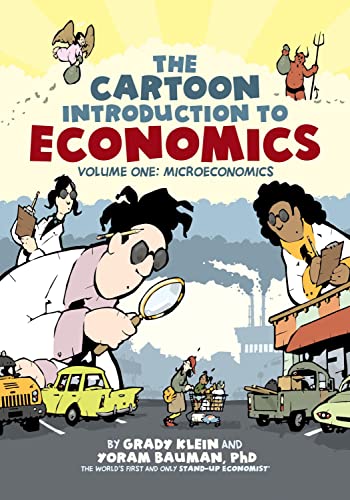
Synopsis
The award-winning illustrator Grady Klein has paired up with the world's only stand-up economist, Yoram Bauman, PhD, to take the dismal out of the dismal science. From the optimizing individual to game theory to price theory, The Cartoon Introduction to Economics is the most digestible, explicable, and humorous 200-page introduction to microeconomics you'll ever read.
Bauman has put the comedy into economy at comedy clubs and universities around the country and around the world (his Principles of Economics, Translated is a YouTube cult classic). As an educator at both the university and high school levels, he has learned how to make economics relevant to today's world and today's students. As Google's chief economist, Hal Varian, wrote, You don't need a brand-new economics. You just need to see the really cool stuff, the material they didn't get to when you studied economics. The Cartoon Introduction to Economics is all about integrating the really cool stuff into an overview of the entire discipline of microeconomics, from decision trees to game trees to taxes and thinking at the margin. Rendering the cool stuff fun is the artistry of the illustrator and lauded graphic novelist Klein. Panel by panel, page by page, he puts comics into economics. So if the vertiginous economy or a dour professor's 600-page econ textbook has you desperate for a fun, factual guide to economics, reach for The Cartoon Introduction to Economics and let the collaborative genius of the Klein-Bauman team walk you through an entire introductory microeconomics course."synopsis" may belong to another edition of this title.
About the Author
A freelance cartoonist, illustrator, and animator, Grady Klein is the creator of the Lost Colony series of graphic novels. An environmental economist at the University of Washington (and a part-time teacher at Seattle's Lakeside High School), Yoram Bauman, PhD, is the world's first and only stand-up economist.
Reviews
As a study aide, if you can get past—or roll with—the often-precious humor presented by humorist/Ph.D. Bauman, this book is well organized and direct, using its overviews to deflate some of the pomposity that surrounds economic theory. While pro–free trade, the book regards the theories it presents with a slight grain of salt, giving the reader an even broader view of economic history, with the trends that worked short- and long-term. Often, though, this is almost as tedious as an economics textbook—only those who are assigned a class in microeconomics might find some enjoyment in this book, a potential respite from their dry assignments. Also on the negative side, the drawings seem to be flat blobs. For those required to study the subject or already familiar with it, this has some value as a colorful brush up, but the merely curious may struggle. (Jan.)
Copyright © Reed Business Information, a division of Reed Elsevier Inc. All rights reserved.
Barging in on Larry Gonick’s seeming monopoly, Klein and Bauman serve up a similar blend of humor and solid instruction on a topic everyone’s supposed to know something about (besides history, Gonick’s covered chemistry, computers, physics, the environment, statistics, genetics, and sex). Klein’s zippy drawing looks like Gonick’s, especially in its scribbly treatment of the figures’ hair, though his preferences for relatively thick lines and bare-bones perspective (one item in front of another against distant or no backdrop) also conjure the work of the marvelous New Yorker cartoonist Lou Myers (1915–2005). Within three parts on “The Optimizing Individual,” “Strategic Interactions,” and “Market Interactions,” and explaining such bedrock economic concepts as risk, Pareto efficiency, game theory, auctions, supply and demand, and margins, Bauman’s text, delivered by three figures whose lab coats and experimenter’s clipboards suggest they’re not just economists but scientists (and constitute a red flag to those who think social science is an oxymoron), bears out his self-characterization, “the world’s first and only stand-up economist.” Probably the least dismal treatment of the dismal science ever. --Ray Olson
"About this title" may belong to another edition of this title.
Search results for Cartoon Introduction to Economics, Volume I: Microeconomics

Stock Image
Cartoon Introduction to Economics: Volume One: Microeconomics
Seller: World of Books (was SecondSale), Montgomery, IL, U.S.A.
Seller rating 5 out of 5 stars

Paperback. Condition: Good. A work about integrating the cool stuff into an overview of the discipline of microeconomics, from decision trees to game trees to taxes and thinking at the margin. It puts comics into economics. It walks you through an introductory microeconomics course. Seller Inventory # 00107214527
Seller Image
Cartoon Introduction to Economics, Volume I: Microeconomics
Seller: Dream Books Co., Denver, CO, U.S.A.
Seller rating 5 out of 5 stars
Condition: acceptable. This copy has clearly been enjoyedâ"expect noticeable shelf wear and some minor creases to the cover. Binding is strong, and all pages are legible. May contain previous library markings or stamps. Seller Inventory # DBV.0809094819.A
Seller Image
Cartoon Introduction to Economics, Volume I: Microeconomics
Seller: Zoom Books East, Glendale Heights, IL, U.S.A.
Seller rating 5 out of 5 stars
Condition: good. Book is in good condition and may include underlining highlighting and minimal wear. The book can also include "From the library of" labels. May not contain miscellaneous items toys, dvds, etc. . We offer 100% money back guarantee and 24 7 customer service. Seller Inventory # ZEV.0809094819.G
Stock Image
Cartoon Introduction to Economics, Volume I: Microeconomics
Seller: NW Book Rescue, Hubbard, OR, U.S.A.
Seller rating 2 out of 5 stars

paperback. Condition: Very Good. Pages are clean with no markings. Very little, if any, shelf wear. Any images shown are stock photographs and product may differ from what is shown. Seller Inventory # *-SFRC-20260731-0311-46.9K-C4707
Seller Image
Cartoon Introduction to Economics, Volume I: Microeconomics
Seller: Dream Books Co., Denver, CO, U.S.A.
Seller rating 5 out of 5 stars
Condition: good. Gently used with minimal wear on the corners and cover. A few pages may contain light highlighting or writing, but the text remains fully legible. Dust jacket may be missing, and supplemental materials like CDs or codes may not be included. May be ex-library with library markings. Ships promptly! Seller Inventory # DBV.0809094819.G
Seller Image
Cartoon Introduction to Economics, Volume I: Microeconomics
Seller: Greenworld Books, Arlington, TX, U.S.A.
Seller rating 5 out of 5 stars
Condition: good. Fast Free Shipping â" Good condition. It may show normal signs of use, such as light writing, highlighting, or library markings, but all pages are intact and the book is fully readable. A solid, complete copy that's ready to enjoy. Seller Inventory # GWV.0809094819.G
Stock Image
Cartoon Introduction to Economics: Volume One: Microeconomics
Seller: World of Books Inc, Montgomery, IL, U.S.A.
Seller rating 4 out of 5 stars

Paperback. Condition: Good. A work about integrating the cool stuff into an overview of the discipline of microeconomics, from decision trees to game trees to taxes and thinking at the margin. It puts comics into economics. It walks you through an introductory microeconomics course. Seller Inventory # CIN0809094819G
Seller Image
Cartoon Introduction to Economics, Volume I: Microeconomics
Seller: Goodwill Books, Hillsboro, OR, U.S.A.
Seller rating 5 out of 5 stars
Condition: acceptable. Fairly worn, but readable and intact. If applicable: Dust jacket, disc or access code may not be included. Seller Inventory # GICWV.0809094819.A
Seller Image
Cartoon Introduction to Economics, Volume I: Microeconomics
Seller: Goodwill, Brooklyn Park, MN, U.S.A.
Seller rating 4 out of 5 stars
Condition: good. All pages and cover are intact including the dust cover, if applicable . Spine may show signs of wear. Pages may include limited notes and highlighting. May include "From the library of" labels. Shrink wrap, dust covers, or boxed set case may be missing. Item may be missing bundled media. Seller Inventory # 2Y6RUU000DHN_ns
Seller Image
Cartoon Introduction to Economics, Volume I: Microeconomics
Seller: Greenworld Books, Arlington, TX, U.S.A.
Seller rating 5 out of 5 stars
Condition: very_good. Fast Free Shipping â" Very Good condition book with a firm cover and clean pages. Shows normal use and some light wear or limited notes markings. A solid, nice copy to enjoy. Seller Inventory # GWV.0809094819.VG