Items related to The Catholic Experience of Small Christian Communities

100% Satisfaction is Guaranteed! For New condition books in our store; You will be the first user. You will be the first to open the book cover. For Used condition books in our store; It shows signs of wear from consistent use, but it remains in good condition and works perfectly. All pages and cover are intact , but may have aesthetic issues such as price clipping, nicks, scratches, and scuffs. Pages may include some notes and highlighting. For all our books; Cargo will be delivered in the required time. There are no problems in page content and in the paper. There are no problems except minor faults.
"synopsis" may belong to another edition of this title.
About the Author:
Bernard J. Lee, S.M directs the Institute for Ministry at Loyola University and is the author of Paulist books The Galilean Jewishness of Jesus and Jesus and the Metaphors of God. He lives in New Orleans. Dr. William V. D'Antonio was the principal researcher of the small Christian community study. He is a sociologist with a special interest in family, religion, ethnicity, and politics.
From Library Journal:
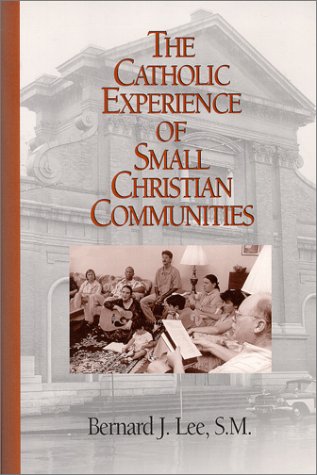
Lee (Loyola Univ., New Orleans), a Marianist priest and theologian, joins sociologist D'Antonio (Catholic Univ. of America) to detail a 1995-1997 study of the post-Vatican II phenomenon of small lay communities developing within the U.S. Catholic Church. More traditional groups, such as secular institutes and third orders, were not included in the project, which was conducted by researchers and theologians. This large census of small Christian communities (SCCs) found at least 37,000 groups with a strong parish connection. Types sampled were categorized as general SCCs, Hispanic/Latino, Charismatic, Call to Action, and Eucharist centered. The results show that the deep need for belonging and faith sharing are not met on the parish level alone and hark back to the household communities of the early church. This careful study may serve as a model for future ones monitoring the changing ways of faith living. It should be carefully considered by religious decision-makers. Recommended for religion and sociology collections.
-Anna M. Donnelly, St. Johns Univ. Lib., New York
Copyright 2000 Reed Business Information, Inc.
-Anna M. Donnelly, St. Johns Univ. Lib., New York
Copyright 2000 Reed Business Information, Inc.
"About this title" may belong to another edition of this title.
- PublisherPaulist Pr
- Publication date2000
- ISBN 10 0809139375
- ISBN 13 9780809139378
- BindingPaperback
- Number of pages191
Buy New
Learn more about this copy
US$ 25.88
Shipping:
US$ 3.50
Within U.S.A.
Top Search Results from the AbeBooks Marketplace
Stock Image
The Catholic Experience of Small Christian Communities
Seller:
Rating

Book Description Paperback. Condition: new. New. Seller Inventory # Wizard0809139375
Buy New
US$ 25.88
Convert currency
Stock Image
The Catholic Experience of Small Christian Communities
Seller:
Rating
Book Description Paperback. Condition: new. New Copy. Customer Service Guaranteed. Seller Inventory # think0809139375
Buy New
US$ 27.44
Convert currency
Stock Image
The Catholic Experience of Small Christian Communities
Seller:
Rating
Book Description Condition: new. Seller Inventory # FrontCover0809139375
Buy New
US$ 29.86
Convert currency
Stock Image
The Catholic Experience of Small Christian Communities
Seller:
Rating
Book Description Paperback. Condition: new. New. Fast Shipping and good customer service. Seller Inventory # Holz_New_0809139375
Buy New
US$ 56.44
Convert currency
Stock Image
THE CATHOLIC EXPERIENCE OF SMALL
Seller:
Rating

Book Description Condition: New. New. In shrink wrap. Looks like an interesting title! 0.4. Seller Inventory # Q-0809139375
Buy New
US$ 57.60
Convert currency