
Items related to Notes from a Sealed Room: An Israeli View of the Gulf...
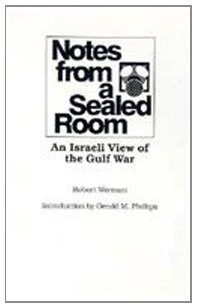
Synopsis
In this compelling and often startling account, Robert Werman chronicles his experiences as an Israeli citizen living in Jerusalem during the Gulf War. On January 19, 1991, he began writing daily reports on his computer, sending them to friends and a few computer networks that dealt with Jewish culture and the politics of the Middle East. To Werman’s surprise, he received numerous electronic responses to his entries, sometimes as many as one hundred a day. As a result, his "war diary" was born, a diary that he continued until February 22, 1991, when, near the end of the war, he was hospitalized for a heart condition.
In the early entries, Werman notes each Iraqi Scud attack, describing in detail the sealed room in which he and his family sought shelter during the expected chemical attacks. "Sitting in the antigas room, members of the family try to put on a brave face, make jokes. . . . Only the dog, a rather stately collie, sits quietly and does not appear at all excited. We pity the dog, for he is the only one without a mask. But then we remember thatwithout a maskhe is our canary in the coal mine." Futilely, Werman seeks patterns to the attacks, attempting to predict when they might occur. He writes of the nation’s response to war: joggers running with their gas masks in hand, schools temporarily disbanded while children meet in small groups to continue their education, city streets emptied by six o'clock each evening as people wait in their homes for the sound of the sirens that herald an assault. He discusses the varying opinions concerning retaliation against Iraq, the fluctuating morale of the country, the damage produced by Iraqi missiles, and the widespread speculation of Israeli citizens concerning their country’s survival. Yet Werman’s daily reports, digressions, and explanations not only include his observations and impressions; they also poignantly reveal his own personal story and political, religious, and philosophical views.
Werman’s journal gives a singular view of a country under siege, recounting in detail the pressures, conflicts, and dangers existing during a war. It is a distinctive book, a fascinating personal and political account of a man, his family, their nation, and a war.
"synopsis" may belong to another edition of this title.
About the Author
Robert Werman, trained as a physician and clinical neurologist, immigrated to Israel from the United States in 1967. He has taught at Columbia, Cambridge, and Indiana universities and is now professor of neurophysiology at Hebrew University in Jerusalem. He is the author of two books of poetry.
Reviews
During the six-week Gulf war in 1991, Werman, an American-born Israeli physician, lived through the threat and the reality of Scud attacks, and sent daily reports to electronic pen pals over a computer network that extended as far as the U.S. and Japan. He records what it was like to huddle in a poison gas-proof room in his house in Jerusalem, struggling with fear and anger as Iraqi missiles fell on Israel. Between alerts Werman and his family attempted to live normally, observing the Sabbath, entertaining friends, following the news. (Aside from Saddam Hussein, the figure that turns up most frequently in the diary is CNN reporter Peter Arnett, whom Werman regarded as a tool of the Iraqi government and an Israeli-basher.) Werman experienced the last three Scud attacks in a cardiac intensive-care ward: "So I was to finish the war as a patient," he writes in the epilogue, "struck down not by a missile but by a traitor, my heart." His book is a vivid personal account.
Copyright 1992 Reed Business Information, Inc.
"About this title" may belong to another edition of this title.
Search results for Notes from a Sealed Room: An Israeli View of the Gulf...

Stock Image
Notes from a Sealed Room: An Israeli View of the Gulf War
Published by
Carbondale, Illinois, U.S.A.: Southern Illinois Univ Pr, 1993, Carbondale, Illinois, U.S.A., 1993
ISBN 10: 080931830X
ISBN 13: 9780809318308
Used
Hardcover
First Edition
Seller: DBookmahn's Used and Rare Military Books, Burke, VA, U.S.A.
Seller rating 3 out of 5 stars

Hard Cover. Condition: Near Fine. First Edition. Hard Cover. Near Fine/Near Fine. First Edition. 8vo - over 7¾" - 9¾" tall. 192pp. Israel during the Gulf War. Seller Inventory # 003276
Stock Image
Notes From a Sealed Room: An Israeli View of the Gulf War
Published by
Southern IL, IL, 1993
ISBN 10: 080931830X
ISBN 13: 9780809318308
Used
Hardcover
First Edition
Seller: Between the Covers-Rare Books, Inc. ABAA, Gloucester City, NJ, U.S.A.
Seller rating 5 out of 5 stars

Hardcover. Condition: Near Fine. First edition. Near fine in near fine dustwrapper. Advanced review copy with info, spine ends of book and dustwrapper bumped, tiny tear on bottom spine end. Seller Inventory # 215604
Stock Image
Notes from a sealed room : an Israeli view of the Gulf war.
Published by
Southern Illinois Univ Pr, 1993
ISBN 10: 080931830X
ISBN 13: 9780809318308
Used
Softcover
Seller: Kloof Booksellers & Scientia Verlag, Amsterdam, Netherlands
Seller rating 4 out of 5 stars

Condition: very good. Carbondale,1993. Orig. cloth binding. Dustjacket. xxvi,192p. - In this compelling and often startling account, Robert Werman chronicles his experiences as an Israeli citizen living in Jerusalem during the Gulf War. On January 19, 1991, he began writing daily reports on his computer, sending them to friends and a few computer networks that dealt with Jewish culture and the politics of the Middle East. To Werman s surprise, he received numerous electronic responses to his entries, sometimes as many as one hundred a day. As a result, his war diary was born, a diary that he continued until February 22, 1991, when, near the end of the war, he was hospitalized for a heart condition. In the early entries, Werman notes each Iraqi Scud attack, describing in detail the sealed room in which he and his family sought shelter during the expected chemical attacks. Sitting in the antigas room, members of the family try to put on a brave face, make jokes. . . . Only the dog, a rather stately collie, sits quietly and does not appear at all excited. We pity the dog, for he is the only one without a mask. But then we remember thatwithout a maskhe is our canary in the coal mine. Futilely, Werman seeks patterns to the attacks, attempting to predict when they might occur. He writes of the nation s response to war: joggers running with their gas masks in hand, schools temporarily disbanded while children meet in small groups to continue their education, city streets emptied by six o'clock each evening as people wait in their homes for the sound of the sirens that herald an assault. He discusses the varying opinions concerning retaliation against Iraq, the fluctuating morale of the country, the damage produced by Iraqi missiles, and the widespread speculation of Israeli citizens concerning their country s survival. Yet Werman s daily reports, digressions, and explanations not only include his observations and impressions; they also poignantly reveal his own personal story and political, religious, and philosophical views. Werman s journal gives a singular view of a country under siege, recounting in detail the pressures, conflicts, and dangers existing duringa war. It is a distinctive book, a fascinating personal and political account of a man, his family, their nation, and a war. Condition : very good copy. ISBN 9780809318308. Keywords : , Seller Inventory # 114589
Buy Used
US$ 20.31
US$ 34.90 shipping
Ships from Netherlands to U.S.A.
Ships from Netherlands to U.S.A.
Quantity: 1 available
Stock Image
Notes from a Sealed Room: An Israeli View of the Gulf War
Published by
Southern Illinois Univ Pr, 1993
ISBN 10: 080931830X
ISBN 13: 9780809318308
New
Hardcover
Seller: SHIMEDIA, Brooklyn, NY, U.S.A.
Seller rating 4 out of 5 stars
Condition: New. Satisfaction Guaranteed or your money back. Seller Inventory # 080931830X