
Items related to The Architecture of R.M. Schindler
Synopsis
“The spirit of Schindler warms the works of all of us who were touched by his life.”
—Frank O. Gehry
“He is the most important architect in California of his day and deserves highly the attention given to him at last by his hometown, Vienna.”
—Philip Johnson
With such masterworks as the Schindler-Chace House and the Lovell Beach House in California, the Vienna-born modernist R. M. Schindler (1887–1953) is recognized as one of the most innovative architects of the 20th century. Nearly 50 years after his death, admiration for his breathtakingly original houses and apartment buildings is at an all-time peak.
Containing many never-published drawings and photographs and spanning Schindler’s early years in Vienna, his apprenticeship with Frank Lloyd Wright, and his bold contributions to West Coast modernism, this book—which accompanies the first major Schindler retrospective—offers the most comprehensive view of his genius to date.
"synopsis" may belong to another edition of this title.
About the Author
Elizabeth A.T. Smith, curator of the Schindler exhibition, is James W. Alsdorf Chief Curator at the Museum of Contemporary Art, Chicago.
Robert Sweeney is president of the Friends of the Schindler House.
Richard Guy Wilson chairs the Department of Architectural History at the University of Virginia.
Kurt G. F. Helfrich is a curator at the University Art Museum at the University of California, Santa Barbara.
Michael Darling is assistant curator of the Schindler exhibition.
Reviews
In life, avant-garde West Coast architect Rudolf Schindler had his loyal admirers, but he was largely dismissed by prominent tastemakers for perceived transgressions against Modernist design principles. Only long after his death in 1953 have serious efforts gone into assessing his oeuvre. The books reviewed here are welcome additions to the now-burgeoning field of Schindler studies. The Architecture of R.M. Schindler offers five scholarly essays and a wealth of illustrations and photos. Curators Smith and Darling compiled the catalog to accompany a major retrospective put together by the Museum of Contemporary Art in Los Angeles and traveling to Washington, DC, and Vienna, Austria. The text examines the distinct phases of his creative evolution from 1912 until his death but breaks no new ground, except perhaps for disclosures found in recently released personal correspondence detailing the bohemian life Schindler and family led at his west Los Angeles home. It is this landmark 1921 house that is the subject of Schindler House, a happy collaboration between one-time resident Smith (Frank Lloyd Wright: Hollyhock House and Olive Hall) and photographer Mudford. As his own home, Schindler built one of the most startlingly original structures of the 20th century, provoking both fulsome praise and bewildered condemnation. Probing its history and presenting the structure from all angles, this slim volume does more to promote an appreciation of this legendary abode than any prior publication. Schindler House is a most attractive purchase for large public and academic libraries. Comprehensive architecture collections should have The Architecture of R.M. Schindler. For general collections, the most balanced treatment remains David Gebhard's Schindler (William Stout, 1997. reprint). David Solt?sz, Cuyahoga Cty. P.L., Parma, OH
Copyright 2001 Reed Business Information, Inc.
"About this title" may belong to another edition of this title.
Search results for The Architecture of R.M. Schindler

Stock Image
The Architecture of R.M. Schindler
Seller: Books From California, Simi Valley, CA, U.S.A.
Seller rating 4 out of 5 stars

hardcover. Condition: Good. Seller Inventory # mon0004231700
Stock Image
The Architecture of R.M. Schindler
Seller: ThriftBooks-Atlanta, AUSTELL, GA, U.S.A.
Seller rating 5 out of 5 stars

Hardcover. Condition: Fair. No Jacket. Missing dust jacket; Readable copy. Pages may have considerable notes/highlighting. ~ ThriftBooks: Read More, Spend Less. Seller Inventory # G0810942232I5N01
Stock Image
The Architecture of R.M. Schindler
Published by
Museum of Contemporary Art, Los Angeles / Harry N. Abrams, Los Angeles / New York, 2001
ISBN 10: 0810942232
ISBN 13: 9780810942233
Used
Hardcover
Seller: Mullen Books, ABAA, Marietta, PA, U.S.A.
Seller rating 4 out of 5 stars
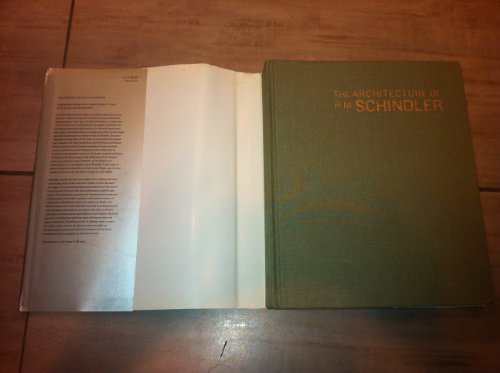
Hardcover. Quarto. Hardcover. Illustrated boards. Front with a architectural sketch, rear with a photo of the architect. Grey Cloth binding. Illustrated end papers. 284 pages : illustrations (some color) ; 29 cm. With such masterworks as the Schindler-Chace House and the Lovell Beach House in California, the Vienna-born modernist R.M. Schindler (1887-1953) is recognized as one of the most innovative architects of the 20th century. Nearly 50 years after his death, admiration for his breathtakingly original houses and apartment buildings is at an all-time peak. Containing many never-published drawings and photographs and spanning Schindler's early years in Vienna, his apprenticeship with Frank Lloyd Wright, and his bold contributions to West Coast modernism, this book -- which accompanies the first major Schindler retrospective -- offers the most comprehensive view of his genius to date. VG-. Ex-lib with typical markings. Jacket in sleeve. Some toning around text block edges and a little bumping at the corner. Binding still nice and strong. Seller Inventory # 203632
Stock Image
The Architecture of R.M. Schindler
Published by
Harry N. Abrams and The Museum of Contemporary Art, Los Angeles, 2001
ISBN 10: 0810942232
ISBN 13: 9780810942233
Used
Hardcover
Seller: ANARTIST, New York, NY, U.S.A.
Seller rating 5 out of 5 stars
Hardcover with dustjacket, 284 pages, very good condition; light edgewear to dj; no internal marks. Foreign shipping may be extra. Seller Inventory # ThSmHa85
Seller Image
The Architecture of R. M. Schindler
Published by
Museum of Contemporary Art / Harry N. Abrams, Los Angeles, 2001
ISBN 10: 0810942232
ISBN 13: 9780810942233
Used
Hardcover
First Edition
Seller: Midway Book Store (ABAA), St. Paul, MN, U.S.A.
Seller rating 5 out of 5 stars
Hardcover. First edition. 28.5 x 23.5 cm. Quarto. 283pp. 265 illustrations, 107 plates in full color. Grey cloth in dust jacket. Published on occasion of the exhibition of the same name held at The Museum of Contemporary Art, Los Angeles, 25 February - 3 June 2001. Light toning to the page edges. Near Fine in Near Fine dust jacket. Seller Inventory # 63928
Seller Image
THE ARCHITECTURE OF R. M. SCHINDLER
Seller: Books on the Boulevard, Sherman Oaks, CA, U.S.A.
Seller rating 4 out of 5 stars
Hardcover. Condition: Very Good. Dust Jacket Condition: Very Good. First. Binding tight and straight, inner pages clean and unmarked. Dust Jacket is price-intact, clean with very mild shelfwear. Pictorial endpapers, color plates.; 11.3 X 9.4 X 1.1 inches. Seller Inventory # 58477
Stock Image
The Architecture of R. M. Schindler
Published by
MOCA/ABRAMS, LOS ANGELES/NY, 2007
ISBN 10: 0810942232
ISBN 13: 9780810942233
Used
Hardcover
First Edition
Seller: WAVERLEY BOOKS ABAA, Santa Monica, CA, U.S.A.
Seller rating 3 out of 5 stars

Hardcover. Condition: Fine. Dust Jacket Condition: Fine. First Edition; First Printing. First edition. Fine in fine dust jacket. (283pp. ) (9 1/4" X 11 1/4") Illustrated throughout. ; 9 1/4" X 11 1/4"; 283 pages. Seller Inventory # 3116526
Stock Image
The Architecture of R.M. Schindler
Seller: BWS BKS, Ferndale, NY, U.S.A.
Seller rating 2 out of 5 stars

Hardcover. Condition: New. 1.14 x 11.27 x 9.39 Inches. Seller Inventory # 69238