
Items related to What's in a Name?: Reflections on Language, Magic,...
Synopsis
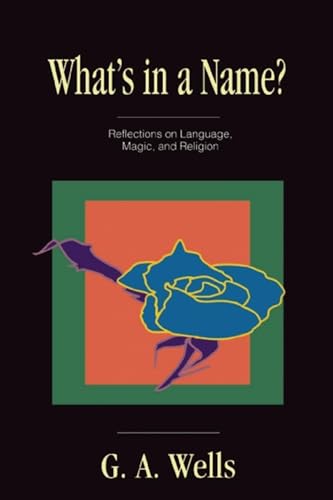
Wells identifies influential mistakes about language embedded in the empiricist philosophical tradition of Locke, Russell and Ayer. He shows how these errors stimulated a religious backlash, in which faith became coupled with commonsense realism. He also covers behaviourism and magical thinking.
"synopsis" may belong to another edition of this title.
Search results for What's in a Name?: Reflections on Language, Magic,...

Stock Image
What's in a Name?
Seller: ThriftBooks-Atlanta, AUSTELL, GA, U.S.A.
Seller rating 5 out of 5 stars

Paperback. Condition: Very Good. No Jacket. May have limited writing in cover pages. Pages are unmarked. ~ ThriftBooks: Read More, Spend Less. Seller Inventory # G081269239XI4N00
Stock Image
What's in a Name?: Reflections on Language, Magic, and Religion
Seller: Midtown Scholar Bookstore, Harrisburg, PA, U.S.A.
Seller rating 5 out of 5 stars
Paperback. Condition: Good. Good - Bumped and creased book with tears to the extremities, but not affecting the text block, may have remainder mark or previous owner's name - GOOD Standard-sized. Seller Inventory # M081269239XZ3
Stock Image
What's in A Name? Reflections On Language, Magic, And Religion.
Published by
Open Court. 1993., 1993
ISBN 10: 081269239X
ISBN 13: 9780812692396
Used
Softcover
First Edition
Seller: Tacoma Book Center, Tacoma, WA, U.S.A.
Seller rating 4 out of 5 stars

ISBN 0-8126-9239-X. Trade Paperback. First Printing. Tight sound unmarked copy in Very Good condition with minor edge wear. Seller Inventory # 125157
Seller Image
What's in a Name? : Reflections on Language, Magic, and Religion
Seller: GreatBookPrices, Columbia, MD, U.S.A.
Seller rating 5 out of 5 stars
Condition: New. Seller Inventory # 2021484-n
Stock Image
Whats in a Name?: Reflections on Language, Magic, and Religion
Seller: Lakeside Books, Benton Harbor, MI, U.S.A.
Seller rating 5 out of 5 stars
Condition: New. Brand New! Not Overstocks or Low Quality Book Club Editions! Direct From the Publisher! We're not a giant, faceless warehouse organization! We're a small town bookstore that loves books and loves it's customers! Buy from Lakeside Books! Seller Inventory # OTF-9780812692396
Stock Image
What's in a Name?: Reflections on Language, Magic, and Religion
Seller: California Books, Miami, FL, U.S.A.
Seller rating 5 out of 5 stars
Condition: New. Seller Inventory # I-9780812692396
Seller Image
What's in a Name?
Published by
Open Court Publishing Co ,U.S., US, 1993
ISBN 10: 081269239X
ISBN 13: 9780812692396
New
Paperback
Seller: Rarewaves USA, HEBRON, KY, U.S.A.
Seller rating 5 out of 5 stars
Paperback. Condition: New. We may smile to be told that, in some cultures, the eating of timid or ugly animals is believed to make the eater timid or ugly. Yet, equally fundamental misunderstandings of the relations between things, words and ideas are rife among Western thinkers. In this provocative essay, G.A. Wells identifies some influential mistakes about language embedded in the empiricist philosophical tradition of Locke, Russell and Ayer. Wells shows how these errors stimulated a religious backlash, in which faith became coupled with commonsense realism, in such writers as Keith Ward, Teilhard de Chardin and Thomas Altizer. Similar misconceptions gave rise both to the behaviourism of Watson and Ryle, and to the anti-behaviourist Chomskyan reaction with its chimera of a "universal grammar". Magical thinking, the writer claims, derives from plausible errors concerning the efficacy of gestures and words, and survives even though these errors have been refuted. Wells illustrates the influence of misconceptions about language as they manifest themselves in contemporary religious apologetics. Seller Inventory # LU-9780812692396
Seller Image
What's in a Name? : Reflections on Language, Magic, and Religion
Seller: GreatBookPrices, Columbia, MD, U.S.A.
Seller rating 5 out of 5 stars
Condition: As New. Unread book in perfect condition. Seller Inventory # 2021484
Stock Image
What's in a Name?
Seller: PBShop.store US, Wood Dale, IL, U.S.A.
Seller rating 5 out of 5 stars
PAP. Condition: New. New Book. Shipped from UK. Established seller since 2000. Seller Inventory # CX-9780812692396
Stock Image
Language, Magic and Religion by Wells, G.A. ( Author ) ON Sep-23-2003, Paperback
Published by
Open Court Publishing Co ,U.S. 2003-09-23, 2003
ISBN 10: 081269239X
ISBN 13: 9780812692396
New
Paperback
Seller: Chiron Media, Wallingford, United Kingdom
Seller rating 5 out of 5 stars
Paperback. Condition: New. Brand new book, sourced directly from publisher. Dispatch time is 6-7 days from our warehouse. Book will be sent in robust, secure packaging to ensure it reaches you securely. Seller Inventory # 6666-IUK-9780812692396
Buy New
US$ 24.10
US$ 6.59 shipping
Ships from United Kingdom to U.S.A.
Ships from United Kingdom to U.S.A.
Quantity: Over 20 available