
Items related to The Martinsville Seven: Race, Rape, and Capital Punishment...
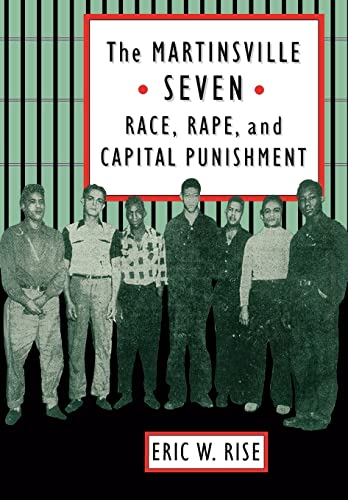
The Martinsville Seven: Race, Rape, and Capital Punishment (Constitutionalism and Democracy) - Hardcover
Synopsis
This book offers the first comprehensive treatment of the case of the Martinsville Seven, a group of young black men executed in 1951 for the rape of a white woman in Martinsville, Virginia. Covering every aspect of the proceedings from the commission of the crime through two appeals, Eric W. Rise reexamines common assumptions about the administration of justice in the South. Although the defendants confessed to the crime, racial prejudice undeniably contributed to their eventual executions. Rise highlights the efforts of the attorneys who, rather than focusing on procedural errors, directly attacked the discriminatory application of the death penalty. The Martinsville Seven case was the first instance in which statistical evidence was used to prove systematic discrimination against blacks in capital cases.
"synopsis" may belong to another edition of this title.
About the Author
Eric W. Rise is Assistant Professor of Sociology and Criminal Justice at the University of Delaware.
From the Back Cover
In January 1949 a thirty-two-year-old white woman in Martinsville, Virginia, accused seven young black men of raping her. Within two days state and local police had rounded up all the suspects and extracted confessions from them. In a series of trials that lasted eleven days, all were found guilty and sentenced to death - a sentence that was carried out, amid a storm of protest from civil-rights advocates and death-penalty opponents, in February 1951. Here is the first comprehensive treatment of the Martinsville case. Covering every aspect of the proceedings, from the commission of the crime through two sets of appeals, Eric Rise reexamines common assumptions about the administration of justice in the South. Although racial prejudice undeniably contributed to the outcome of the case, so did concerns for due process, crime control, community stability, judicial restraint, and domestic security. The success of the due process campaign by groups such as the NAACP helped curb the most egregious abuses of authority, but it did little to help defendants who conceded their guilt but protested unusually severe sentences. The author focuses on the efforts of the attorneys for the Martinsville Seven, who, rather than citing procedural errors, directly attacked the discriminatory application of the death penalty. It was the first case in which statistical evidence was used to substantiate systematic discrimination against blacks in capital cases.
Reviews
This is a careful exposition of a notorious Virginia case that led to the 1951 electrocution of seven young black men convicted of raping a white woman. Rise, who teaches sociology and criminal justice at the University of Delaware, first sketches the Jan. 8, 1949, attack of Ruby Floyd in a black neighborhood in the western Virginia town of Martinsville. The black community, he notes, was shocked not by the convictions but by the death sentences. The NAACP and a discomfiting rival, the left-wing Civil Rights Congress, campaigned against the convictions. The author charges that the judicial system, which rejected several appeals, ignored the climate of "hostility and prejudice" against the defendants, valuing social order over due process. Most important, the appeals marked the NAACP's first attempt to use equal-protection arguments (previously cited in desegregation cases) to challenge racially disparate sentences. Such arguments persist today. Photos.
Copyright 1995 Reed Business Information, Inc.
"About this title" may belong to another edition of this title.
Search results for The Martinsville Seven: Race, Rape, and Capital Punishment...

Stock Image
Martinsville Seven: Race, Rape, and Capital Punishment
Published by
University of Virginia Press, Charlottesville, 1995
ISBN 10: 0813915678
ISBN 13: 9780813915678
Used
Hardcover
Seller: Magers and Quinn Booksellers, Minneapolis, MN, U.S.A.
Seller rating 5 out of 5 stars

hardcover. Condition: Very Good. May have light to moderate shelf wear and/or a remainder mark. Complete. Clean pages. Seller Inventory # 1565607
Seller Image
The Martinsville Seven: Race, Rape, and Capital Punishment
Published by
University Press of Virginia, 1995
ISBN 10: 0813915678
ISBN 13: 9780813915678
Used
Hardcover
First Edition
Seller: Chamblin Bookmine, Jacksonville, FL, U.S.A.
Seller rating 5 out of 5 stars
Hardcover. 8vo. Condition: Near fine. Dust Jacket Condition: Near fine. 1st edition. 216p. Crisp, white pages unmarked. Brown woven cloth covered boards remain clean, pointed and firmly bound to a white titled spine. Dust jacket is unclipped with minor wrinkling to rear panel. Seller Inventory # 75115
Seller Image
MARTINSVILLE 7
Seller: moluna, Greven, Germany
Seller rating 5 out of 5 stars
Gebunden. Condition: New. Seller Inventory # 898793189
Buy New
US$ 84.84
US$ 55.06 shipping
Ships from Germany to U.S.A.
Ships from Germany to U.S.A.
Quantity: Over 20 available
Stock Image
The Martinsville Seven : Race, Rape and Capital Punishment
Published by
University Of Virginia Press Mai 1995, 1995
ISBN 10: 0813915678
ISBN 13: 9780813915678
New
Hardcover
Seller: AHA-BUCH GmbH, Einbeck, Germany
Seller rating 5 out of 5 stars
Buch. Condition: Neu. Neuware. Seller Inventory # 9780813915678
Buy New
US$ 115.02
US$ 39.34 shipping
Ships from Germany to U.S.A.
Ships from Germany to U.S.A.
Quantity: 2 available
Stock Image
The Martinsville Seven: Race, Rape, and Capital Punishment (Constitutionalism and Democracy)
Published by
University of Virginia Press, 1995
ISBN 10: 0813915678
ISBN 13: 9780813915678
New
Hardcover
Seller: SHIMEDIA, Brooklyn, NY, U.S.A.
Seller rating 4 out of 5 stars

Condition: New. Satisfaction Guaranteed or your money back. Seller Inventory # 0813915678