
Items related to Defining the Family: Law, Technology, and Reproduction...
Synopsis
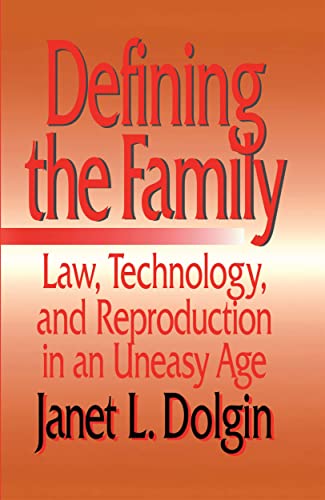
Defining the Family: Law, Technology, and Reproduction in an Uneasy Age provides a sweeping portrait of the family in American law from the nineteenth century to the present. The family today has come to be defined by individuality and choice. Pre-nuptial agreements, non-marital cohabitation, gay and lesbian marriages have all profoundly altered our ideas about marriage and family. In the last few years, reproductive technology and surrogacy have accelerated this process of change at a breathtaking rate. Once simple questions have taken on a dizzying complexity: Who are the real parents of a child? What are the relationships and responsibilities between a child, the woman who carried it to term, and the egg donor? Between viable sperm and the wife of a dead donor?
The courts and the law have been wildly inconsistent and indecisive when grappling with these questions. Should these cases be decided in light of laws governing contracts and property? Or it is more appropriate to act in the best interests of the child, even if that child is unborn, or even unconceived? No longer merely settling disputes among family members, the law is now seeing its own role expand, to the point where it is asked to regulate situations unprecedented in human history. Janet L. Dolgin charts the response of the law to modern reproductive technology both as it transforms our image of the family and is itself transformed by the tide of social forces.
"synopsis" may belong to another edition of this title.
About the Author
Janet L. Dolgin is the Maurice A. Deane Distinguished Professor of Constitutional Law at Hofstra University School of Law in New York.
From the Back Cover
Today, the family has come to be defined by individuality and choice. Once simple questions have taken on a dizzying complexity: Who are the "real" parents of a child? What are the relationships and responsibilities between a child, the woman who carried it to term, and the egg donor? Between the child and the sperm donor? Between viable sperm and the wife of a dead donor? The courts and the law have been wildly inconsistent and indecisive when grappling with these questions. Should these cases be decided in light of laws governing contracts and property? Or is it more appropriate to act in the best interests of the child, even if that "child" is unborn, or even unconceived? No longer merely settling disputes between family members, the law is now seeing its own role expand, to the point where it is asked to regulate situations unprecedented in human history. Defining the Family: Law, Technology, and Reproduction in an Uneasy Age provides a sweeping portrait of the family in American law from the nineteenth century to the present. Janet Dolgin charts the response of the law to modern reproductive technology as it both transforms our image of the family and is itself transformed by the tide of social forces.
"About this title" may belong to another edition of this title.
Search results for Defining the Family: Law, Technology, and Reproduction...

Stock Image
Defining the Family: Law, Technology, and Reproduction in An Uneasy Age
Seller: BooksRun, Philadelphia, PA, U.S.A.
Seller rating 5 out of 5 stars

Hardcover. Condition: Fair. With dust jacket. The item might be beaten up but readable. May contain markings or highlighting, as well as stains, bent corners, or any other major defect, but the text is not obscured in any way. Seller Inventory # 0814718590-7-1-29
Seller Image
Defining the Family: Law, Technology, and Reproduction in An Uneasy Age
Seller: Gate City Books, GREENSBORO, NC, U.S.A.
Seller rating 5 out of 5 stars
Condition: good. USED book in GOOD condition. Great binding, pages and cover show normal signs of wear from use. Seller Inventory # GCM.X5I
Stock Image
Defining the Family : Law, Technology, and Reproduction in an Uneasy Age
Published by
New York University Press, 1997
ISBN 10: 0814718590
ISBN 13: 9780814718599
Used
Hardcover
Seller: Better World Books, Mishawaka, IN, U.S.A.
Seller rating 5 out of 5 stars
Condition: Good. Former library copy. Pages intact with minimal writing/highlighting. The binding may be loose and creased. Dust jackets/supplements are not included. Includes library markings. Stock photo provided. Product includes identifying sticker. Better World Books: Buy Books. Do Good. Seller Inventory # 2523568-6
Seller Image
Defining the Family: Law, Technology, and Reproduction in An Uneasy Age
Seller: -OnTimeBooks-, Phoenix, AZ, U.S.A.
Seller rating 5 out of 5 stars
Condition: good. A copy that has been read, remains in good condition. All pages are intact, and the cover is intact. The spine and cover show signs of wear. Pages can include notes and highlighting and show signs of wear, and the copy can include "From the library of" labels or previous owner inscriptions. 100% GUARANTEE! Shipped with delivery confirmation, if you're not satisfied with purchase please return item! Ships via media mail. Seller Inventory # OTV.0814718590.G
Seller Image
Defining the Family: Law, Technology, and Reproduction in An Uneasy Age
Published by
NYU Press, NY, 1997
ISBN 10: 0814718590
ISBN 13: 9780814718599
Used
Hardcover
First Edition
Signed
Seller: Sekkes Consultants, North Dighton, MA, U.S.A.
Seller rating 5 out of 5 stars
Hardcover. Condition: fine. Dust Jacket Condition: fine. First edition. Defining the Family: Law, Technology, and Reproduction in an Uneasy Age provides a sweeping portrait of the family in American law from the nineteenth century to the present. The family today has come to be defined by individuality and choice. Pre-nuptial agreements, non-marital cohabitation, gay and lesbian marriages have all profoundly altered our ideas about marriage and family. In the last few years, reproductive technology and surrogacy have accelerated this process of change at a breathtaking rate. Presentation to Boston University professor and bibliophile, Sam Stern and his wife Doris. First printing in fine condition. Inscribed by author. book. Seller Inventory # 274619
Stock Image
Defining the Family
Published by
MI - New York University, 1997
ISBN 10: 0814718590
ISBN 13: 9780814718599
New
Hardcover
Seller: PBShop.store UK, Fairford, GLOS, United Kingdom
Seller rating 5 out of 5 stars
HRD. Condition: New. New Book. Delivered from our UK warehouse in 4 to 14 business days. THIS BOOK IS PRINTED ON DEMAND. Established seller since 2000. Seller Inventory # L1-9780814718599
Buy New
US$ 135.60
US$ 6.72 shipping
Ships from United Kingdom to U.S.A.
Ships from United Kingdom to U.S.A.
Quantity: Over 20 available
Seller Image
Defining the Family
Published by
New York University Press, US, 1997
ISBN 10: 0814718590
ISBN 13: 9780814718599
New
Hardcover
Seller: Rarewaves USA, HEBRON, KY, U.S.A.
Seller rating 5 out of 5 stars
Hardback. Condition: New. Defining the Family: Law, Technology, and Reproduction in an Uneasy Age provides a sweeping portrait of the family in American law from the nineteenth century to the present. The family today has come to be defined by individuality and choice. Pre-nuptial agreements, non-marital cohabitation, gay and lesbian marriages have all profoundly altered our ideas about marriage and family. In the last few years, reproductive technology and surrogacy have accelerated this process of change at a breathtaking rate. Once simple questions have taken on a dizzying complexity: Who are the real parents of a child? What are the relationships and responsibilities between a child, the woman who carried it to term, and the egg donor? Between viable sperm and the wife of a dead donor? The courts and the law have been wildly inconsistent and indecisive when grappling with these questions. Should these cases be decided in light of laws governing contracts and property? Or it is more appropriate to act in the best interests of the child, even if that child is unborn, or even unconceived? No longer merely settling disputes among family members, the law is now seeing its own role expand, to the point where it is asked to regulate situations unprecedented in human history. Janet L. Dolgin charts the response of the law to modern reproductive technology both as it transforms our image of the family and is itself transformed by the tide of social forces. Seller Inventory # LU-9780814718599
Stock Image
Defining the Family: Law, Technology, and Reproduction in An Uneasy Age
Published by
New York University Press, 1997
ISBN 10: 0814718590
ISBN 13: 9780814718599
Used
Hardcover
Seller: Anybook.com, Lincoln, United Kingdom
Seller rating 5 out of 5 stars
Condition: Good. This is an ex-library book and may have the usual library/used-book markings inside.This book has hardback covers. In good all round condition. No dust jacket. Please note the Image in this listing is a stock photo and may not match the covers of the actual item,600grams, ISBN:0814718590. Seller Inventory # 5786300
Buy Used
US$ 116.03
US$ 42.78 shipping
Ships from United Kingdom to U.S.A.
Ships from United Kingdom to U.S.A.
Quantity: 1 available
Stock Image
Defining the Family: Law, Technology, and Reproduction in an Uneasy Age
Published by
New York University Press, 1997
ISBN 10: 0814718590
ISBN 13: 9780814718599
New
Hardcover
Seller: Kennys Bookshop and Art Galleries Ltd., Galway, GY, Ireland
Seller rating 5 out of 5 stars
Condition: New. Seller Inventory # V9780814718599
Buy New
US$ 151.12
US$ 10.64 shipping
Ships from Ireland to U.S.A.
Ships from Ireland to U.S.A.
Quantity: Over 20 available
Stock Image
Defining the Family: Law, Technology, and Reproduction in An Uneasy Age
Seller: Ria Christie Collections, Uxbridge, United Kingdom
Seller rating 5 out of 5 stars
Condition: New. In English. Seller Inventory # ria9780814718599_new
Buy New
US$ 146.97
US$ 15.10 shipping
Ships from United Kingdom to U.S.A.
Ships from United Kingdom to U.S.A.
Quantity: Over 20 available