
Items related to Latin Names Explained: A Guide to the Scientific Classificat...
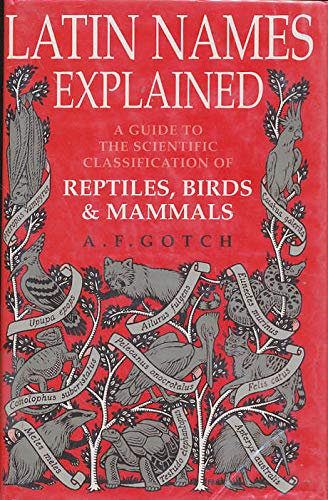
Latin Names Explained: A Guide to the Scientific Classification of Reptiles, Birds and Mammals - Hardcover
Synopsis
Describes the meanings of the Latin names of over 4,000 individual species, and gives a translation of the Latin name
"synopsis" may belong to another edition of this title.
Reviews
Until now, there has been no one book that provided information about the origins of both the common and the Latin names of animals. Birders have many sources, an example being the Dictionary of Scientific Bird Names by James A. Jobling (Oxford, 1991), but other disciplines are not as fortunate. After doing much research, Gotch has brought together in one volume the common and Latin names of some 4,000 species of reptiles, birds, and mammals.
The first part of the book is a brief historical account of how the animal kingdom is divided into phyla, classes, orders, families, genera, and species. The following three parts cover the orders of reptiles, birds, and mammals, with each part arranged in its proper scientific sequence. For each entry the common name is listed first in boldface, followed by the Latin name, which is further translated into English showing, in some cases, the relationship to the common name. A brief description of the species is provided, including some information on geographic distribution. For example, the red-breasted sapsucker has the Latin name Sphyrapicus ruber meaning hammer (sphura), woodpecker (picus), and red (ruber). Its name comes from the fact that it drills holes in decidious trees and drinks the sap and eats the insects that are attracted to the sap. There are separate indexes to the common and Latin names for each part of the book. However, the common-name indexes have some inconsistencies. The red-breasted sapsucker is listed only under Sapsucker, Red-breasted, but the spiny anteater is under both Anteater, Spiny and Spiny Anteater. There seems to be no problem with the Latin indexes.
For the layperson and student, this book can help in understanding the names of animals. The descriptions are concise and easy to understand. It is a good general-science reference book for all libraries, interesting to browse for facts and lore about animal names.
"About this title" may belong to another edition of this title.
Search results for Latin Names Explained: A Guide to the Scientific Classificat...

Seller Image
Latin Names Explained: A Guide to the Scientific Classification of Reptiles, Birds and Mammals
Seller: -OnTimeBooks-, Phoenix, AZ, U.S.A.
Seller rating 5 out of 5 stars

Condition: very_good. Gently read. May have name of previous ownership, or ex-library edition. Binding tight; spine straight and smooth, with no creasing; covers clean and crisp. Minimal signs of handling or shelving. 100% GUARANTEE! Shipped with delivery confirmation, if you're not satisfied with purchase please return item! Ships USPS Media Mail. Seller Inventory # OTV.0816033773.VG
Stock Image
Latin Names Explained: A Guide to the Scientific Classification of Reptiles, Birds and Mammals
Seller: HPB-Red, Dallas, TX, U.S.A.
Seller rating 5 out of 5 stars
Hardcover. Condition: Acceptable. Connecting readers with great books since 1972. Used textbooks may not include companion materials such as access codes, etc. May have condition issues including wear and notes/highlighting. We ship orders daily and Customer Service is our top priority! Seller Inventory # S_468785425
Stock Image
Latin Names Explained: A Guide to the Scientific Classification of Reptiles, Birds and Mammals
Seller: HPB-Red, Dallas, TX, U.S.A.
Seller rating 5 out of 5 stars
Hardcover. Condition: Good. Connecting readers with great books since 1972! Used textbooks may not include companion materials such as access codes, etc. May have some wear or writing/highlighting. We ship orders daily and Customer Service is our top priority! Seller Inventory # S_466803222
Stock Image
Latin Names Explained: A Guide to the Scientific Classification of Reptiles, Birds and Mammals
Published by
Facts on File (edition 1st US), 1996
ISBN 10: 0816033773
ISBN 13: 9780816033775
Used
Hardcover
Seller: BooksRun, Philadelphia, PA, U.S.A.
Seller rating 5 out of 5 stars
Hardcover. Condition: Very Good. 1st US. With dust jacket. It's a well-cared-for item that has seen limited use. The item may show minor signs of wear. All the text is legible, with all pages included. It may have slight markings and/or highlighting. Seller Inventory # 0816033773-11-1-29
Stock Image
Latin Names Explained: A Guide to the Scientific Classification of Reptiles, Birds and Mammals
Seller: Books From California, Simi Valley, CA, U.S.A.
Seller rating 4 out of 5 stars

Hardcover. Condition: Good. Seller Inventory # mon0004214938
Stock Image
Latin Names Explained: A Guide to the Scientific Classification of Reptiles, Birds and Mammals
Seller: WorldofBooks, Goring-By-Sea, WS, United Kingdom
Seller rating 5 out of 5 stars
Hardback. Condition: Very Good. The book has been read, but is in excellent condition. Pages are intact and not marred by notes or highlighting. The spine remains undamaged. Seller Inventory # GOR015027005
Buy Used
US$ 66.71
US$ 7.49 shipping
Ships from United Kingdom to U.S.A.
Ships from United Kingdom to U.S.A.
Quantity: 1 available
Stock Image
Latin Names Explained: A Guide to the Scientific Classification of Reptiles, Birds and Mammals
Seller: DeckleEdge LLC, Albuquerque, NM, U.S.A.
Seller rating 5 out of 5 stars
hardcover. Condition: new. Seller Inventory # Shelfdream0816033773