
Items related to Landscape with Human Figure
Synopsis
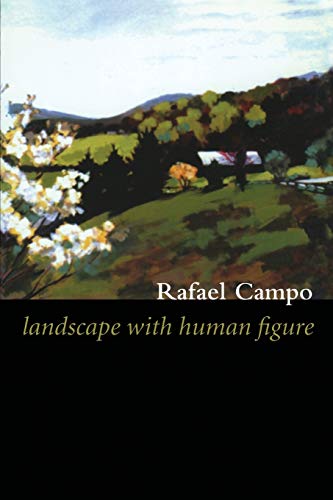
In Landscape with Human Figure, his fourth and most compelling collection of poetry, Rafael Campo confirms his status as one of America’s most important poets. Like his predecessor William Carlos Williams, who was also a physician, Campo plumbs the depths of our capacity for empathy. Campo writes stunning, candid poems from outside the academy, poems that arise with equal beauty from a bleak Boston tenement or a moonlit Spanish plaza, poems that remain unafraid to explore and to celebrate his identity as a doctor and Cuban American gay man. Yet no matter what their unexpected and inspired sources, Campo’s poems insistently remind us of the necessity of poetry itself in our increasingly fractured society; his writing brings us together—just as did the incantations of humankind’s earliest healers—into the warm circle of community and connectedness. In this heart-wrenching, haunting, and ultimately humane work, Rafael Campo has painted as if in blood and breath a gorgeously complex world, in which every one of us can be found.
"synopsis" may belong to another edition of this title.
About the Author
Rafael Campo teaches and practices general internal medicine at Harvard Medical School and Beth Israel Deaconess Medical Center in Boston. He is the recipient of numerous awards and honors, including a John Simon Guggenheim Memorial Fellowship and a Pushcart Prize. His debut collection of poetry, The Other Man Was Me, won the 1993 National Poetry Series award. His second collection, What the Body Told, won a Lambda Literary Award; his third, Diva, was a finalist in 2000 for the National Book Critics Circle Award and the Paterson Poetry Prize (both titles also available from Duke University Press). His work has been published in DoubleTake, the Los Angeles Times, The Nation, The New Republic, The New York Times Magazine, Out, The Progressive, Salon, Slate, and The Washington Post Book World. He is also the author of a collection of essays now available in paperback under the title The Desire to Heal. He lives in Jamaica Plain, Massachusetts.
From the Back Cover
"Rafael Campo is an accomplished formalist. I hugely enjoy watching him skitter from sestina to pantoum, sonnet to rhymed couplets, to say nothing of his own nonce forms devised as the situation suggests."--Maxine Kumin
Reviews
A modern-day poet/M.D. teaching and practicing general internal medicine at Harvard Medical School and Beth Israel Deaconess Medical Center in Boston, Campo writes restless, worldly narrative poems, often rhyming, that take and unapologetically engage the world as it presents itself: "Your back,/ As you leaned over glucose forming bonds/ With oxygen, was broad and strong; your leg/ Was pressing into mine, while all around the college seemed too temporal to beg// the question any longer. Tenting out/ My jeans, my surging, rock-hard cock propelled/ me to your dorm," he writes of his underground self. Campo has garnered a Lambda Literary Award for Diva (1999), which was also an NBCC finalist. When his insouciant, call-them-as-I-seem-them descriptions work, in this fourth collection, they are luminous, addressing the ravages of AIDS, particularly, with care and respect. In "Phone Messages on Call," for instance, each of five sections begins with a shorthand-like phone message such as "Pls call soon. Diarrhea x 2d. PS I have SIDA (AIDS)"; the poems that follow are narrative rhyming couplets that describe the returned call. "Undetectable," a lyric about two lovers, both with AIDS, embeds haunting lyricism in lines such as "Neuropathy,/ lymphoma, rectal warts, plus viral loads/ consistently above 300K." The rhymes and near-rhymes in both poems seem essential. Less vital-seeming are the poems set in Cuba and elsewhere, where the speaker remarks on various devastations, but leaves unchanged. Yet Campo's virtuosity and willingness to put the world in the poems gives this uneven book a real groundedness and depth. (Feb.)Forecast: Campo has appeared on National Public Radio and published poems in the Nation and New York Times Magazine, among other prominent venues. Look for an author tour, a fair number of reviews and short magazine profiles, driven by the medical angle, to push sales.
Copyright 2001 Cahners Business Information, Inc.
Poems in physician-poet Campo's fourth collection (after Diva, a National Book Critics Circle nominee) show how hard it is to sustain a complex, healthy identity, a process ("this act of definition") threatened by inward and outward obstacles imperfections of bodies and mind, excesses of "our flawed humanity borders nature never made." Campo's candid, meditative poetry bears witness ("I want to be/ A witness once again") to "the enormity/ of yearning and of disbelief" in those who live with illness. A Cuban American gay man in "unending exile" (he practices medicine in Boston), Campo writes compelling poems about patients in the ER, probing relationships between doctor and patient, between a patient's case "history" and the cultural mainstream, between an immigrant family and aspirations to study medicine, between sexuality and the restraint of lovers. Not unlike Chekhov, another physician-author, the steady-eyed Campo comes to terms with the darkest of human problems ("the muffled screams/ along a hallway to the absolute") by fusing empathy and clinical accuracy. Strengthened by his hands-on knowledge of healing and suffering and kept gentle by bearing his burdens with grace, Campo asserts that, despite "the harrowed world we are together, we are here to stay." For most poetry collections. Frank Allen, Northampton Community Coll., Tannersville, PA
Copyright 2001 Reed Business Information, Inc.
In The Poetry of Healing (1997), Harvard physician Campo disclosed how writing formal poetry helps him heal the fissures of compound identity as a Cuban, Catholic, gay man as well as a doctor. His actual poems record that healing, better than ever before in this, his fourth collection. Writing in regular meters and rhyme frees the person in the doctor, so greatly that Campo can report on the one hand wanting to give his patients joy as well as prescriptions and on the other that a demented AIDS patient so annoyed him that he wished "he would hurry up and die"--and then the man fervently kissed his hand. He writes candidly and with pictorial clarity and color about love won, matured, alienated, and lost; powerfully about the burden of dark skin in a white society, especially in the sonnet sequence "Afraid of the Dark"; and with satiric bite and rueful sympathy about his people and motherland in "Cuban Canticle in Five Parts." The physician can heal his readers as well as himself. Ray Olson
Copyright © American Library Association. All rights reserved
"About this title" may belong to another edition of this title.
Search results for Landscape with Human Figure

Stock Image
Landscape with Human Figure
Seller: World of Books (was SecondSale), Montgomery, IL, U.S.A.
Seller rating 5 out of 5 stars

Paperback. Condition: Very Good. The latest collection of poetry by Campo. Seller Inventory # 00066711374
Stock Image
Landscape with Human Figure
Seller: ThriftBooks-Dallas, Dallas, TX, U.S.A.
Seller rating 5 out of 5 stars
Paperback. Condition: Good. No Jacket. Pages can have notes/highlighting. Spine may show signs of wear. ~ ThriftBooks: Read More, Spend Less. Seller Inventory # G0822328909I3N00
Stock Image
Landscape with Human Figure
Seller: ThriftBooks-Dallas, Dallas, TX, U.S.A.
Seller rating 5 out of 5 stars
Paperback. Condition: Very Good. No Jacket. May have limited writing in cover pages. Pages are unmarked. ~ ThriftBooks: Read More, Spend Less. Seller Inventory # G0822328909I4N00
Seller Image
Landscape with Human Figure
Seller: -OnTimeBooks-, Phoenix, AZ, U.S.A.
Seller rating 5 out of 5 stars
Condition: very_good. Gently read. May have name of previous ownership, or ex-library edition. Binding tight; spine straight and smooth, with no creasing; covers clean and crisp. Minimal signs of handling or shelving. 100% GUARANTEE! Shipped with delivery confirmation, if you're not satisfied with purchase please return item! Ships USPS Media Mail. Seller Inventory # OTV.0822328909.VG
Stock Image
Landscape with Human Figure
Published by
Duke University Press, 2002
ISBN 10: 0822328909
ISBN 13: 9780822328902
Used
Softcover
Signed
Seller: Wonder Book, Frederick, MD, U.S.A.
Seller rating 5 out of 5 stars
Condition: As New. Signed Copy . Inscribed by author on title page. Seller Inventory # W00B-01455
Stock Image
Landscape with Human Figure
Published by
Duke University Press, 2002
ISBN 10: 0822328909
ISBN 13: 9780822328902
Used
Softcover
First Edition
Seller: Better World Books, Mishawaka, IN, U.S.A.
Seller rating 5 out of 5 stars
Condition: Good. First Edition. Pages intact with minimal writing/highlighting. The binding may be loose and creased. Dust jackets/supplements are not included. Stock photo provided. Product includes identifying sticker. Better World Books: Buy Books. Do Good. Seller Inventory # 9025795-6
Stock Image
Landscape with Human Figure
Published by
Duke University Press Books, 2002
ISBN 10: 0822328909
ISBN 13: 9780822328902
Used
Paperback
Seller: Midtown Scholar Bookstore, Harrisburg, PA, U.S.A.
Seller rating 5 out of 5 stars
Paperback. Condition: Very Good. Very Good - Crisp, clean, unread book with some shelfwear/edgewear, may have a remainder mark - NICE PAPERBACK Standard-sized. Seller Inventory # M0822328909Z2
Stock Image
Landscape with Human Figure
Seller: World of Books Inc, Montgomery, IL, U.S.A.
Seller rating 4 out of 5 stars

Paperback. Condition: Very Good. The latest collection of poetry by Campo. Seller Inventory # CIN0822328909VG
Stock Image
Landscape with Human Figure
Published by
Duke University Press Books, 2002
ISBN 10: 0822328909
ISBN 13: 9780822328902
Used
Paperback
Seller: Midtown Scholar Bookstore, Harrisburg, PA, U.S.A.
Seller rating 5 out of 5 stars
Paperback. Condition: Good. Good - Bumped and creased book with tears to the extremities, but not affecting the text block, may have remainder mark or previous owner's name - GOOD PAPERBACK Standard-sized. Seller Inventory # M0822328909Z3
Stock Image
Landscape with Human Figure
Published by
Duke Univ. Press, Durham, 2002
ISBN 10: 0822328909
ISBN 13: 9780822328902
New
Paperback
Seller: Valley Books, AMHERST, MA, U.S.A.
Seller rating 4 out of 5 stars
Paperback. Condition: New. 88pp. Inscribed by the author to Bill Pritchard, well-known literary critic and book reviewer. Size: 8vo - over 7¾" - 9¾" tall. Seller Inventory # 062137