
Items related to The River Ran Red: Homestead 1892 (Regional)
Synopsis
The violence that erupted at Carnegie Steel's giant Homestead mill near Pittsburgh on July 6. 1892, caused a congressional investigation and trials for treason, motivated a nearly successful assassination attempt on Frick, contributed to the defeat of President Benjamin Harrison for a second term, and changed the course of the American labor movement.
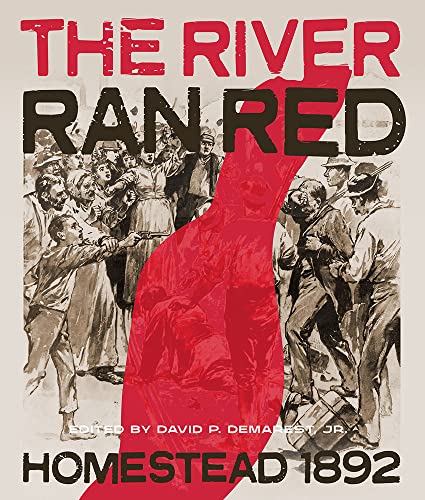
"The River Ran Red" commemorates the one-hundredth anniversary of the Homestead strike of 1892. Instead of retelling the story of the strike, it recreates the events of that summer in excerpts from contemporary newspapers and magazines, reproductions of pen-and-ink sketches and photographs made on the scene, passages from the congressional investigation that resulted from the strike, first-hand accounts by observers and participants, and poems, songs, and sermons from across the country. Contributions by outstanding scholars provide the context for understanding the social and cultural aspects of the strike, as well as its violence.
"The River Ran Red" is the collaboration of a team of writers, archivists, and historians, including Joseph Frazier Wall, who writes of the role of Andrew Carnegie at Homestead, and David Montgomery, who considers the significance of the Homestead Strike for the present. The book is both readable and richly illustrated. It recalls public and personal reactions to an event in our history who's reverberations can still be felt today.
"The River Ran Red" commemorates the one-hundredth anniversary of the Homestead strike of 1892. Instead of retelling the story of the strike, it recreates the events of that summer in excerpts from contemporary newspapers and magazines, reproductions of pen-and-ink sketches and photographs made on the scene, passages from the congressional investigation that resulted from the strike, first-hand accounts by observers and participants, and poems, songs, and sermons from across the country. Contributions by outstanding scholars provide the context for understanding the social and cultural aspects of the strike, as well as its violence.
"The River Ran Red" is the collaboration of a team of writers, archivists, and historians, including Joseph Frazier Wall, who writes of the role of Andrew Carnegie at Homestead, and David Montgomery, who considers the significance of the Homestead Strike for the present. The book is both readable and richly illustrated. It recalls public and personal reactions to an event in our history who's reverberations can still be felt today.
"synopsis" may belong to another edition of this title.
About the Author
David P. Demarest Jr. teaches English at Carnegie Mellon University.
Reviews
July 6, 1992 will mark the 100th anniversary of the most significant labor-management confrontation in U.S. history: the Homestead Strike. In commemoration of this industrial crisis, Demarest (Carnegie-Mellon) and eight coeditors have produced an anthology of events surrounding the conflict. The numerous illustrations include photographs, cartoons, and period engravings. The text, which includes excerpts from magazine and newspaper articles, Congressional testimony, and speeches and memoranda, reveals the viewpoints of some major players: industrialists Andrew Carnegie and Henry Clay Frick, unionist John McLuckie, and anarchists Emma Goldman and Alexander Berkman. Although this anthology contains a wealth of information, it lacks an index to guide the reader to specific material in the text. Recommended for public libraries and for those who wish to read a dramatic portrayal of the Homestead Strike. Krause (Univ. of British Columbia) provides a more scholarly treatment, examining the strike in terms of broader issues confronting the Gilded Age. He focuses on the labor-management disputes of the era, which represented the never-ending "conflict between the pursuit of private interest and the defense of the common good." Individuals like Carnegie amassed material wealth at the expense of common laborers who wanted only decent wages and security for their families. Krause suggests that the Homestead lockout revealed the difficulty of reconciling America's vision of democracy for all with the reality of material progress restricted to a fortunate few. Moreover, the author questions whether this "dilemma" will ever be reconciled. An important contribution to the study of American history; highly recommended for research library collections.
- B.A. Kremer, Johns Hopkins Univ. Libs., Baltimore
Copyright 1992 Reed Business Information, Inc.
"About this title" may belong to another edition of this title.
Search results for The River Ran Red: Homestead 1892 (Regional)

Stock Image
The River Ran Red: Homestead 1892 (Pittsburgh Series in Social & Labor History)
Published by
University of Pittsburgh Press, 1992
ISBN 10: 0822954788
ISBN 13: 9780822954781
Used
Softcover
Seller: Wonder Book, Frederick, MD, U.S.A.
Seller rating 5 out of 5 stars

Condition: Good. Good condition. A copy that has been read but remains intact. May contain markings such as bookplates, stamps, limited notes and highlighting, or a few light stains. Seller Inventory # Y09K-00429
Stock Image
The River Ran Red
Published by
University of Pittsburgh Press, 1992
ISBN 10: 0822954788
ISBN 13: 9780822954781
Used
Paperback
Seller: ThriftBooks-Atlanta, AUSTELL, GA, U.S.A.
Seller rating 5 out of 5 stars
Paperback. Condition: Fair. No Jacket. Readable copy. Pages may have considerable notes/highlighting. ~ ThriftBooks: Read More, Spend Less. Seller Inventory # G0822954788I5N00
Stock Image
The River Ran Red
Published by
University of Pittsburgh Press, 1992
ISBN 10: 0822954788
ISBN 13: 9780822954781
Used
Softcover
Seller: Better World Books: West, Reno, NV, U.S.A.
Seller rating 5 out of 5 stars
Condition: Good. Pages intact with minimal writing/highlighting. The binding may be loose and creased. Dust jackets/supplements are not included. Stock photo provided. Product includes identifying sticker. Better World Books: Buy Books. Do Good. Seller Inventory # 10426975-6
Stock Image
The River Ran Red
Published by
University of Pittsburgh Press, 1992
ISBN 10: 0822954788
ISBN 13: 9780822954781
Used
Softcover
Seller: Better World Books, Mishawaka, IN, U.S.A.
Seller rating 5 out of 5 stars
Condition: Good. Pages intact with minimal writing/highlighting. The binding may be loose and creased. Dust jackets/supplements are not included. Stock photo provided. Product includes identifying sticker. Better World Books: Buy Books. Do Good. Seller Inventory # 10426975-6
Stock Image
The River Ran Red: Homestead 1892 (Regional)
Published by
University of Pittsburgh Press, 1992
ISBN 10: 0822954788
ISBN 13: 9780822954781
Used
paperback
Seller: HPB-Diamond, Dallas, TX, U.S.A.
Seller rating 5 out of 5 stars
paperback. Condition: Very Good. Connecting readers with great books since 1972! Used books may not include companion materials, and may have some shelf wear or limited writing. We ship orders daily and Customer Service is our top priority! Seller Inventory # S_442956240
Stock Image
The River Ran Red (Pittsburgh Series in Social & Labor History)
Published by
University of Pittsburgh Press, 1992
ISBN 10: 0822954788
ISBN 13: 9780822954781
Used
Paperback
Seller: Midtown Scholar Bookstore, Harrisburg, PA, U.S.A.
Seller rating 5 out of 5 stars
Paperback. Condition: Good. Good - Bumped and creased book with tears to the extremities, but not affecting the text block, may have remainder mark or previous owner's name - GOOD Oversized. PAPERBACK. Seller Inventory # M0822954788Z3
Stock Image
The River Ran Red (Pittsburgh Series in Social & Labor History)
Published by
University of Pittsburgh Press, 1992
ISBN 10: 0822954788
ISBN 13: 9780822954781
Used
Paperback
Seller: HPB-Emerald, Dallas, TX, U.S.A.
Seller rating 5 out of 5 stars
Paperback. Condition: Very Good. Connecting readers with great books since 1972! Used books may not include companion materials, and may have some shelf wear or limited writing. We ship orders daily and Customer Service is our top priority! Seller Inventory # S_483031683
Stock Image
River Ran Red
Published by
University of Pittsburgh Press, PIttsburgh, 1992
ISBN 10: 0822954788
ISBN 13: 9780822954781
Used
paperback
Seller: Magers and Quinn Booksellers, Minneapolis, MN, U.S.A.
Seller rating 5 out of 5 stars
paperback. Condition: Very Good. May have light to moderate shelf wear and/or a remainder mark. Complete. Clean pages. Seller Inventory # 1556347
Stock Image
The River Ran Red (Pittsburgh Series in Social and Labor History)
Published by
University of Pittsburgh Press, 1992
ISBN 10: 0822954788
ISBN 13: 9780822954781
Used
paperback
Seller: Books From California, Simi Valley, CA, U.S.A.
Seller rating 4 out of 5 stars

paperback. Condition: Very Good. Seller Inventory # mon0004124573
Stock Image
The River Ran Red (Pittsburgh Series in Social & Labor History)
Published by
University of Pittsburgh Press, 1992
ISBN 10: 0822954788
ISBN 13: 9780822954781
Used
Paperback
Seller: Textbook Bookie, Little Rock, AR, U.S.A.
Seller rating 4 out of 5 stars
Paperback. Condition: Good. Book in Good condition. Seller Inventory # 9780822954781-good