
Items related to How Libraries and Librarians Help: A Guide to Identifying...
Synopsis
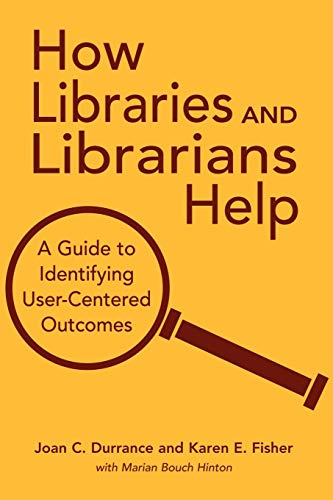
Being able to tell your library's story, illustrating how library services provide value and help the community and users, is the key to your library's future. The practice of measuring outcomes is becoming crucial to the library's ongoing mission: libraries are being called upon to address the value of library programs by assessing their effects on library patrons and the community as a whole. With funding under a National Leadership Grant from the Institute of Museum and Library Services (IMLS), Durrance and Fisher have developed the How Libraries and Librarians Help (HLLH) Outcome Model, field testing it in six libraries over two years. In this practical reference, they share their findings, cutting-edge, step-by-step HLLH methods, and library success stories that bring the process to life with outcomes like, Empowering Youth and Strengthening Community. interpret data with seven easy exercises; Apply the four-step process to assess and present outcomes; Measure and report your library's contributions; Draw together all the pieces to communicate a compelling case for library services; To stay in the game, library directors, administrators, managers, and community leaders must prove the value of the library and its services using outcome measures. Here's how to quantify the contribution of your library's programs to individuals and communities to gain recognition and funding.
"synopsis" may belong to another edition of this title.
Reviews
This how-to-do-it guide both explains how to assess library services and offers practical ways to share experiences and frame the library story. The authors used a National Leadership Grant to develop the How Libraries and Librarians Help (HLLH) Outcomes Model to communicate and measure the impact of library services. It is divided into three parts: "Outcomes," "How to Measure and Predict Outcomes," and "Putting Outcomes to Use," and includes sample outcomes models, a community user survey, and tips on matching outcomes and audiences. The chapter on ways to predict outcomes and examples from people who have used the HLLH model are especially useful. Public libraries need to offer objective evidence of what programs work to underscore how necessary libraries are to peoples' lives, and this practical guide will help. Patricia Hogan
Copyright © American Library Association. All rights reserved
"About this title" may belong to another edition of this title.
Search results for How Libraries and Librarians Help: A Guide to Identifying...

Stock Image
How Libraries and Librarians Help: A Guide to Identifying User-Centered Outcomes
Seller: Orion Tech, Kingwood, TX, U.S.A.
Seller rating 5 out of 5 stars

paperback. Condition: Very Good. Seller Inventory # 0838908926-2-35644437
Stock Image
How Libraries and Librarians Help: A Guide to Identifying User-Centered Outcomes
Seller: Books From California, Simi Valley, CA, U.S.A.
Seller rating 4 out of 5 stars

paperback. Condition: Very Good. Seller Inventory # mon0003983828
Seller Image
How Libraries and Librarians Help A Guide to Identifying User-Centered Outcomes
Published by
American Library Association, 2004
ISBN 10: 0838908926
ISBN 13: 9780838908921
Used
Paperback
Seller: Cloud Runner Books, Minneapolis, MN, U.S.A.
Seller rating 5 out of 5 stars
Paperback. Condition: Very Good. Paperback. Illustrated. Very Good. Note: Ex library copy in excellent condition, having the usual stamps, stickers, and marks. All orders shipped securely in a bubble envelope or box/hard mailer. Seller Inventory # 00034989
Seller Image
How Libraries And Librarians Help : A Guide To Identifying User-Centered Outcomes
Seller: GreatBookPrices, Columbia, MD, U.S.A.
Seller rating 5 out of 5 stars
Condition: New. Seller Inventory # 3422438-n
Seller Image
How Libraries and Librarians Help: A Guide to Identifying User-Centered Outcomes (Paperback or Softback)
Published by
American Library Association 12/1/2004, 2004
ISBN 10: 0838908926
ISBN 13: 9780838908921
New
Paperback or Softback
Seller: BargainBookStores, Grand Rapids, MI, U.S.A.
Seller rating 5 out of 5 stars
Paperback or Softback. Condition: New. How Libraries and Librarians Help: A Guide to Identifying User-Centered Outcomes. Book. Seller Inventory # BBS-9780838908921
Seller Image
How Libraries And Librarians Help : A Guide To Identifying User-Centered Outcomes
Seller: GreatBookPrices, Columbia, MD, U.S.A.
Seller rating 5 out of 5 stars
Condition: As New. Unread book in perfect condition. Seller Inventory # 3422438
Stock Image
How Libraries and Librarians Help: A Guide to Identifying User-Centered Outcomes
Seller: BennettBooksLtd, Los Angeles, CA, U.S.A.
Seller rating 5 out of 5 stars
paperback. Condition: New. In shrink wrap. Looks like an interesting title! Seller Inventory # Q-0838908926
Seller Image
How Libraries And Librarians Help : A Guide To Identifying User-Centered Outcomes
Seller: GreatBookPricesUK, Woodford Green, United Kingdom
Seller rating 5 out of 5 stars
Condition: As New. Unread book in perfect condition. Seller Inventory # 3422438
Buy Used
US$ 72.13
US$ 20.06 shipping
Ships from United Kingdom to U.S.A.
Ships from United Kingdom to U.S.A.
Quantity: Over 20 available
Stock Image
How Libraries and Librarians Help A Guide to Identifying Usercentered Outcomes
Seller: Revaluation Books, Exeter, United Kingdom
Seller rating 5 out of 5 stars
Paperback. Condition: Brand New. 183 pages. 8.75x6.00x0.50 inches. In Stock. Seller Inventory # x-0838908926
Buy New
US$ 82.07
US$ 13.37 shipping
Ships from United Kingdom to U.S.A.
Ships from United Kingdom to U.S.A.
Quantity: 2 available
Seller Image
How Libraries And Librarians Help : A Guide To Identifying User-Centered Outcomes
Seller: GreatBookPricesUK, Woodford Green, United Kingdom
Seller rating 5 out of 5 stars
Condition: New. Seller Inventory # 3422438-n
Buy New
US$ 75.85
US$ 20.06 shipping
Ships from United Kingdom to U.S.A.
Ships from United Kingdom to U.S.A.
Quantity: Over 20 available