
Items related to The Soul Knows No Bars: Inmates Reflect on Life, Death,...
Synopsis
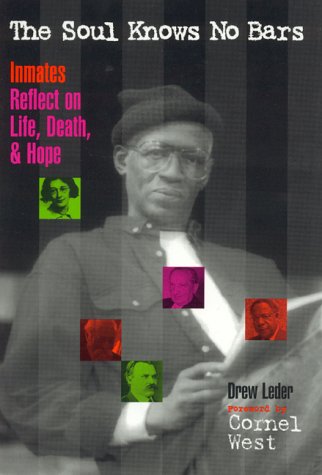
The Soul Knows No Bars compiles all of the authors' reactions to texts by Foucault, Nietzsche, Heidegger, and others.
"synopsis" may belong to another edition of this title.
From the Back Cover
"Revealed in pages of this book are the intelligence, compassion and humanity of both the prisoners and the author...Leder searches for his own soul as the prisoners search for theirs. This book belongs in every classroom and in every home-because as much as it teaches us about the human beings who are incarcerated in America's Archipelago, it teaches us about ourselves."
--Natalie J. Sokoloff, Professor of Sociology
"Drew Leder is a kind of latter-day Socrates...This is philosophy at its best-the courageous love and quest for wisdom that sheds light and enlightens souls in the heart of American darkness."
--Cornel West
"Put a phiosophy professor into a locked room with incarcerated thieves, drug dealers, and murderers, throw in Socrates, Nietzsche, Cornel West and Heidegger - and what do you get? Conversations that will knock your socks off. A book you simply can't put down."
--Sister Helen Prejean, CSJ, author of Dead Man Walking
"A rare gem of a book...[Leder] artfully demonstrates that inmates are not unreachable, inhuman nor incapable of being taught; nor are they uninterested in the profound philosophical tenets of thinkers like Socrates, Nietzsche, and Foucault. Leder forces us to rediscover a truth that our society often forgets.Our prisons are not filled with soulless cast-offs of little or no consequence, but with men and women who hope, feel, desire, bleed, and, most importantly, who think."
--Kweisi Mfume, president and CEO, NAACP
Reviews
Leder (philosophy, Loyola Coll.; Spiritual Passages: Embracing Life's Sacred Journey) considers himself a "Jewish Quaker" with "Hindu beliefs." This eclectic spiritual sensibility led him to study and write about prison life. What results here is a startling revelation about the sophisticated philosophies of a group of inmates from the Maryland State Penitentiary, who discuss race, violence, birth, death, redemption, and the misuse of power with uncanny sensitivity. These convicted thieves, drug dealers, and murderers tackle difficult philosophical and theological issues within the contexts of classical and modern philosophies. In stark contrast to the popular image of criminals, the inmates are keenly aware of moral complexities and responsibilities as well as the price they have to pay for the unspeakable miseries they have caused their victims. They are also aware that poverty, suffering, and injustice provide the breeding grounds for crime. Here, Leder effectively puts a human face on incarcerated criminals without excusing their crimes.
-Chogollah Maroufi, California State Univ., Los Angeles
Copyright 2000 Reed Business Information, Inc.
"About this title" may belong to another edition of this title.
Search results for The Soul Knows No Bars: Inmates Reflect on Life, Death,...

Stock Image
The Soul Knows No Bars: Inmates Reflect on Life, Death, and Hope
Published by
Rowman & Littlefield Publishers (edition ), 1999
ISBN 10: 0847692906
ISBN 13: 9780847692903
Used
Hardcover
Seller: BooksRun, Philadelphia, PA, U.S.A.
Seller rating 5 out of 5 stars

Hardcover. Condition: Fair. With dust jacket. The item might be beaten up but readable. May contain markings or highlighting, as well as stains, bent corners, or any other major defect, but the text is not obscured in any way. Seller Inventory # 0847692906-7-1-29
Stock Image
The Soul Knows No Bars : Inmates Reflect on Life, Death, and Hope
Published by
Rowman & Littlefield Publishers, Incorporated, 1999
ISBN 10: 0847692906
ISBN 13: 9780847692903
Used
Hardcover
Seller: Better World Books, Mishawaka, IN, U.S.A.
Seller rating 5 out of 5 stars
Condition: Good. Former library copy. Pages intact with minimal writing/highlighting. The binding may be loose and creased. Dust jackets/supplements are not included. Includes library markings. Stock photo provided. Product includes identifying sticker. Better World Books: Buy Books. Do Good. Seller Inventory # 3570336-6
Stock Image
The Soul Knows No Bars: Inmates Reflect on Life, Death and Hope
Published by
Rowman & Littlefield Publishers, Inc., 1999
ISBN 10: 0847692906
ISBN 13: 9780847692903
Used
Hardcover
Seller: Wonder Book, Frederick, MD, U.S.A.
Seller rating 5 out of 5 stars
Condition: Good. Good condition. Very Good dust jacket. A copy that has been read but remains intact. May contain markings such as bookplates, stamps, limited notes and highlighting, or a few light stains. Seller Inventory # S07E-01575
Stock Image
The Soul Knows No Bars: Inmates Reflect on Life, Death, and Hope
Published by
Rowman & Littlefield Publishers, 1999
ISBN 10: 0847692906
ISBN 13: 9780847692903
Used
Hardcover
Seller: ThriftBooks-Atlanta, AUSTELL, GA, U.S.A.
Seller rating 5 out of 5 stars
Hardcover. Condition: Very Good. No Jacket. Former library book; May have limited writing in cover pages. Pages are unmarked. ~ ThriftBooks: Read More, Spend Less. Seller Inventory # G0847692906I4N10
Stock Image
The Soul Knows No Bars: Inmates Reflect on Life, Death and Hope
Published by
Rowman & Littlefield Publishers, Inc., 1999
ISBN 10: 0847692906
ISBN 13: 9780847692903
Used
Hardcover
Signed
Seller: Wonder Book, Frederick, MD, U.S.A.
Seller rating 5 out of 5 stars
Condition: Very Good. Signed Copy . Good dust jacket. Inscribed by author on front endpage. Dust jacket price clipped. In protective mylar cover. Seller Inventory # K05OS-00130
Stock Image
The Soul Knows No Bars: Inmates Reflect on Life, Death, and Hope
Published by
Rowman & Littlefield Publishers, 1999
ISBN 10: 0847692906
ISBN 13: 9780847692903
New
Hardcover
Seller: SHIMEDIA, Brooklyn, NY, U.S.A.
Seller rating 4 out of 5 stars

Condition: New. Satisfaction Guaranteed or your money back. Seller Inventory # 0847692906
Stock Image
The Soul Knows No Bars: Inmates Reflect on Life, Death and Hope
Published by
Rowman & Littlefield Publishers, Inc., 1999
ISBN 10: 0847692906
ISBN 13: 9780847692903
New
Hardcover
Seller: BennettBooksLtd, Los Angeles, CA, U.S.A.
Seller rating 5 out of 5 stars
hardcover. Condition: New. In shrink wrap. Looks like an interesting title! Seller Inventory # Q-0847692906