
Items related to Science of Sugar Confectionery (RSC Paperbacks)
Synopsis
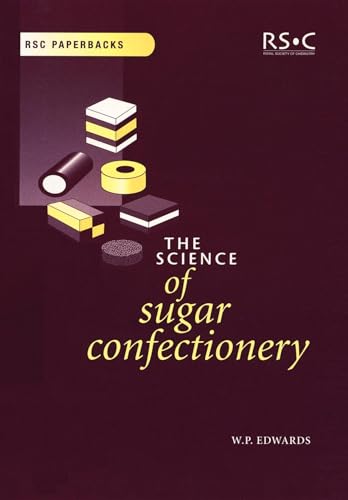
Confectionery is a topic close to many people's hearts and its manufacture involves some interesting science. The confectionery industry is divided into three classes: chocolate, flour and sugar confectionery. It is the background science of this latter category that is covered in The Science of Sugar Confectionery. The manufacture of confectionery is not a science based industry, as these products have traditionally been created by skilled confectioners working empirically. In fact, scientific understanding of the production process has only been acquired retroactively. Historically however, sugar confectionery has had technological synergies with the pharmaceutical industry, such as making sugar tablets and applying panned sugar coatings. This book gives an introduction to the subject, with some basic definitions and commonly used ingredients and then moves on to discuss the chemistry of various types of sugar confectionery. These include "sugar glasses" (boiled sweets), "grained sugar products" (fondants), toffees and fudges, "hydrocolloids" (gums, pastilles and jellies) and concludes with a chapter dedicated to sugar-free confectionery.
"synopsis" may belong to another edition of this title.
Excerpt. © Reprinted by permission. All rights reserved.
The Science of Sugar Confectionery
By W.P. EdwardsThe Royal Society of Chemistry
Copyright © 2000 The Royal Society of Chemistry
All rights reserved.
ISBN: 978-0-85404-593-8All rights reserved.
Contents
Chapter 1 Introduction,
Chapter 2 Basic Science,
Chapter 3 Ingredients,
Chapter 4 Emulsifiers, Colours and Flavours,
Chapter 5 Confectionery Plant,
Chapter 6 Sugar Glasses in the Chemistry of Boiled Sweets,
Chapter 7 Grained Sugar Products,
Chapter 8 Pan Coating,
Chapter 9 Toffees and Caramels,
Chapter 10 Gums, Gelled Products and Liquorice,
Chapter 11 Chewing Gum,
Chapter 12 Aerated Products,
Chapter 13 Sugar-free Confectionery,
Chapter 14 Lozenges,
Chapter 15 Tabletting,
Chapter 16 Experiments,
Chapter 17 The Future,
Subject Index,
CHAPTER 1
Introduction
The confectionery industry divides confectionery into three classes: chocolate confectionery, flour confectionery and sugar confectionery. Chocolate confectionery is obviously things made out of chocolate. Flour confectionery covers items made out of flour. Traditionally, and confusingly, this covers both long life products, such as biscuits, in addition to short-life bakery products. Sugar confectionery covers the rest of confectionery. In spite of the above definition, liquorice, which does contain flour, is considered to be sugar confectionery. The confectionery industry has created many confectionery products that are a mixture of categories, e.g. a flour or sugar confectionery centre that is covered with chocolate. There is another category that is sometimes referred to as 'sugar-free sugar confectionery'. This oxymoron refers to products that resemble sugar confectionery products but which are made without any sugars. The usual reason for making these products is to satisfy special dietary needs. A better name might be 'sugar confectionery analogues'.
The manufacture of confectionery is not a science-based industry. Confectionery products have traditionally been created by skilled craftsman confectioners working empirically, and scientific understanding of confectionery products has been acquired retroactively. Historically, sugar confectionery does have a link with one of the science-based industries – pharmaceuticals. In the eighteenth century, sugar confectionery products were made by pharmacists as pleasant products because the active pharmaceutical products were unpleasant. The two industries continue to share some technology, such as making sugar tablets and applying panned sugar coatings. There are products that although apparently confectionery are legally medicines. This usually applies to cough sweets and similar products. In the United Kingdom these products are regulated under the Medicines Act and require a product licence. This means that all the ingredients for the product are specified and cannot easily be altered. The dividing line between confectionery and medicines is not uniform in all countries.
One reason that confectionery making is not a science-based industry is the very long product life. The Rowntree's fruit pastille was invented in 1879 and was first marketed in 1881. This product is still one of the leading sugar confectionery lines in the UK today (1999), and it appears that it will continue to be sold into the 21st century. The man who invented it, Claud August Gaget, knew nothing of proteins or the peptide bond. In 1879 very little was known about proteins in scientific circles so there was no scientific basis from which to work.
FOOD LAW
Legislation affects all parts of the f
"About this title" may belong to another edition of this title.
Search results for Science of Sugar Confectionery (RSC Paperbacks)

Stock Image
The Science of Sugar Confectionery: 23 (RSC Paperbacks)
Seller: Bahamut Media, Reading, United Kingdom
Seller rating 4 out of 5 stars

Paperback. Condition: Very Good. This book is in very good condition and will be shipped within 24 hours of ordering. The cover may have some limited signs of wear but the pages are clean, intact and the spine remains undamaged. This book has clearly been well maintained and looked after thus far. Money back guarantee if you are not satisfied. See all our books here, order more than 1 book and get discounted shipping. Seller Inventory # 6545-9780854045938
Buy Used
US$ 3.88
US$ 9.24 shipping
Ships from United Kingdom to U.S.A.
Ships from United Kingdom to U.S.A.
Quantity: 2 available
Stock Image
Science of Sugar Confectionery: 23 (RSC Paperbacks)
Published by
Royal Society of Chemistry, 2000
ISBN 10: 0854045937
ISBN 13: 9780854045938
Used
Paperback
Seller: WorldofBooks, Goring-By-Sea, WS, United Kingdom
Seller rating 5 out of 5 stars

Paperback. Condition: Very Good. The book has been read, but is in excellent condition. Pages are intact and not marred by notes or highlighting. The spine remains undamaged. Seller Inventory # GOR005364407
Buy Used
US$ 28.03
US$ 7.41 shipping
Ships from United Kingdom to U.S.A.
Ships from United Kingdom to U.S.A.
Quantity: 1 available
Stock Image
The Science of Sugar Confectionery: 23 (RSC Paperbacks)
Seller: AwesomeBooks, Wallingford, United Kingdom
Seller rating 5 out of 5 stars
Paperback. Condition: Very Good. The Science of Sugar Confectionery: 23 (RSC Paperbacks) This book is in very good condition and will be shipped within 24 hours of ordering. The cover may have some limited signs of wear but the pages are clean, intact and the spine remains undamaged. This book has clearly been well maintained and looked after thus far. Money back guarantee if you are not satisfied. See all our books here, order more than 1 book and get discounted shipping. Seller Inventory # 7719-9780854045938
Buy Used
US$ 30.11
US$ 5.45 shipping
Ships from United Kingdom to U.S.A.
Ships from United Kingdom to U.S.A.
Quantity: 2 available
Stock Image
The Science of Sugar Confectionery
Published by
Royal Society of Chemistry, The, 2000
ISBN 10: 0854045937
ISBN 13: 9780854045938
Used
Paperback
Seller: Barclay Books, York, WA, Australia
Seller rating 5 out of 5 stars
Paperback. Since the first edition of The Science of Sugar Confectionery (2000), the confectionery industry has responded to ever-changing consumer habits. This new edition has been thoroughly revised to reflect industry's response to market driven nutrition and dietary concerns, as well as changes in legislation, labelling, and technology. Building on the strengths of the first edition, the author's personal knowledge and experience of the sugar confectionery industry is used to provide a thorough and accessible account of the field. Written so the reader needs no more than a rudimentary level of chemistry, this book covers the basic definitions, commonly used and new ingredients in the industry. It then discusses the various types of sugar confectionery including "sugar glasses" (boiled sweets), "grained sugar products" (fondants), toffees and fudges, "hydrocolloids" (gums, pastilles and jellies) and concludes with a new chapter on future outlooks. Featuring expanded coverage of special dietary needs, covering topics such as vegetarianism and veganism, religious requirements and supplemented products, this new edition reflects current and evolving needs in the sugar confectionery field. 2000. First edition. A fine, as new, copy. Seller Inventory # 13925266
Buy Used
US$ 28.78
US$ 32.50 shipping
Ships from Australia to U.S.A.
Ships from Australia to U.S.A.
Quantity: 1 available