
Items related to Song Offerings
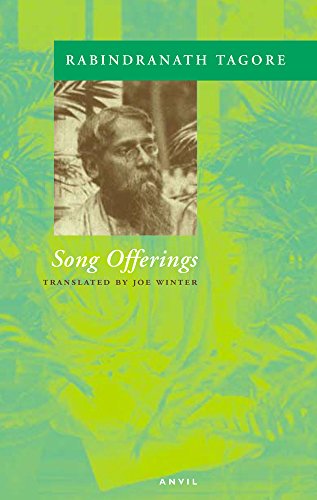
Synopsis
The Bengali poet Rabindranath Tagore (1861-1941) received the Nobel Prize for Literature in 1913 primarily for this work, parts of which he had rendered into the lucid, grave English prose of prayer. Although he wrote over 40 books of poetry, this is the only one whose name is known outside the subcontinent.
Tagore's most famous work deserves to be seen as it appeared in the Bengali - a series of jewels, the whole with the authority virtually of a holy book, and each one a metaphysical delight. Joe Winter's complete translation, the first in English verse, emulates the grandeur and lightness of movement of these wonderful song-poems.
Joe Winter, born in London in 1943, taught English in secondary schools in London from 1967-94. He has contributed regularly to The Statesman. Anvil has also published Guest and Host, his poems of life in Calcutta, and Naked Lonely Hand, his selection of poems by Jibanananda Das. His versions of Tagore’s essays Of Myself (Atmaparichay; co-translated with Devadatta Joardar) and Das’s Bengal the Beautiful are published in 2006.
"synopsis" may belong to another edition of this title.
About the Author
Rabindranath Tagore (1861-1941) became the first non-Westerner to win the Nobel Prize in 1913. Among the writers to have translated his work are Gide, Neruda, Pasternak and Akhmatova. His world tours featured debates with figures as diverse as his friend and admirer Gandhi, Einstein and H.G. Wells. The national anthems of both India and Bangladesh were Tagore's compositions.
Joe Winter, born in London in 1943, taught English until retiring in 1994 and moving to Calcutta. He has published a book of his own poems, Guest and Host, in 2003, as well as his translations of the Bengali poet Jibanananda Das (also published by Anvil).
Joe Winter, born in London in 1943, taught English until retiring in 1994 and moving to Calcutta. He has published a book of his own poems, Guest and Host, in 2003, as well as his translations of the Bengali poet Jibanananda Das (also published by Anvil).
Reviews
Of the 50 books of poems Rabindranath Tagore (1861-1941) wrote in Bengali, Gitanjali, or Song Offerings, may be the most beloved by readers of that language and singers, for Tagore made good on the title and turned them into songs. Tagore's own prose translations of half the book, plus other work, led to his Nobel Prize in 1913; Joe Winter, a London ex-pat now of Calcutta, preserves the original chronological sequence of 157 poems with his rhymed translations the first complete set of translations to appear in English. The rhymes stress many of the poems' images, but having them together overcomes most objections.
Copyright 2001 Cahners Business Information, Inc.
"About this title" may belong to another edition of this title.
Search results for Song Offerings

Stock Image
Song Offerings
Seller: Wonder Book, Frederick, MD, U.S.A.
Seller rating 5 out of 5 stars

Condition: Very Good. Very Good condition. A copy that may have a few cosmetic defects. May also contain light spine creasing or a few markings such as an owner's name, short gifter's inscription or light stamp. Seller Inventory # N21C-03497
Stock Image
Song Offerings
Published by
Carcanet Press, Limited, 2008
ISBN 10: 0856463116
ISBN 13: 9780856463112
Used
Softcover
Seller: Better World Books, Mishawaka, IN, U.S.A.
Seller rating 5 out of 5 stars
Condition: Good. Pages intact with minimal writing/highlighting. The binding may be loose and creased. Dust jackets/supplements are not included. Stock photo provided. Product includes identifying sticker. Better World Books: Buy Books. Do Good. Seller Inventory # 14809036-6
Stock Image
Song Offerings
Seller: ThriftBooks-Dallas, Dallas, TX, U.S.A.
Seller rating 5 out of 5 stars
Paperback. Condition: Very Good. No Jacket. May have limited writing in cover pages. Pages are unmarked. ~ ThriftBooks: Read More, Spend Less. Seller Inventory # G0856463116I4N00
Stock Image
Song Offerings
Seller: The Maryland Book Bank, Baltimore, MD, U.S.A.
Seller rating 5 out of 5 stars
paperback. Condition: Good. Corners are slightly bent. Used - Good. Seller Inventory # 12-Q-2-0265
Stock Image
Song Offerings (Gitanjali)
Seller: WorldofBooks, Goring-By-Sea, WS, United Kingdom
Seller rating 5 out of 5 stars
Paperback. Condition: Very Good. The book has been read, but is in excellent condition. Pages are intact and not marred by notes or highlighting. The spine remains undamaged. Seller Inventory # GOR001590975
Buy Used
US$ 3.34
US$ 7.50 shipping
Ships from United Kingdom to U.S.A.
Ships from United Kingdom to U.S.A.
Quantity: 2 available
Stock Image
Song Offerings
Published by
Carcanet Press, Limited, 2008
ISBN 10: 0856463116
ISBN 13: 9780856463112
Used
Softcover
Seller: Better World Books Ltd, Dunfermline, United Kingdom
Seller rating 5 out of 5 stars
Condition: Good. Pages intact with minimal writing/highlighting. The binding may be loose and creased. Dust jackets/supplements are not included. Stock photo provided. Product includes identifying sticker. Better World Books: Buy Books. Do Good. Seller Inventory # 14809036-6
Buy Used
US$ 6.26
US$ 6.70 shipping
Ships from United Kingdom to U.S.A.
Ships from United Kingdom to U.S.A.
Quantity: 1 available
Stock Image
Song Offerings
Published by
Carcanet Press, Limited, 2008
ISBN 10: 0856463116
ISBN 13: 9780856463112
Used
Softcover
Seller: Better World Books Ltd, Dunfermline, United Kingdom
Seller rating 5 out of 5 stars
Condition: Very Good. Former library copy. Pages intact with possible writing/highlighting. Binding strong with minor wear. Dust jackets/supplements may not be included. Includes library markings. Stock photo provided. Product includes identifying sticker. Better World Books: Buy Books. Do Good. Seller Inventory # GRP63415668
Buy Used
US$ 6.26
US$ 6.70 shipping
Ships from United Kingdom to U.S.A.
Ships from United Kingdom to U.S.A.
Quantity: 1 available
Stock Image
Song Offerings
Published by
Anvil Press Poetry, 2008
ISBN 10: 0856463116
ISBN 13: 9780856463112
Used
Trade Paperback
Seller: Arundel Books, Seattle, WA, U.S.A.
Seller rating 5 out of 5 stars
Trade Paperback. Condition: Very Good. Reprint. 2001 Reprint edition. 8vo. - over 7¾ in. - 9¾ in., 199pp. Mild fading to wrap spine, tight binding, interior text clean. Very Good copy. Seller Inventory # 657797
Stock Image
Song Offerings (Gitanjali)
Published by
Anvil Press Poetry, London, 1998
ISBN 10: 0856463116
ISBN 13: 9780856463112
Used
Paperback
Seller: Chequamegon Books, Washburn, WI, U.S.A.
Seller rating 5 out of 5 stars
Paperback. Condition: Fine. Translated and introduced by Joe Winter. ; 5 1/2 x 8 1/2"; 199 pages. Seller Inventory # 114291
Stock Image
Song Offerings (Gitanjali)
Seller: AproposBooks&Comics, London, United Kingdom
Seller rating 4 out of 5 stars

Soft cover. Condition: Near Fine. Seller Inventory # ABE-1716148338646
Buy Used
US$ 5.45
US$ 20.03 shipping
Ships from United Kingdom to U.S.A.
Ships from United Kingdom to U.S.A.
Quantity: 1 available