
Items related to Women's Rights Versus Women's Rites: A Study...
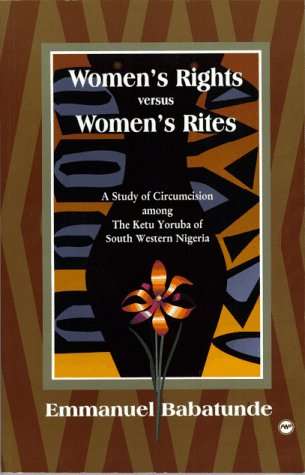
Women's Rights Versus Women's Rites: A Study of Circumcision Among the Ketu Yoruba of South Western Nigeria - Softcover
Synopsis
The outpouring of western concern over the issue of female circumcision offers a case study in how well-intentioned efforts of Americans to improve the lot of oppressed people elsewhere in the world can have precisely the opposite effect. In at least some societies targeted, the practice has increased.
Beginning with a critique of Alice Walker's novel, Possessing the Secret of Joy, the book employs in-depth anthropological study to decipher the cultural logic responsible for female circumcision. The study suggests that in fact the practice continues because traditional culture identifies procreation as the measurement of self-worth and links fertility with circumcision.
"synopsis" may belong to another edition of this title.
About the Author
Emmanuel Babatunde is the director of the honors program at Lincoln University, Pennsylvania, where he teaches anthropology.
From the Back Cover
The outpouring of western concern over the issue of female circumcision offers a case study in how well-intentional efforts of Americans to improve the lot of oppressed people elsewhere in the world can have precisely the opposite effect. In at least some societies targeted, the practice has increased. This book suggests that to end the widespread practice of female circumcision as quickly as possible, the present approach of protest and challenge should go beyond arousing indignation. This approach only creates a siege mentality in societies where female circumcision is still practiced. The feeling that "they are attacking our way of life" has led to communal regrouping as well as a renewed determination that no young female should escape the blade.
Beginning with a critique of Alice Walker's novel, Possessing the Secret of Joy, which epitomizes the method of indignation, the book employs in-depth anthropological study to decipher the cultural logic responsible for female circumcision. It corrects certain anthropological distortions in popular literature about this practice, especially the perception that circumcision is meant to reduce a woman's pleasure in hopes of reducing the possibility of promiscuity. The study suggests that in fact the practice continues because the traditional culture identifies procreation as the measurement of self-worth and links fertility with circumcision.
Excerpt. © Reprinted by permission. All rights reserved.
Introduction - Alice Walker's novel Possessing the Secret of Joy was a monumental masterstroke of timing, content relevance, and suitability...... Walker's story is built around the practice of circumcision demonstrating its horrific consequences on the protagonist-the epitome of the exploited, overly abused female-a character with whom most contemporary women could identify. Ritual circumcision, clitoridectomy and infibulation is practiced in parts of the Horn of Africa and Arabia. In Walker's novel, the protagonist, Tashi, otherwise known as Evelyn, is, the sacrificial lamb who vicariously carries the pain inflicted by man's inhumanity to women in the name of culture for nothing other than the need for control and for domination. Tashi marries Adam, the African-American pastor, and moves to America with him. She becomes mentally unstable because of the pains she has suffered, but suppressed, as a result of losing her sister, Dura, a hemophiliac who died after undergoing the excision. Returning to Africa, Tashi killed M'Lissa, the elderly woman who performed the excision on her sister and on countless other women. Before her execution, Tashi comes to the conclusion that resisting historical brutalization of women amounts to "possessing the secret of joy."
Africa is the land of torture and mutilation. America is the center of healing. The intermediaries, as usual, are the missionaries. This time, however, the missionaries are African-Americans. America is also the land of well-motivated female freedom fighters who must take the battle of liberation to other lands on behalf of all abused women. By choosing to focus on circumcision rather than the more severe infibulation prevalent in some areas of Islamic influence such as in regions around the horn of African and Arabia, sub-Saharan Africa is targeted, identifying it, as usual, as the source of the unsavory while transforming the motivation of this selective attention to one of chivalry, protecting the weakest of the weak. Such is the new image that Africa commands in the present world order, and it comes with a language of derision, a language associated with weakness and falability.
It is this language of derision, this condemnation of "barbarity" that comes through clearly when the exercise (regarded as so "sacred," as many anthropologists discovered during their fieldwork, that one could not discuss it) becomes so disparagingly trivialized in Ms. Walker's hands. Hence, the gory detail intended to shock when she writes: - Abruptly, inside, there was silence: And then I saw M'Lissa shuffle out, dragging her lame leg, and at first I didn't realize she was carrying anything, or it was so insignificant and unclean that she carried it not in her fingers but between her toes. Chicken -a hen, not a cock - was scratching futilely in the dirt between the hut and the tree where the other girls, their own ordeal over, lay. M'Lissa lifted her foot and flung this small object in the direction of the hen, and she, as if waiting for this moment rushed toward M'Lissa upturned foot, ground, and in one quick movement of beak and neck, gobbled it down. (1992,73)
Quite apart from the transformation of hen from an herbivorous to a carnivorous animal, the supposed nonchalance with which the excised part is treated is sickeningly false. The level of barbarity that it conjures is only equal to the offensive language that the slave raiders used to describe Africa, that is, to justify slavery. The practice of genital mutilation will not stop through condemnations of barbarity. It will not stop through patronizing postures intended to export the high sexual tension prevalent in some industrialized areas to traditional areas of the world. Conquest and control are not the prime motivations undergirding interpersonal relations in traditional societies. Rather, complementarity and co-existence are the crucial principles promoting group survival. Culture, traditional or industrialized, must change by accommodating new experiences. When it does not, it slowly dies out. Alice Walker is not the first to write compellingly on the subject of circumcision, and she was swift to recognize this fact. She detailed her gratitude to, among others, Esther Oogunmodede, Nawal El Sadawi, Frank Hosken, Lila Said, Awa Thiam, Gloria Steinem, Fatima Abdul Mahmoud (1992,285). Neither was this piece of literature intended to be a sympathetic presentation along the line of Ngugi wa Thiongo's The River Between. A practice of such barbarity according to Walker's thesis, does not deserve an iota of sympathy. Her work is a piece of social engineering that exploits an abhorrent cultural practice to force the discussion of issues that Alice Walker sees as crucial to the total emancipation of women. In line with this intent, Possessing the Secret of Joy advances new controversial norms.
The brilliance of Walker's novel resides in veiling the promotion of these new cut-edge norms in the cloak of righteous indignation against circumcision, a practice generally seen to be unacceptable, obsolete, exploitative, and downrightly dehumanizing. Ms. Walker sensationalized the horrific to draw attention to the deplorable, while surreptitiously advancing the controversial which she sees as crucial to the dethronement of men from the pedestal that male-oriented structures have placed them. That timely defeat of men should lead to the establishment of that prototypical society in which women are freed of the nuisance of men in general and black men in particular. She selected this strategy solely because of her consummate knowledge of American psychology. It is generous, quick to come to the deliverance of those it considers downtrodden, short in temper, and easily bored. The excitement Possessing the Secrets of Joy generated was even more short-lived in the American psyche in 1992 because of its preoccupation with the ritual of national political elections. It is precisely to keep this discourse on-going that it becomes crucial to dig into the more latent but equally portentous hidden agenda of the book.
"About this title" may belong to another edition of this title.
Search results for Women's Rights Versus Women's Rites: A Study...

Seller Image
Women's Rights Versus Women's Rites: A Study of Circumcision Among the Ketu Yoruba of South Western Nigeria
Seller: -OnTimeBooks-, Phoenix, AZ, U.S.A.
Seller rating 5 out of 5 stars

Condition: good. A copy that has been read, remains in good condition. All pages are intact, and the cover is intact. The spine and cover show signs of wear. Pages can include notes and highlighting and show signs of wear, and the copy can include "From the library of" labels or previous owner inscriptions. 100% GUARANTEE! Shipped with delivery confirmation, if you're not satisfied with purchase please return item! Ships via media mail. Seller Inventory # OTV.0865436266.G