
Items related to The Limits of State Action
Synopsis
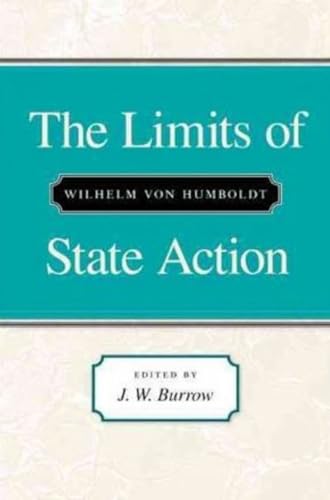
The Limits of State Action has an exuberance and attention to principle that make it a valuable introduction to classical liberal political thought. It is also crucial for an understanding of liberalism as it developed in Europe at the turn of the nineteenth century. Humboldt explores the role that liberty plays in individual development, discusses criteria for permitting the state to limit individual actions, and suggests ways of confining the state to its proper bounds. In so doing, he uniquely combines the ancient concern for human excellence and the modern concern for what has come to be known as negative liberty.
J. W. Burrow is Professor of History at the University of Sussex.
"synopsis" may belong to another edition of this title.
Book Description
This text is important both as one of the most interesting contributions to the liberalism of the German Enlightenment, and as the most significant source for the ideas which John Stuart Mill popularized in his essay On Liberty. Humboldt's concern is to define the criteria by which the permissible limits of the state's activities may be determined.
About the Author
Burrow is professor of European thought at Oxford University and fellow of Balliol College.
"About this title" may belong to another edition of this title.
Search results for The Limits of State Action

Stock Image
Limits of State Action
Seller: World of Books (was SecondSale), Montgomery, IL, U.S.A.
Seller rating 5 out of 5 stars

Paperback. Condition: Fair. 2014 Reprint of 1854 Edition. Full facsimile of the original edition. Not reproduced with Optical Recognition Software. Translated by Joseph Coulthard. According to the author the grand, leading principle, towards which every argument . unfolded in these pages directly converges, is the absolute and essential importance of human development in its richest diversity. This description by Wilhelm von Humboldt of his purpose in writing this classic work animates John Stuart Mill's On Liberty and serves as its famous epigraph. Seldom has a book spoken so dramatically to another writer. Many commentators even believe that Humboldt's discussion of issues of freedom and individual responsibility possesses greater clarity and directness than Mill's. This title, written by Germany's greatest philosopher of freedom, as F. A. Hayek called him, has an exuberance and attention to principle that make it a valuable introduction to classical liberal political thought. It is also crucial for an understanding of liberalism as it developed in Europe at the turn of the nineteenth century. Humboldt explores the role that liberty plays in individual development, discusses criteria for permitting the state to limit individual actions, and suggests ways of confining the state to its proper bounds. In so doing, he uniquely combines the ancient concern for human excellence and the modern concern for what has come to be known as negative liberty. Seller Inventory # CIN0865971099A
Stock Image
Limits of State Action
Seller: World of Books (was SecondSale), Montgomery, IL, U.S.A.
Seller rating 5 out of 5 stars
Paperback. Condition: Good. 2014 Reprint of 1854 Edition. Full facsimile of the original edition. Not reproduced with Optical Recognition Software. Translated by Joseph Coulthard. According to the author the grand, leading principle, towards which every argument . unfolded in these pages directly converges, is the absolute and essential importance of human development in its richest diversity. This description by Wilhelm von Humboldt of his purpose in writing this classic work animates John Stuart Mill's On Liberty and serves as its famous epigraph. Seldom has a book spoken so dramatically to another writer. Many commentators even believe that Humboldt's discussion of issues of freedom and individual responsibility possesses greater clarity and directness than Mill's. This title, written by Germany's greatest philosopher of freedom, as F. A. Hayek called him, has an exuberance and attention to principle that make it a valuable introduction to classical liberal political thought. It is also crucial for an understanding of liberalism as it developed in Europe at the turn of the nineteenth century. Humboldt explores the role that liberty plays in individual development, discusses criteria for permitting the state to limit individual actions, and suggests ways of confining the state to its proper bounds. In so doing, he uniquely combines the ancient concern for human excellence and the modern concern for what has come to be known as negative liberty. Seller Inventory # 00107805064
Stock Image
Limits of State Action, The
Seller: HPB-Diamond, Dallas, TX, U.S.A.
Seller rating 5 out of 5 stars
Paperback. Condition: Very Good. Connecting readers with great books since 1972! Used books may not include companion materials, and may have some shelf wear or limited writing. We ship orders daily and Customer Service is our top priority! Seller Inventory # S_477824729
Stock Image
The Limits of State Action
Seller: Wonder Book, Frederick, MD, U.S.A.
Seller rating 5 out of 5 stars
Condition: Good. Good condition. A copy that has been read but remains intact. May contain markings such as bookplates, stamps, limited notes and highlighting, or a few light stains. Seller Inventory # H08Q-01119
Stock Image
The Limits of State Action
Seller: HPB-Ruby, Dallas, TX, U.S.A.
Seller rating 5 out of 5 stars
paperback. Condition: Very Good. Connecting readers with great books since 1972! Used books may not include companion materials, and may have some shelf wear or limited writing. We ship orders daily and Customer Service is our top priority! Seller Inventory # S_481669306
Stock Image
Limits of State Action
Seller: World of Books Inc, Montgomery, IL, U.S.A.
Seller rating 4 out of 5 stars

Paperback. Condition: Fair. 2014 Reprint of 1854 Edition. Full facsimile of the original edition. Not reproduced with Optical Recognition Software. Translated by Joseph Coulthard. According to the author the grand, leading principle, towards which every argument . unfolded in these pages directly converges, is the absolute and essential importance of human development in its richest diversity. This description by Wilhelm von Humboldt of his purpose in writing this classic work animates John Stuart Mill's On Liberty and serves as its famous epigraph. Seldom has a book spoken so dramatically to another writer. Many commentators even believe that Humboldt's discussion of issues of freedom and individual responsibility possesses greater clarity and directness than Mill's. This title, written by Germany's greatest philosopher of freedom, as F. A. Hayek called him, has an exuberance and attention to principle that make it a valuable introduction to classical liberal political thought. It is also crucial for an understanding of liberalism as it developed in Europe at the turn of the nineteenth century. Humboldt explores the role that liberty plays in individual development, discusses criteria for permitting the state to limit individual actions, and suggests ways of confining the state to its proper bounds. In so doing, he uniquely combines the ancient concern for human excellence and the modern concern for what has come to be known as negative liberty. Seller Inventory # CIN0865971099A
Stock Image
Limits of State Action
Seller: World of Books Inc, Montgomery, IL, U.S.A.
Seller rating 4 out of 5 stars
Paperback. Condition: Good. 2014 Reprint of 1854 Edition. Full facsimile of the original edition. Not reproduced with Optical Recognition Software. Translated by Joseph Coulthard. According to the author the grand, leading principle, towards which every argument . unfolded in these pages directly converges, is the absolute and essential importance of human development in its richest diversity. This description by Wilhelm von Humboldt of his purpose in writing this classic work animates John Stuart Mill's On Liberty and serves as its famous epigraph. Seldom has a book spoken so dramatically to another writer. Many commentators even believe that Humboldt's discussion of issues of freedom and individual responsibility possesses greater clarity and directness than Mill's. This title, written by Germany's greatest philosopher of freedom, as F. A. Hayek called him, has an exuberance and attention to principle that make it a valuable introduction to classical liberal political thought. It is also crucial for an understanding of liberalism as it developed in Europe at the turn of the nineteenth century. Humboldt explores the role that liberty plays in individual development, discusses criteria for permitting the state to limit individual actions, and suggests ways of confining the state to its proper bounds. In so doing, he uniquely combines the ancient concern for human excellence and the modern concern for what has come to be known as negative liberty. Seller Inventory # CIN0865971099G
Stock Image
The Limits of State Action
Seller: ThriftBooks-Dallas, Dallas, TX, U.S.A.
Seller rating 5 out of 5 stars
Paperback. Condition: Good. No Jacket. Pages can have notes/highlighting. Spine may show signs of wear. ~ ThriftBooks: Read More, Spend Less. Seller Inventory # G0865971099I3N00
Stock Image
The Limits of State Action
Seller: ThriftBooks-Atlanta, AUSTELL, GA, U.S.A.
Seller rating 5 out of 5 stars
Paperback. Condition: Very Good. No Jacket. May have limited writing in cover pages. Pages are unmarked. ~ ThriftBooks: Read More, Spend Less. Seller Inventory # G0865971099I4N00
Stock Image
The Limits of State Action
Seller: ThriftBooks-Dallas, Dallas, TX, U.S.A.
Seller rating 5 out of 5 stars
Paperback. Condition: Fair. No Jacket. Readable copy. Pages may have considerable notes/highlighting. ~ ThriftBooks: Read More, Spend Less. Seller Inventory # G0865971099I5N00