
Items related to Business Cycles, Part I (The Collected Works of F....
Business Cycles, Part I (The Collected Works of F. A. Hayek) - Softcover
Book 7 of 18: The Collected Works of F.A. Hayek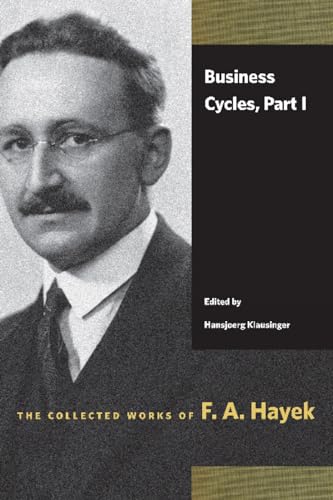
Synopsis
In the years following its publication, F. A. Hayek’s pioneering work on business cycles was regarded as an important challenge to what later became known as Keynesian macroeconomics. Today, as debates rage on over the monetary origins of the current economic and financial crisis, economists are once again paying heed to Hayek’s thoughts on the repercussions of excessive central bank interventions.
Business Cycles, Part I and Business Cycles, Part II bring together Hayek’s work on what causes periods of boom and bust in the economy. Moving away from the classical emphasis on equilibrium, Hayek demonstrates that business cycles are generated by the adaptation of the structure of production to changes in relative demand. Thus, when central banks artificially lower interest rates, the result is a misallocation of capital and the creation of asset bubbles and additional instability. Part I contains his two major monographs on the topic: Monetary Theory and the Trade Cycle and Prices and Production. Part II assembles twelve of his shorter papers on the topic, covering a period from the 1920s to 1981 and revealing the evolution of Hayek’s thought.
In addition to bringing together Hayek’s work on business cycles, these two volumes also include extensive introductions by Hansjoerg Klausinger, placing the writings in intellectual context, including their reception and the theoretical debates to which they contributed.
F. A. Hayek (1899–1992), recipient of the Medal of Freedom in 1991 and co-winner of the Nobel Memorial Prize in Economic Sciences in 1974, was a pioneer in monetary theory and one of the principal proponents of classical liberal thought in the twentieth century. He taught at the London School of Economics, the University of Chicago, and the University of Freiburg.
Hansjoerg Klausinger is Associate Professor in the Department of Economics at WU, Vienna University of Economics and Business.
"synopsis" may belong to another edition of this title.
About the Author
F. A. Hayek (1899 1992), recipient of the Presidential Medal of Freedom in 1991 and cowinner of the Nobel Memorial Prize in Economics in 1974, was a leading proponent of classical liberalismin the twentieth century. Hansjoerg Klausinger is associate professor in the Department of Economics at the Vienna University of Economics and Business Administration."
"About this title" may belong to another edition of this title.
Search results for Business Cycles, Part I (The Collected Works of F....

Seller Image
Business Cycles, Part I (The Collected Works of F. A. Hayek)
Seller: Coas Books, Las Cruces, NM, U.S.A.
Seller rating 5 out of 5 stars

Condition: good. Cover image may vary. Sealed. Paperback. Volume 1. Seller Inventory # COBV.0865979030.G
Seller Image
Business Cycles
Seller: GreatBookPrices, Columbia, MD, U.S.A.
Seller rating 5 out of 5 stars
Condition: New. Seller Inventory # 29568619-n
Seller Image
Business Cycles, Part I (Paperback or Softback)
Published by
Liberty Fund 3/24/2017, 2017
ISBN 10: 0865979030
ISBN 13: 9780865979031
New
Paperback or Softback
Seller: BargainBookStores, Grand Rapids, MI, U.S.A.
Seller rating 5 out of 5 stars
Paperback or Softback. Condition: New. Business Cycles, Part I. Book. Seller Inventory # BBS-9780865979031
Seller Image
Business Cycles
Seller: GreatBookPrices, Columbia, MD, U.S.A.
Seller rating 5 out of 5 stars
Condition: As New. Unread book in perfect condition. Seller Inventory # 29568619
Stock Image
Business Cycles, Part I Format: Paperback
Seller: INDOO, Avenel, NJ, U.S.A.
Seller rating 5 out of 5 stars
Condition: As New. Unread copy in mint condition. Seller Inventory # PG9780865979031
Stock Image
Business Cycles, Part I Format: Paperback
Seller: INDOO, Avenel, NJ, U.S.A.
Seller rating 5 out of 5 stars
Condition: New. Brand New. Seller Inventory # 9780865979031
Seller Image
Business Cycles
Seller: Rarewaves.com USA, London, LONDO, United Kingdom
Seller rating 5 out of 5 stars
Paperback. Condition: New. In the years following its publication, F A Hayeks pioneering work on business cycles was regarded as an important challenge to what was later known as Keynesian macroeconomics. Today, as debates rage on over monetary origins of the current economic and financial crisis, economics are once again paying heed to Hayeks thoughts on the repercussions of excessive central bank interventions. Business Cycles, Part II assembles twelve of Hayeks shorter papers on the topic, ranging from 1920s to 1981, his final word on the subject. They include four previously unpublished works. Seller Inventory # LU-9780865979031
Buy New
US$ 17.54
Free Shipping
Ships from United Kingdom to U.S.A.
Ships from United Kingdom to U.S.A.
Quantity: 4 available
Seller Image
Business Cycles
Seller: Rarewaves USA, HEBRON, KY, U.S.A.
Seller rating 5 out of 5 stars
Paperback. Condition: New. In the years following its publication, F A Hayeks pioneering work on business cycles was regarded as an important challenge to what was later known as Keynesian macroeconomics. Today, as debates rage on over monetary origins of the current economic and financial crisis, economics are once again paying heed to Hayeks thoughts on the repercussions of excessive central bank interventions. Business Cycles, Part II assembles twelve of Hayeks shorter papers on the topic, ranging from 1920s to 1981, his final word on the subject. They include four previously unpublished works. Seller Inventory # LU-9780865979031
Stock Image
Business Cycles (Paperback)
Published by
Liberty Fund Inc, Indianapolis, IN, 2017
ISBN 10: 0865979030
ISBN 13: 9780865979031
New
Paperback
Seller: Grand Eagle Retail, Bensenville, IL, U.S.A.
Seller rating 5 out of 5 stars
Paperback. Condition: new. Paperback. In the years following its publication, F A Hayeks pioneering work on business cycles was regarded as an important challenge to what was later known as Keynesian macroeconomics. Today, as debates rage on over monetary origins of the current economic and financial crisis, economics are once again paying heed to Hayeks thoughts on the repercussions of excessive central bank interventions. Business Cycles, Part II assembles twelve of Hayeks shorter papers on the topic, ranging from 1920s to 1981, his final word on the subject. They include four previously unpublished works. Shipping may be from multiple locations in the US or from the UK, depending on stock availability. Seller Inventory # 9780865979031
Stock Image
Business Cycles: Part I (Collected Works of F. A. Hayek)
Published by
Liberty Fund Inc. (US) 2017-03-01, 2017
ISBN 10: 0865979030
ISBN 13: 9780865979031
New
Paperback
Seller: Chiron Media, Wallingford, United Kingdom
Seller rating 5 out of 5 stars
Paperback. Condition: New. Brand new book, sourced directly from publisher. Dispatch time is 24-48 hours from our warehouse. Book will be sent in robust, secure packaging to ensure it reaches you securely. Seller Inventory # 6666-GRD-9780865979031
Buy New
US$ 14.32
US$ 6.60 shipping
Ships from United Kingdom to U.S.A.
Ships from United Kingdom to U.S.A.
Quantity: 2 available