
Items related to First Language (Juniper Prize for Poetry)
Synopsis
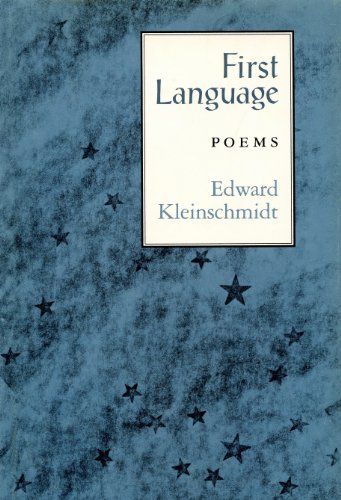
This book is the winner of the 1989 Juniper Prize, the annual poetry award sponsored by the University of Massachusetts Press.
The poems in First Language do what Keats said poems must do: "surprise by a fine excess." Edward Kleinschmidt's words ricochet and deflect on their way to and from the heart. As the title suggests, these poems work from the source, that area of language, memory, and experience behind the operative meaning of words. Kleinschmidt dives into the layered implications of words for their limitless possibilities, to places that even those words had forgotten they had access to. He does so with a playful, astute intelligence and originality. He is the wild card in any deck of contemporary poets.
"synopsis" may belong to another edition of this title.
About the Author
Edward Kleinschmidt's first book of poetry, Magnetism, received the 1988 Poetry Award from the San Francisco Bay Area Book Reviewers Association. The volume was praised in The Massachusetts Review by Paul Jenkins, who wrote: "Kleinschmidt commits himself to an extravagance of wordplay, a wind shear of words, that carries him frequently beyond story and thought into realms of invention that can only be described as inspired. [These poems are] guided not by the logic of storytelling or even of feeling but by the force-field of language itself."
Reviews
The poems in Kleinschmidt's ( Magnetism ) second collection appear novel at first glance, but through repetition come to seem formulaic and coy. "In all / Problems there must be some connection," Kleinschmidt contends, in "Some Problems with the Mind/Body Problem," and similar questions and pronouncements dog his mostly pedestrian oeuvre: "About thinking: when a thought hits you, let it run, / Walk, crawl, stand still, be a thought, itself, whatever," he advises in "Celebrating Thinking." Such prescriptive statements concern what is not , rather than what is , and the poet's persistence in perceiving all in a negative light brings on the superfluous gloom implied in a title such as " 'Nothing Is but What Is Not.' " Surrealism redeems several poems, but when imagery releases readily identifiable emotion too quickly, it becomes horrific, as in "Random Panic in the U.S.A.": "your mother had a black road / where her blood ran. / She gave you random / Thoughts in a basket / For your wedding."
Copyright 1989 Reed Business Information, Inc.
"About this title" may belong to another edition of this title.
Search results for First Language (Juniper Prize for Poetry)

Stock Image
First Language : Poems (Juniper Prize for Poetry)
Published by
University of Massachusetts Press, 1990
ISBN 10: 0870236997
ISBN 13: 9780870236990
Used
Hardcover
First Edition
Seller: Twice-Loved Books, East Palestine, OH, U.S.A.
Seller rating 5 out of 5 stars

Hardcover. Condition: Fine. Dust Jacket Condition: Good. 1st Edition. Sturdy cloth-bound hardcover in Fine condition, with Good only dustjacket. Book itself is essentially flawless. Dustjacket chipped and torn at the top of the spine, moderate edgewear, but jacket is otherwise clean, complete, and intact. The book is quite clean and stain-free, square and straight, very firm and tight in its binding, no pages are loose, torn, folded, creased, or missing. The hinges are sound and undamaged, the corners are sharp and unbumped. All pages are clean and stain free, bright and white, and all text is sharp and legible. There is no writing, underlining, highlighting, or other such markings anywhere in the book. Five-star seller, buy with confidence, professional booksellers for 35 years, selling books online since 1995. B45. Seller Inventory # 019345
Stock Image
First Language (Juniper Prize for Poetry) INSCRIBED to poet Gregory Orr
Published by
University of Massachusetts Press, Amherst, (1990), 1990
ISBN 10: 0870236997
ISBN 13: 9780870236990
Used
Hardcover
First Edition
Signed
Seller: Heartwood Books, A.B.A.A., Charlottesville, VA, U.S.A.
Seller rating 5 out of 5 stars
Cloth. Condition: Good Plus. Dust Jacket Condition: Good Plus. First Edition. INSCRIBED by the author to poet Gregory Orr. Good Plus, internally clean, solid hard cover First Printing with some fading and light spotting to the spin. The Good Plus dust jacket is complete but has a two inch tear and tiny tear. The jacket is foxed on the flaps and on the back side but this is not visible on the front, back or spine of the jacket. Top edge foxed. Signed by Author(s). Seller Inventory # 22085
Seller Image
First Language (Juniper Prize for Poetry)
Published by
University of Massachusetts Press, 1990
ISBN 10: 0870236997
ISBN 13: 9780870236990
Used
Hardcover
Seller: -OnTimeBooks-, Phoenix, AZ, U.S.A.
Seller rating 5 out of 5 stars
Condition: good. A copy that has been read, remains in good condition. All pages are intact, and the cover is intact. The spine and cover show signs of wear. Pages can include notes and highlighting and show signs of wear, and the copy can include "From the library of" labels or previous owner inscriptions. 100% GUARANTEE! Shipped with delivery confirmation, if you're not satisfied with purchase please return item! Ships via media mail. Seller Inventory # OTV.0870236997.G