
Items related to Small Craft Advisory: A Book About the Building of...
Synopsis
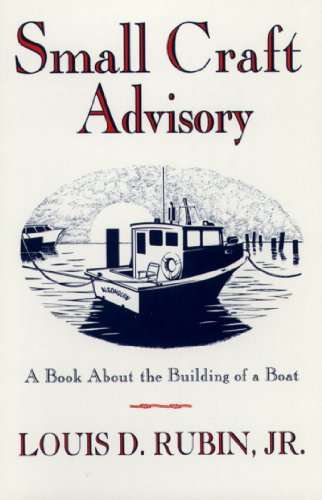
Small Craft Advisory is an enchanting book about Louis Rubin’s obsession with boats and his years of often hilarious boating adventures.
When Louis Rubin was thirteen, he built a leaky little boat and paddled it out to the edge of the ship channel in Charleston, South Carolina, where he felt the inexorable pull of the water. Fifty years and dozens of boats later—sailboats, powerboats, inboards and outboards—the pull is as strong as ever.
In the tradition established by Mark Twain, Joseph Conrad, and Herman Melville, distinguished author and scholar Louis Rubin explores man’s longtime passion for boats. He examines the compulsion that has prompted him and hundreds of thousands of other non-nautical persons to spend so much time, and no small portion of their incomes, on watercraft that they can use only infrequently.
As his new boat (a cabin cruiser made of wood on a workboat hull) is being built, Rubin tells of his past boats and numerous boating disasters and draws a poignant comparison between his two passions: watercraft and the craft of writing.
Anyone who has ever bought and owned a boat—or wondered why people are obsessed by them—will love this amusing, evocative, beautifully crafted memoir by an inveterate boat-owner.
When Louis Rubin was thirteen, he built a leaky little boat and paddled it out to the edge of the ship channel in Charleston, South Carolina, where he felt the inexorable pull of the water. Fifty years and dozens of boats later—sailboats, powerboats, inboards and outboards—the pull is as strong as ever.
In the tradition established by Mark Twain, Joseph Conrad, and Herman Melville, distinguished author and scholar Louis Rubin explores man’s longtime passion for boats. He examines the compulsion that has prompted him and hundreds of thousands of other non-nautical persons to spend so much time, and no small portion of their incomes, on watercraft that they can use only infrequently.
As his new boat (a cabin cruiser made of wood on a workboat hull) is being built, Rubin tells of his past boats and numerous boating disasters and draws a poignant comparison between his two passions: watercraft and the craft of writing.
Anyone who has ever bought and owned a boat—or wondered why people are obsessed by them—will love this amusing, evocative, beautifully crafted memoir by an inveterate boat-owner.
"synopsis" may belong to another edition of this title.
From Kirkus Reviews
From the vantage of his mid-60s, critic, writer, and retired teacher Rubin (The Mockingbird in the Gum Tree, p. 997) offers a pleasantly rambling memoir about his lifelong romance with boats and about the building of what he suspects will be his last one, the wooden-hulled 24-footer Algonquin. As a young boy in Charleston, S.C., who lived on a river near the sea but couldn't swim a stroke, Rubin tacked together his first leaky skiff and tasted the romance of free movement on the water. Rubin never did learn to swim--a failure about which he's got some typically funny and modestly exploratory things to say--but from that time on he was never without a boat, or far from one. Entering retirement, and having gotten his children through college, he's now able to afford a boat that's an end-of-life equivalent of that childhood skiff--a craft at last that he can design and have built exactly the way he wants it. The result is the sturdy and unpretentious Algonquin, modeled after the harbor workboats that infatuated Rubin as a boy, and her construction from keel up (the boat is named for the publishing company of which Rubin is founder, and also for a coastal liner his father once took passage on) gives the author occasion to reminisce about his lifetime of boats before this one, with conversational side trips into books, places, the meaning of boats and travel, and even--by means of bits of family history that make up some of the most readable pages of this readable book--the psychology of risk-taking and the emotional roots of Rubin's constant but often impractical love of water and boats. Though maybe not casting its lines to quite the same historical breadth as Witold Rybczynski's The Most Beautiful House in the World (1989), this offers itself as a worthy and natural companion to that other andante and evocative memoir of the building of something much loved. -- Copyright ©1991, Kirkus Associates, LP. All rights reserved.
From Library Journal
Rubin ( The Mockingbird in the Gum Tree: A Literary Gallimaufry , LJ 9/1/91) is a retired distinguished professor of literature, founder of Algonquin Books of Chapel Hill, and the author of numerous articles and 40 books. He also loves boats, especially unpretentious workboats, and has owned a dozen of them in his 67 years. He built a boat when he was 13, owned many used ones, and finally in 1990 had a new wooden 24-foot boat hand built for him. From his childhood boat to his latest one, the experience of boating has been an act of liberation, an elemental freedom which provides a theme for this memoir. His affection for old or old-style boats provides a noncompetitive counter to the stress and ambition of academic and business life. In describing the building of his boat he is describing the building of his life, reasserting the shaping value of memory and imagination. This gracefully written contemplation should be welcomed even in public libraries far from the sea.
- Roland Person, Southern Illinois Univ. Lib., Carbondale
Copyright 1991 Reed Business Information, Inc.
"About this title" may belong to another edition of this title.
Search results for Small Craft Advisory: A Book About the Building of...

Stock Image
Small Craft Advisory: A Book A
Seller: World of Books (was SecondSale), Montgomery, IL, U.S.A.
Seller rating 5 out of 5 stars

Condition: Good. Item in very good condition! Textbooks may not include supplemental items i.e. CDs, access codes etc. Seller Inventory # 00077579623
Stock Image
Small Craft Advisory: A Book About the Building of a Boat
Seller: World of Books Inc, Montgomery, IL, U.S.A.
Seller rating 4 out of 5 stars

Paperback. Condition: Good. In this volume, the author explores his obsession with boats, and describes his years of often hilarious boating adventures. Seller Inventory # CIN0871135337G
Stock Image
Small Craft Advisory: A Book About the Building of a Boat
Published by
Atlantic Monthly Press (edition 2nd ed.), 1994
ISBN 10: 0871135337
ISBN 13: 9780871135339
Used
Paperback
Seller: BooksRun, Philadelphia, PA, U.S.A.
Seller rating 5 out of 5 stars
Paperback. Condition: Fair. 2nd ed. The item might be beaten up but readable. May contain markings or highlighting, as well as stains, bent corners, or any other major defect, but the text is not obscured in any way. Seller Inventory # 0871135337-7-1
Stock Image
Small Craft Advisory
Seller: ThriftBooks-Dallas, Dallas, TX, U.S.A.
Seller rating 5 out of 5 stars
Paperback. Condition: Very Good. No Jacket. May have limited writing in cover pages. Pages are unmarked. ~ ThriftBooks: Read More, Spend Less. Seller Inventory # G0871135337I4N00
Stock Image
Small Craft Advisory
Seller: ThriftBooks-Atlanta, AUSTELL, GA, U.S.A.
Seller rating 5 out of 5 stars
Paperback. Condition: Good. No Jacket. Pages can have notes/highlighting. Spine may show signs of wear. ~ ThriftBooks: Read More, Spend Less. Seller Inventory # G0871135337I3N00
Stock Image
Small Craft Advisory: A Book About the Building of a Boat
Seller: Wonder Book, Frederick, MD, U.S.A.
Seller rating 5 out of 5 stars
Condition: Good. Good condition. A copy that has been read but remains intact. May contain markings such as bookplates, stamps, limited notes and highlighting, or a few light stains. Seller Inventory # Z09A-03000
Stock Image
Small Craft Advisory : A Book about the Building of a Boat
Published by
Grove/Atlantic, Incorporated, 1994
ISBN 10: 0871135337
ISBN 13: 9780871135339
Used
Softcover
Seller: Better World Books, Mishawaka, IN, U.S.A.
Seller rating 5 out of 5 stars
Condition: Fine. Used book that is in almost brand-new condition. May contain a remainder mark. Better World Books: Buy Books. Do Good. Seller Inventory # 52349561-6
Stock Image
Small Craft Advisory : A Book about the Building of a Boat
Published by
Grove/Atlantic, Incorporated, 1994
ISBN 10: 0871135337
ISBN 13: 9780871135339
Used
Softcover
Seller: Better World Books, Mishawaka, IN, U.S.A.
Seller rating 5 out of 5 stars
Condition: Good. Pages intact with minimal writing/highlighting. The binding may be loose and creased. Dust jackets/supplements are not included. Stock photo provided. Product includes identifying sticker. Better World Books: Buy Books. Do Good. Seller Inventory # 39303666-6
Stock Image
Small Craft Advisory : A Book about the Building of a Boat
Published by
Grove/Atlantic, Incorporated, 1994
ISBN 10: 0871135337
ISBN 13: 9780871135339
Used
Softcover
Seller: Better World Books, Mishawaka, IN, U.S.A.
Seller rating 5 out of 5 stars
Condition: Very Good. Pages intact with possible writing/highlighting. Binding strong with minor wear. Dust jackets/supplements may not be included. Stock photo provided. Product includes identifying sticker. Better World Books: Buy Books. Do Good. Seller Inventory # 54607772-6
Stock Image
Small Craft Advisory: A Book About the Building of a Boat
Seller: HPB-Emerald, Dallas, TX, U.S.A.
Seller rating 5 out of 5 stars
paperback. Condition: Very Good. Connecting readers with great books since 1972! Used books may not include companion materials, and may have some shelf wear or limited writing. We ship orders daily and Customer Service is our top priority! Seller Inventory # S_478259673