
Items related to White Protestant Nation: The Rise of the American Conservati...
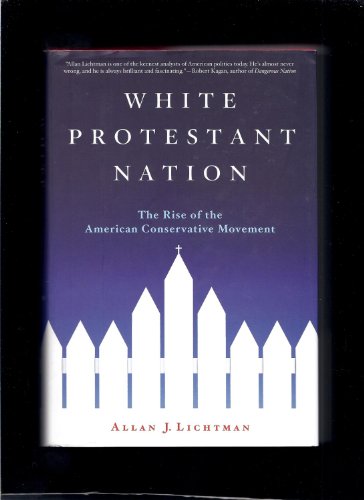
Synopsis
Spanning nearly one hundred years of American political history, and abounding with outsize characters--from Lindbergh to Goldwater to Gingrich to Abramoff-- White Protestant Nation offers a penetrating look at the origins, evolution, and triumph (at times) of modern conservatism. Lichtman is both a professor of political history at American University and a veteran journalist, and after ten years of prodigious research, he has produced what may be the definitive history of the modern conservative movement in America. He brings to life a gallery of dynamic right-wing personalities, from luminaries such as Strom Thurmond, Phyllis Schlafly, and Bill Kristol to indispensable inside operators like financiers Frank Gannett and J. Howard Pew. He explodes the conventional wisdom that modern conservative politics began with Goldwater and instead traces the roots of today’s movement to the 1920s. And he lays bare the tactics that conservatives have used for generations to put their slant on policy and culture; to choke the growth of the liberal state; and to build the most powerful media, fundraising, and intellectual network in the history of representative government. White Protestant Nation is entertaining, provocative, enlightening, and essential reading for anyone who cares about modern American politics and its history.
"synopsis" may belong to another edition of this title.
About the Author
Allan J. Lichtman received his Ph.D. from Harvard University and is a longtime journalist and professor of history at American University in Washington, D.C. He is the author of six other books, including The Keys to the White House.
From the Back Cover
"Allan Lichtman is one the keenest analysts of American politics today. He's almost never wrong, and he is always brilliant and fascinating." --Robert Kagan, author of Dangerous Nation and Of Paradise and Power
"Allan Lichtman has undertaken an important, insightful and timely study, and his well-written report in White Protestant Nation provides true insight into modern conservatism." --John W. Dean, former Nixon White House counsel and author of Pure Goldwater
"Penetrating, detailed, and astute, Allan Lichtman's White Protestant Nation reveals the deep motivations behind modern American conservatism--and in the process shows us why that movement faces political decline despite its power and wealth." --Joe Conason, author of It Can Happen Here
"White Protestant Nation is an absolutely essential chronicle of the rise of the conservative movement. We have read this story in parts, but now Lichtman has brought it together in a compelling and illuminating narrative." --Max Blumenthal, the Nation Institute
"Allan Lichtman's new book breaks important ground. Based on an extraordinary range of archival sources, he reminds us that conservatism is not the recent product of Ronald Reagan or Karl Rove, but is deeply embedded in more than a century of American politics and culture." --Robert Griffith, author of The Politics of Fear: Joseph R. McCarthy and the Senate
"White Protestant Nation is must-reading for every conservative and liberal in America. Lichtman's meticulous research and acute analysis reveals the hidden history of how America's conservative movement rose to power in the twentieth century and why it faces such serious challenges today." --Richard Bond, former chairman of the Republican National Committee
"Impressive . . . Comprehensive . . . With an extraordinary breadth of vision and an impressive grasp of the forces that shape political history, the author examines the many forces underlying modern conservatism and lays out some of the challenges it faces. . . . An important examination of the political, moral, and economic forces that continue to shape the movement." --Kirkus Reviews
"Lichtman profiles the behind-the-scenes operators who have crafted the marching orders for right-wing Americans in the last half-century. . . . As a structural blueprint of conservative political power . . . this book is without peer, giving readers a wonderful historical survey of the last eighty years of conservative politics." --Publishers Weekly
From the Inside Flap
Spanning nearly one hundred years of American political history, and abounding with outsize characters--from Lindbergh to Goldwater to Gingrich to Abramoff--White Protestant Nation offers a penetrating and comprehensive look at the origins, evolution, and triumph (at times) of modern conservatism
In the long-awaited new book from the author of The Keys to the White House--which the Baltimore Sun called "a must book for political junkies" and which remains influential after more than fifteen years in print--Allan J. Lichtman has produced what may be the definitive history of the modern conservative movement in America.
Lichtman is both a professor of political history and a veteran journalist, and he has spent the past ten years combing through more than 150 manuscript collections--confidential memos, internal strategy papers, secret correspondence, and much more--to capture the entire tapestry and trajectory of the conservative movement. He brings to life a gallery of dynamic right-wing personalities, from luminaries such as Strom Thurmond, Billy Graham, Phyllis Schlafly, William F. Buckley Jr., and Bill Kristol to indispensable inside operators like financiers Frank Gannett, J. Howard Pew, and Richard Mellon Scaife. He explodes the conventional wisdom that modern conservative politics began with Goldwater and instead traces the roots of today's movement to the 1920s. He shows how modern conservatism was born out of post-World War I fears that secular, pluralistic, and cosmopolitan forces threatened America's national identity. And he lays bare the tactics that conservatives have used for generations to put their slant on policy and culture; to choke the growth of the liberal state from the New Deal era to the Great Society to the Clinton years; and to build the most powerful network of media, fundraising, and intellectual organizations in the history of representative government.
Ultimately, Lichtman concludes that conservative ideology is grounded not in specific issues such as limited government, low taxes, or free markets--most of which are disposable ideas that the right has been quick to embrace or reject to suit the needs of the moment--but rather in a dual vision of America as a white Protestant nation, and a country whose greatness is driven by private enterprise. He argues that President George W. Bush is the heir to both the strengths and weaknesses of this tradition, and he explores whether Bush is presiding over the demise of the modern conservative movement.
Lively, comprehensive, and built on unprecedented primary research, White Protestant Nation tells the whole story of the modern conservative movement and its place within the big picture of American history. This book is entertaining, provocative, enlightening, and essential reading for anyone who cares about American politics and its history.
Reviews
This comprehensive study of conservative politics from the post-WWI era to the present is replete with clear analysis and good nuggets of information. Lichtman (The Keys of the White House) profiles the behind-the-scenes operators who have crafted the marching orders for right-wing Americans in the last half-century—financiers like J. Howard Pew, Frank Gannett and the Du Ponts, direct-mail kingpin Richard Viguerie and drawing-room conservatives like William F. Buckley and Bill Kristol. Lichtman observes how a clique of probusiness, mainly Protestant, Americans chaffed at the birth of the welfare state under Democratic administrations and built a network of organizations to resist social engineering and encroaching federal power. The book argues that in postwar America, rising fears over immigration, desegregation and sexual egalitarianism gave bloom to an ethic of Anglo-Saxon supremacy—but Lichtman ignores the deep roots such ideas have in American culture. Lichtman also neglects the transformation in the post–civil rights era, when the conservative movement tried to shed its extreme racial and cultural doctrines and began attracting minority voters and politicos. As a structural blueprint of conservative political power, however, this book is without peer, giving readers a wonderful historical survey of the last 80 years of conservative politics. (June)
Copyright © Reed Business Information, a division of Reed Elsevier Inc. All rights reserved.
Excerpt. © Reprinted by permission. All rights reserved.
WHITE PROTESTANT NATION
The Rise of the American Conservative MovementBy Allan J. LichtmanAtlantic Monthly Press
Copyright © 2008 Allan J. LichtmanAll right reserved.
ISBN: 978-0-87113-984-9
Contents
INTRODUCTION....................................................................11 THE BIRTH OF THE MODERN RIGHT, 1920-1928......................................82 CRYING IN THE WILDERNESS, 1929-1936...........................................503 UP FROM THE ASHES, 1936-1945..................................................934 THE BEST AND THE WORST YEARS FOR CONSERVATIVES, 1945-1952.....................1365 STRANGERS IN A MODERN REPUBLICAN LAND, 1952-1960..............................1846 CONSERVATIVES FALL, RISE, AND FALL AGAIN, 1960-1968...........................2327 THE RIGHT REBUILDS IN ADVERSITY, 1969-1976....................................2818 THE REAGAN REVOLUTION, 1977-1984..............................................3309 RESTORING THE CONSERVATIVE CONSENSUS, 1985-2000...............................379EPILOGUE: A CONSERVATIVE IMPLOSION?.............................................436ACKNOWLEDGMENTS.................................................................457APPENDIX........................................................................459NOTES...........................................................................461BIBLIOGRAPHY....................................................................527INDEX...........................................................................561
Chapter One
THE BIRTH OF THE MODERN RIGHT, 1920-1928
In 1920 the three leading Republican candidates for president, U.S. Army General Leonard Wood, Governor Frank Lowden of Illinois, and Senator Hiram Johnson of California, had hopelessly deadlocked the Republican nominating convention that convened in Chicago. Party leaders, purportedly after meeting in a smoke-filled room at the Blackstone Hotel, then turned to an unlikely compromise nominee, Senator Warren Harding of Ohio. In six undistinguished years in the Senate, the reliably conservative Harding had devoted far more energy to golf, poker, and womanizing than to matters of state. His speaking style, said journalist H. L. Mencken, "reminds me of a string of wet sponges." After Harding's nomination on the tenth ballot, the Republican National Committee paid to send his mistress on a world tour. The Republican-leaning New York Times said, "We must go back to Franklin Pierce if we would seek a president who measures down to his [Harding's] stature."
Yet Harding quickly came to embody the sentiments of a conservative electorate in 1920. He promised a "return to normalcy" for Americans tired of liberal reform, war, and waves of Catholic and Jewish immigrants from southern and eastern Europe. He pledged to end "ineffective meddling" by government in business affairs and to govern as an "America First" president, who, mindful of "racial differences" among people, would open the nation's golden door to "only the immigrant who can be assimilated and thoroughly imbued with the American spirit."
The incumbent Democratic president Woodrow Wilson was everything that Harding was not. Wilson was learned and erudite. He was a brilliant writer, an inspiring orator, and a master of statecraft. He had big ideas for leaving his mark on world history. But the future of America in the 1920s belonged to Harding's Republicans, not Wilson's Democrats.
In April 1917, a month after his second inauguration, Wilson led the nation into World War I. The president worried that war would imperil civil liberties and domestic reform and empower reactionary men of business. But he also nurtured plans for shaping a postwar international order based on self-determination, free trade, and collective security as alternatives to "atavistic imperialism and revolutionary socialism." If Wilson achieved these ambitious goals, he would likely become the first American president elected to a third term and establish his Democrats as America's enduring majority party. It didn't work out as planned for the president, the Democratic Party, the nation, or the world.
Modern conservativism took flight in response to the crisis that followed a brutal war and a failed peace. The war unleashed a wave of nationalism at home that brought on the government's repression of dissent and spread civil and racial strife across the nation. America sacrificed 118,000 young men to a savage war that annulled all standards of morality and restraint. Wilson's Democratic coalition first cracked in 1918, when Republicans recaptured the U.S. House and Senate, a week before Armistice Day, and congressional voting moved to the right. Then Wilson's peace plans collapsed amid the base ambitions of Europe's rulers, and bomb-throwing Bolsheviks replaced club-wielding Huns as the shadow falling on civilization. Although the president salvaged his plan for a League of Nations, the Senate rejected the treaty that established the League and Wilson suffered a debilitating stroke, which dashed his hopes for another presidential run. No matter. Failure abroad, social unrest and fears of radical subversion at home, and a postwar recession made 1920 a bad year for any Democratic candidate for president. On Election Day, voters cast their ballots overwhelmingly for a return to peacetime normalcy. Harding won the most decisive popular-vote victory in American history, with 60 percent of the poplar vote to 34 percent for Ohio governor James Cox, whom Democrats had nominated after forty-four ballots at their San Francisco convention.
By the 1920s a gulf had opened between Americans still devoted to a national identity defined by late-nineteenth-century Victorian values and those tied to the increasingly pluralistic cultural forces of the twentieth century. Anti-pluralists joined with leaders of business to forge a new conservative consensus in the 1920s that locked together support for private enterprise and white Protestant cultural values. The conservatives who dominated American politics in the 1920s established most of the enduring ideas and institutions that would ground the modern political right. Taken together, the prohibition of vice, anticommunism, conservative maternalism, evangelical Protestantism, business conservatism, racial science and containment, and the grassroots organizing of the Ku Klux Klan formed a stout defense of America's white Protestant, free enterprise civilization.
PROHIBITION POLITICS
For Wayne B. Wheeler of the Anti-Saloon League, the dark clouds of World War I had the silver lining of encouraging moral reform. "America has just two gigantic foes, kaiserism and the liquor traffic," Wheeler said, and he predicted victory over both these evils. Wheeler was right. In January 1919, two months after the war ended, the states ratified the Eighteenth Amendment prohibiting the manufacture, transport, and sale of alcohol. The successful campaign for prohibition showed that white Protestants, often led by women reformers, could successfully wage a bottom-up battle for their vision of moral conduct and a just society. Anti-alcohol campaigns had for many decades targeted working-class immigrants, most often Catholic, who patronized saloons and vice dens. In the South, prohibitionists argued that rum and whiskey had become symbols of freedom for blacks that led to social disharmony, crime, and the sexual violation of white women by black men.
The Eighteenth Amendment was not the only "prohibition" for conservatives who sought moral renewal after the desolation of total war. By the mid-1920s America's broad program of state-sponsored morality had gained international attention. In 1925, British historian A. F. Pollard cited the United States as "the rising hope of stern and unbending Tories." American laws, he said, "were not so much a means of change as a method of putting on record moral aspirations, a liturgy rather than legislation; and the statutebook was less the fiat of the State than a book of common prayer."
Prewar campaigns against vice and smut had fit comfortably with social reform. But modern conservatives shed commitments to improving housing or abolishing sweatshops. They focused instead on sexual permissiveness in an era of growing leisure time, mobility, privacy, unsupervised youth, assertive women, and defiance of law. The prewar increase in sexual experience before or outside of marriage accelerated during the 1920s. Skirts and bathing suits rose above the knee and popular versions of Freudian psychology proclaimed that sex was healthy and repression harmful. Sexuality paraded openly in the popular culture, while bawdier material fueled the underground trade in pulp novels, lurid memoirs, and pornographic magazines. Society was "assailed on all sides by a million erotic stimuli-in literature, in the theatre, and in life," wrote popular philosopher and historian Will Durant in 1929. "The sexual instinct escaped from the jail in which Puritanism had imprisoned it and ran amuck in the streets."
For conservatives, moral decline afflicted not only America's great cities but also small cities and towns, where journalist Frank R. Kent uncovered a paradox of the Jazz Age. He discovered "the completeness with which all liberal thought has vanished, the astounding degree to which the country has become conservatized" in its politics. But Kent also found "the truly extraordinary extent to which the country is drenched with smut by the steadily increasing stream of pornographic periodicals and dirty fiction magazines." This "great bumper American smut crop," he said, posed "a greater menace to the future than any communistic, socialistic, or Bolshevistic propaganda." However, "the flood of sexual literature caters to a passion impossible to wholly curb or control." An undaunted Nellie B. Miller, literature chair of the General Federation of Women's Clubs, vowed that members would "fight against filth on Main Street." She proposed lawsuits, boycotts, and "the weapon which Main Street has employed from time immemorial in less worthy causes-social disapproval."
Moral reformers struggled to scrub indecent and seditious material from the culture. In their view, smut thrived symbiotically with subversion, feminism, and the low morals of new immigrants from southern and eastern Europe. "The parlor Bolshevist in literary and art circles," wrote John S. Sumner, head of the New York Society for the Suppression of Vice, "are just as great a menace" as political agitators. "While the governmental authorities are struggling against foreign ideas and their advocates regarding political attack," he said, "we have had the same conflict with foreign ideas calculated and intended to break down American standards of decency and morality." Sumner warned that "sex antagonism" brought on by "radical feminists" would "eventually break down the moral fiber of the nation." He said that America suffered from "racial indigestion" because "people in great numbers have come from countries where moral laxness is notorious." His society compiled statistics showing that "less than one-third of [obscenity] offenders were of real American stock." Moral guardians like Sumner, often backed by Protestant businessmen, also sought to sway public opinion, sometimes in concert with publishers worried about competition from small-time purveyors of smut. And some morals crusaders, such as white Protestant leaders of the Women's Christian Temperance Union, marketed their own uplifting material, with minimal success.
The erotically charged society of the 1920s also led to fears that Americans, especially the young, were falling victim to deviant sexuality such as oral sex and homosexuality and to the scourge of venereal disease. After the war, however, efforts to prevent venereal disease through education and the administration of chemical prophylaxis that had been effective for American soldiers gave way to an emphasis on moral uplift and law enforcement. According to moral reformers of the era, preventative measures only encouraged prostitution and promiscuity. Their answers were to restore the moral integrity of society and rigorously prosecute prostitutes and other sex offenders. Congress failed to renew wartime appropriations for controlling venereal disease and state censorship boards banned as obscene films and other forms of anti-venereal propaganda. In 1926 the federal government eliminated federal aid to the states for preventing venereal disease and state appropriations for this purpose declined during the 1920s.
Although Catholics opposed the campaign against alcohol, they often supported prohibitions not aimed at members of their faith. America's leading Catholic politician, New York's governor Al Smith, signed the 1927 Theater Padlock Law, which banned "obscene, indecent, immoral or impure" productions. The people, he said, "desire clean, moral public entertainment." In Boston, the renowned Ward and Watch Society, run by the city's Protestant establishment, had for decades attacked the entwined evils of degraded social conditions and impure culture. In the 1920s leaders of the society narrowed their concern to cultural purity as they made the transition from progressive to conservative. By the decade's end, however, initiative in the campaign for decency had passed from the Protestant establishment to Catholic leaders, who said that they were protecting ordinary citizens from greedy smut merchants and morally lax intellectuals and artists such as famed novelist Sinclair Lewis. A 1927 editorial in The Pilot, the official newspaper of the Archdiocese of Boston, condemned Lewis's portrayal of a wayward evangelist in Elmer Gantry for "possessing those two nauseating ingredients, sex appeal and religious skepticism, which apparently must be injected into the modern novel."
After World War I, the Catholic Church crusaded worldwide for moral renewal, working through "Catholic Action" by the laity, papal edicts, suasion by the clergy, and sometimes alliances with government. In 1920 Pope Benedict XV warned that atrocities of war had led to "the diminution of conjugal fidelity and the diminution of respect for constituted authority. Licentious habits followed, even among young women." In 1930 his successor Pope Pius XI issued twelve rules to ensure that "feminine garb be based on modesty and their ornament be a defense of virtue."
In Congress, disputes raged inconclusively over movie censorship and customs regulations of obscene materials. America needed to rescue a Jewish-dominated film industry "from the devil and the hands of 500 un- Christians," advised the Reverend Wilbur Fiske Crafts, one of America's first professional religious lobbyists. Since 1907, state and local censors had taken aim at movies, which they believed molded the character of everyday Americans untouched by highbrow culture. Although only federal regulators could effectively control the content and distribution of movies, many conservatives, including President Calvin Coolidge, balked at erecting a costly enforcement bureaucracy.
To avert federal regulation and ease pressure from religious leaders and the movies' financiers, Hollywood adopted self-regulation. Presbyterian elder and former Republican Party chairman Will H. Hays headed a new professional association called the Motion Picture Producers and Distributors Association of America, which adopted a voluntary production code in 1930 (not put into full force until 1934) that ratified Christian morality and conservative politics. The code stated, "Correct entertainment raises the whole standard of a nation," whereas "Wrong entertainment lowers the whole living condition and moral ideals of a race." The code banned obscenity, nudity, drinking, sex outside of wedlock, suggestive dancing, drug use, homosexuality, prostitution, and amour between blacks and whites. Movies must not mention Jesus Christ, "except in reverence." They must not ridicule "good, innocence, morality or justice," "law, natural or divine," and "ministers of religion." They must never side "with evil and against good." The code tied "the Ten Commandments in with the newest and most widespread form of entertainment," recalled its author, Jesuit priest Daniel Lord. Without compulsory enforcement, however, filmmakers often circumvented the code.
Efforts to restrain predatory drug addicts complemented the prohibition of alcohol. In 1914, Congress established federal control over opiates and cocaine, while states tightened their antinarcotics laws. A near panic over drug-induced crime that hit the United States during the 1920s led public officials and private reformers to declare America's first war on drugs. The nation closed its public drug treatment clinics and, as it had done with venereal disease, adopted a moral and law enforcement approach to narcotics. Addicts had no recourse other than illegal sources of supply. The decade's most energetic antinarcotics crusader, Richmond P. Hobson, head of the International Narcotic Education Association, claimed that "nine-tenths of the murders and robberies are now committed by addicts." He said that drugs are "a national calamity more devastating that the Black Death of the Middle Ages," and warned of more than a million drug addicts preying on America. For moral reformers, drug and alcohol use undermined the family and threatened the purity of American women. Even more than drink, however, enslavement to narcotics undercut discipline, self-mastery, and the free will needed to follow a godly life. In 1930 Congress established a Federal Bureau of Narcotics to enforce the drug laws and in 1937 began controlling marijuana through the Marihuana Tax Act.
Despite a continued drug war, however, the nation's experiment with Prohibition crashed in the late 1920s. Prohibition exposed the tension between moral reformers and a business community opposed to government control over industry. The dynastic Du Pont family, which controlled the family chemical company and General Motors, took the lead in organizing the Association Against the Prohibition Amendment, which sought to turn public opinion against Prohibition. Although drinking declined during the 1920s, a continuing thirst for alcohol gave rise to a thriving underground market operated by organized criminal syndicates that waged bloody street battles for control of market share and paid off law enforcement officials to look the other way. The prisons swelled with felons convicted of violating the dry laws and collateral crimes. The cost of federal law enforcement quintupled during the '20s and intruded into the lives of ordinary Americans. Anyone looking for a drink could find a rural roadhouse, an urban saloon turned "restaurant" or "candy store," or a popular nightclub turned speakeasy where, for the first time, women could drink alongside men in an ambience of titillating sophistication. After 1925 the pretense of enforcing Prohibition evaporated in large cities. Even in rural Iowa, the state Republican chairman noted, "A great many of our people, who believe in temperance are coming to the conclusion that the Eighteenth Amendment and the Volstead Act do not contribute to the temperance or sobriety of the people."
(Continues...)
Excerpted from WHITE PROTESTANT NATIONby Allan J. Lichtman Copyright © 2008 by Allan J. Lichtman. Excerpted by permission.
All rights reserved. No part of this excerpt may be reproduced or reprinted without permission in writing from the publisher.
Excerpts are provided by Dial-A-Book Inc. solely for the personal use of visitors to this web site.
"About this title" may belong to another edition of this title.
Search results for White Protestant Nation: The Rise of the American Conservati...

Stock Image
White Protestant Nation: the Rise of the American Conservative Movement
Seller: World of Books (was SecondSale), Montgomery, IL, U.S.A.
Seller rating 5 out of 5 stars

Condition: Very Good. Spanning nearly one hundred years of American political history, and abounding with outsize characters—from Lindbergh to Goldwater to Gingrich to Abramoff—White Protestant Nation offers a penetrating look at the origins, evolution, and triumph (at times) of modern conservatism. Lichtman is both a professor of political history at American University and a veteran journalist, and after ten years of prodigious research, he has produced what may be the definitive history of the modern conservative movement in America. He brings to life a gallery of dynamic right-wing personalities, from luminaries such as Strom Thurmond, Phyllis Schlafly, and Bill Kristol to indispensable inside operators like financiers Frank Gannett and J. Howard Pew. He explodes the conventional wisdom that modern conservative politics began with Goldwater and instead traces the roots of today's movement to the 1920s. And he lays bare the tactics that conservatives have used for generations to put their slant on policy and culture; to choke the growth of the liberal state; and to build the most powerful media, fundraising, and intellectual network in the history of representative government. White Protestant Nation is entertaining, provocative, enlightening, and essential reading for anyone who cares about modern American politics and its history. Seller Inventory # 00105437517
Stock Image
White Protestant Nation: the Rise of the American Conservative Movement
Seller: World of Books (was SecondSale), Montgomery, IL, U.S.A.
Seller rating 5 out of 5 stars
Condition: Fair. Spanning nearly one hundred years of American political history, and abounding with outsize characters—from Lindbergh to Goldwater to Gingrich to Abramoff—White Protestant Nation offers a penetrating look at the origins, evolution, and triumph (at times) of modern conservatism. Lichtman is both a professor of political history at American University and a veteran journalist, and after ten years of prodigious research, he has produced what may be the definitive history of the modern conservative movement in America. He brings to life a gallery of dynamic right-wing personalities, from luminaries such as Strom Thurmond, Phyllis Schlafly, and Bill Kristol to indispensable inside operators like financiers Frank Gannett and J. Howard Pew. He explodes the conventional wisdom that modern conservative politics began with Goldwater and instead traces the roots of today's movement to the 1920s. And he lays bare the tactics that conservatives have used for generations to put their slant on policy and culture; to choke the growth of the liberal state; and to build the most powerful media, fundraising, and intellectual network in the history of representative government. White Protestant Nation is entertaining, provocative, enlightening, and essential reading for anyone who cares about modern American politics and its history. Seller Inventory # 00100839672
Stock Image
White Protestant Nation: The Rise of the American Conservative Movement
Seller: Orion Tech, Kingwood, TX, U.S.A.
Seller rating 5 out of 5 stars
hardcover. Condition: Very Good. Seller Inventory # 0871139847-2-37359518
Stock Image
White Protestant Nation: The Rise of the American Conservative Movement
Published by
Atlantic Monthly Press (edition First Edition), 2008
ISBN 10: 0871139847
ISBN 13: 9780871139849
Used
Hardcover
First Edition
Seller: BooksRun, Philadelphia, PA, U.S.A.
Seller rating 5 out of 5 stars
Hardcover. Condition: Very Good. First Edition. With dust jacket. It's a well-cared-for item that has seen limited use. The item may show minor signs of wear. All the text is legible, with all pages included. It may have slight markings and/or highlighting. Seller Inventory # 0871139847-11-1-29
Stock Image
White Protestant Nation: The Rise of the American Conservative Movement
Seller: ThriftBooks-Phoenix, Phoenix, AZ, U.S.A.
Seller rating 5 out of 5 stars
Hardcover. Condition: Good. No Jacket. Pages can have notes/highlighting. Spine may show signs of wear. ~ ThriftBooks: Read More, Spend Less. Seller Inventory # G0871139847I3N00
Stock Image
White Protestant Nation: The Rise of the American Conservative Movement
Seller: ThriftBooks-Reno, Reno, NV, U.S.A.
Seller rating 5 out of 5 stars
Hardcover. Condition: Very Good. No Jacket. May have limited writing in cover pages. Pages are unmarked. ~ ThriftBooks: Read More, Spend Less. Seller Inventory # G0871139847I4N00
Stock Image
White Protestant Nation: The Rise of the American Conservative Movement
Seller: ThriftBooks-Dallas, Dallas, TX, U.S.A.
Seller rating 5 out of 5 stars
Hardcover. Condition: Very Good. No Jacket. May have limited writing in cover pages. Pages are unmarked. ~ ThriftBooks: Read More, Spend Less. Seller Inventory # G0871139847I4N00
Stock Image
White Protestant Nation: The Rise of the American Conservative Movement
Seller: ThriftBooks-Atlanta, AUSTELL, GA, U.S.A.
Seller rating 5 out of 5 stars
Hardcover. Condition: Very Good. No Jacket. May have limited writing in cover pages. Pages are unmarked. ~ ThriftBooks: Read More, Spend Less. Seller Inventory # G0871139847I4N00
Stock Image
White Protestant Nation: The Rise of the American Conservative Movement
Seller: ThriftBooks-Dallas, Dallas, TX, U.S.A.
Seller rating 5 out of 5 stars
Hardcover. Condition: Good. No Jacket. Pages can have notes/highlighting. Spine may show signs of wear. ~ ThriftBooks: Read More, Spend Less. Seller Inventory # G0871139847I3N00
Stock Image
White Protestant Nation: The Rise of the American Conservative Movement
Seller: HPB-Emerald, Dallas, TX, U.S.A.
Seller rating 5 out of 5 stars
Hardcover. Condition: Very Good. Connecting readers with great books since 1972! Used books may not include companion materials, and may have some shelf wear or limited writing. We ship orders daily and Customer Service is our top priority! Seller Inventory # S_471163509