
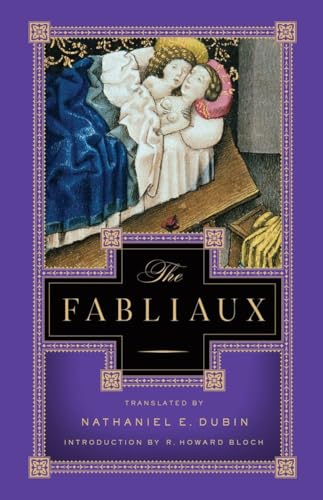
Synopsis
Winner • Modern Language Association’s Scaglione Prize for Translation
Bawdier than The Canterbury Tales, The Fabliaux is the first major English translation of the most scandalous and irreverent poetry in Western literature.
Composed between the twelfth and fourteenth centuries, these virtually unknown erotic and satiric poems lie at the root of the Western comic tradition. Passed down by the anticlerical middle classes of medieval France, The Fabliaux depicts priapic priests, randy wives, and their cuckolded husbands in tales that are shocking even by today’s standards. Chaucer and Boccaccio borrowed heavily from these riotous tales, which were the wit of the common man rebelling against the aristocracy and Church in matters of food, money, and sex. Containing 69 poems with a parallel Old French text, The Fabliaux comes to life in a way that has never been done in nearly eight hundred years."synopsis" may belong to another edition of this title.
About the Authors
Nathaniel E. Dubin is a professor emeritus of modern classical languages at the College of Saint Benedict and St. John’s University in Minnesota.
R. Howard Bloch is the Sterling Professor of French and Humanities at Yale University. The author of numerous award-winning books on French literature and art, he lives in New York.
Reviews
A fabliau is an “Old French comic tale in verse,” explains R. Howard Bloch, Sterling Professor of French at Yale University, in his informative, tantalizing introduction to the first modern anthology of these little-known, devilishly bawdy and irreverent works. The 69 fabliaux presented here in their original French and translated into rascally, buoyant English by Nathaniel E. Dubin, are relentlessly scabrous, egregiously misogynistic, and exuberantly oppositional to “bourgeois respectability” and the church. With such mischievous titles as “The Cleric behind the Chest,” “Black Balls,” and “The Knight Who Made Cunts Talk,” the rollicking fabliaux were composed during the Middle Ages to be performed aloud, forgotten for more than two centuries, then gingerly resurrected by scholars. Vivid, funny, robustly grotesque, and drolly outrageous, these satirical tales of lust, revenge, and folly feature lecherous peasants, fornicating priests, scoundrels, fools, and women wily and tough, castigated and abused. Though their leering focus is on the body and its appetites, the fabliaux do reflect their world, one both alien to us and undeniably familiar. An historic literary achievement bound to arouse vociferous discussion. --Donna Seaman
"About this title" may belong to another edition of this title.
Search results for The Fabliaux

Stock Image
The Fabliaux
Seller: Evergreen Goodwill, Seattle, WA, U.S.A.
Seller rating 5 out of 5 stars

hardcover. Condition: Good. Seller Inventory # mon0000548195
Stock Image
The Fabliaux
Seller: World of Books (was SecondSale), Montgomery, IL, U.S.A.
Seller rating 5 out of 5 stars
Condition: Very Good. Item in very good condition! Textbooks may not include supplemental items i.e. CDs, access codes etc. Seller Inventory # 00104375327
Stock Image
The Fabliaux
Seller: More Than Words, Waltham, MA, U.S.A.
Seller rating 5 out of 5 stars
Condition: Very Good. A bright, square, and overall a nice copy. Seller Inventory # BOS-I-13a-02023
Seller Image
The Fabliaux
Seller: Bay State Book Company, North Smithfield, RI, U.S.A.
Seller rating 5 out of 5 stars
Condition: very_good. Seller Inventory # BSM.15212
Seller Image
The Fabliaux
Seller: Austin Goodwill 1101, Austin, TX, U.S.A.
Seller rating 4 out of 5 stars

Condition: good. Book shows general signs of use and handling. May have light wear on the cover or edges and minimal writing or highlighting. Binding remains tight, and pages are clean and readable. Seller Inventory # CTXV.0871403579.G
Stock Image
The Fabliaux
Seller: Book Outpost, Blawnox, PA, U.S.A.
Seller rating 5 out of 5 stars
Condition: Like New. Never used! Light wear to corners/edges from shelving. Wholesale pricing available via Amazon business.Never used! Light wear to corners/edges from shelving. Seller Inventory # WH-9780871403575-LN
Stock Image
The Fabliaux
Seller: Book Outpost, Blawnox, PA, U.S.A.
Seller rating 5 out of 5 stars
Condition: New. Brand new.New. Seller Inventory # WH-9780871403575-N
Stock Image
The Fabliaux
Seller: Ezekial Books, LLC, Manchester, NH, U.S.A.
Seller rating 5 out of 5 stars
hardcover. Condition: Very Good. 100% Satisfaction Guaranteed. Seller Inventory # 51UMMU000PSA
Stock Image
The Fabliaux
Seller: HPB-Emerald, Dallas, TX, U.S.A.
Seller rating 5 out of 5 stars
Hardcover. Condition: Very Good. Connecting readers with great books since 1972! Used books may not include companion materials, and may have some shelf wear or limited writing. We ship orders daily and Customer Service is our top priority! Seller Inventory # S_470480612
Stock Image
The Fabliaux
Seller: Eagle Eye Books, Decatur, GA, U.S.A.
Seller rating 4 out of 5 stars
Hardcover. Condition: Used. Seller Inventory # 908653