
Items related to The Funhouse Mirror: Reflections on Prison
Synopsis
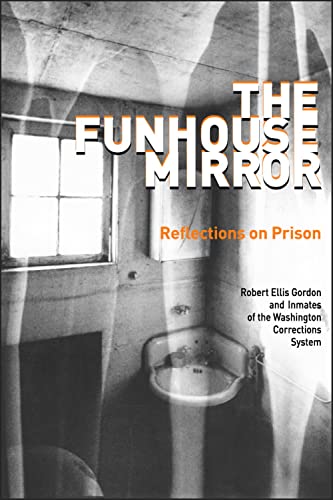
“Prisons are hard places to get into and harder to get out of,” writes Robert Ellis Gordon as he takes you on a remarkable eight-year journey into the Washington State corrections system.
As a writing teacher, Gordon had the unique experience of gaining access to the darkest realms of Washington prisons while remaining free to walk away from penitentiary confines at the end of the day. His account is aided by essays and stories contributed by six extraordinary prison students--works that give this book an unforgettable edge. Together, Gordon and his students provide revealing glimpses of this vast secret-laden subculture of incarcerated individuals, which nationwide comprises more than two million U.S. citizens.
Here is a gallery of portraits of prison life, from the female guard who tantalizes male inmates with her sexuality to the terrified young fish trying to stave off other prisoners. These stories are jarring, harsh, compelling. The Funhouse Mirror, which combines extraordinary story material with fine writing, provides us with an inside look at the prison system we often ignore, yet only at society’s peril. This uncommon book is a significant addition to the literature on American penitentiaries. It is destined to help alter the terms of the debate about one of the great national problems of our time.
Winner of the Washington State Book Award, 2000.
"synopsis" may belong to another edition of this title.
About the Author
Robert Ellis Gordon is the author of the celebrated novel Humping Credenzas With The Late Bobby Kennedy: A Convict's True Account.
A past winner of the Washington State Book Award, Gordon spent many years teaching in the prisons. In 2007 he received a special citation from the State Library for his writing about hidden populations.
Reviews
A surprising-and frequently searing-examination of the prison experience, seen from both inside and out.Novelist Gordon (When Bobby Kennedy Was a Moving Man, 1993) ran intensive writing workshops in Washington State prisons for nine years, until funding was ignominiously truncated. He initially explores the contemporary explosion in incarceration, noting that imprisonment rates have doubled in the last decade, even while the American people are "in no hurry to lay claim to the prisoners in our midst." As implied by his title, he views this reluctance to consider the realities of the imprisonment surge as akin to willful blindness in the face of a ghastly, distorted civic reflection. In contrast, his enthusiasm for his prison teaching experience is palpable: he offers strong tales of prisoners who found release and grace in writing, and discovered the joys of its inherent craftsmanship. Gordon maintains a wry, informed stance that strengthens his arguments regarding prisoner humanity and the pure (and vicious) moral relativism that prisons breed-particularly in the "get-tough" era, when even education and the simplest privileges are stripped away. Additionally, he culls a variety of memorable pieces in distinctive voices from the current and former prisoners he's taught. Yet their writing surges with edgy awareness and hard-won insights: memorable essays range from an attempted murderer's chillingly humorous tips on prison survival ("Commit an Honorable Crime . . . Keep a Good Porn Collection") to a twice-convicted rapist-now held indefinitely according to new Orwellian notions of civil commitment-recounting the violence and contempt accorded sex offenders (who stand lowest on the convict pecking order, along with snitches). Gordon's finely honed stance is most haunting: he draws difficult conclusions regarding the humanity of his charges, he portrays their absurdist moments of honesty or altruism, and he testifies convincingly about the power of writing to foster discipline and engagement with the world-perhaps to stifle criminal nihilism.Not a tremendously hopeful work, but Gordon's audaciousness in regarding the condemned as creative citizens is memorable and gripping. -- Copyright © 2000 Kirkus Associates, LP. All rights reserved.
Excerpt. © Reprinted by permission. All rights reserved.
EXCERPT FROM CHAPTER 7
LITTLE TONY was the tiniest and youngest looking convict student I ever taught. Yet his size and age notwithstanding, I saw no sign that Little Tony had reason to live in fear of sexual enslavement. On the contrary. He was treated with respect by the other convicts in class, all of whom appeared to be older and were certainly much bigger. Moreover, another student told me, Little Tony was down for life without parole. Consequently, I presumed that Little Tony's crime was a very "honorable" one, most likely a multiple murder.
This was at the old McNeil Island Corrections Center, that filthy, drafty monster of an institution where eight men and one toilet inhabited barred, open-tiered cells that were considerably smaller than the average household's living room.
Given these horrifying living conditions, any convict who lived in a one-man cell was considered to be lucky. But there was, as you might expect, a catch: in order to qualify for a solo cell, it had to be determined, by the prison authorities, that the convict in question was insane.
I never did find out the precise nature of Little Tony's diagnosis. All I knew was that he qualified for a one man-cell, and that, as Little Tony explained it, he had several imaginary friends. He hardly ever slept, he said, because he spent most of his nights talking to his imaginary friends. I remember that one of them was named "Shadowfax." I forget the names of the others.
*****
I first heard about Little Tony's imaginary friends one morning during break. About half of the class was outside smoking in the raw February rain. The remaining students, Little Tony among them, were lounging in the prison library where the writing workshop was being held.
As Little Tony talked about his nighttime companions in a matter of fact tone of voice, some of the other students backed him up. Yes, they assured me, Little Tony really did converse all night with his imaginary friends. No, this wasn't bullshit: this was the truth.
The convicts were talking about Little Tony's insanity as if it were nothing more remarkable than the weather, and this seemed strange to me. Why were the convicts so cavalier? Why didn't they regard Little Tony's state of mind to be tragic, alarming, and abnormal?
That night, at the Motel 6 where I was staying, I thought the matter over. And I came to understand that Little Tony's fellow convicts were right. There really wasn't anything remarkable about Little Tony's affliction, at least not once you considered his situation. He lived in a hideous place, a veritable modern-day dungeon. And his youth notwithstanding, he was down for life without parole. He was doomed to spend decade upon decade, in short, living, without hope, in Hell.
Under the circumstances, Little Tony's particular variety of insanity was not only a coping mechanism: it was, quite possibly, a healthly coping mechanism. And healthy or not, it is self-evident that Little Tony's imaginary friends provided far more in the way of love, acceptance, affection, and comfort than prison ever could.
For several months after my residency, I prayed every night for Little Tony. I beseeched whoever is in charge of our souls to permit Little Tony to keep his imaginary friends. "It would be unwise to let him go sane," I'd point out. "Please let him stay crazy, " I'd implore.
My supplications, though unconventional, were fitting. For it was, in the twisted context of prison, clearly and indisputably in Little Tony's best interests to maintain his present level of derangement.
"About this title" may belong to another edition of this title.
Search results for The Funhouse Mirror: Reflections on Prison

Stock Image
The Funhouse Mirror: Reflections on Prison
Published by
Washington State University Press, 2000
ISBN 10: 0874221986
ISBN 13: 9780874221985
Used
Softcover
Seller: World of Books (was SecondSale), Montgomery, IL, U.S.A.
Seller rating 5 out of 5 stars

Condition: Good. Item in good condition. Textbooks may not include supplemental items i.e. CDs, access codes etc. Seller Inventory # 00095485918
Stock Image
The Funhouse Mirror: Reflections on Prison
Published by
Washington State University Press, 2000
ISBN 10: 0874221986
ISBN 13: 9780874221985
Used
Softcover
Seller: World of Books (was SecondSale), Montgomery, IL, U.S.A.
Seller rating 5 out of 5 stars
Condition: Very Good. Item in very good condition! Textbooks may not include supplemental items i.e. CDs, access codes etc. Seller Inventory # 00104869104
Stock Image
The Funhouse Mirror: Reflections on Prison
Published by
Washington State University Pres, 2000
ISBN 10: 0874221986
ISBN 13: 9780874221985
Used
paperback
Seller: Bookmans, Tucson, AZ, U.S.A.
Seller rating 5 out of 5 stars
paperback. Condition: Good. Satisfaction 100% guaranteed. Seller Inventory # mon0002677092
Stock Image
The Funhouse Mirror: Reflections on Prison
Published by
Washington State University Press, 2000
ISBN 10: 0874221986
ISBN 13: 9780874221985
Used
Paperback
Seller: ThriftBooks-Atlanta, AUSTELL, GA, U.S.A.
Seller rating 5 out of 5 stars
Paperback. Condition: Good. No Jacket. Pages can have notes/highlighting. Spine may show signs of wear. ~ ThriftBooks: Read More, Spend Less. Seller Inventory # G0874221986I3N00
Stock Image
The Funhouse Mirror: Reflections on Prison
Published by
Washington State University Press, 2000
ISBN 10: 0874221986
ISBN 13: 9780874221985
Used
Softcover
Seller: Wonder Book, Frederick, MD, U.S.A.
Seller rating 5 out of 5 stars
Condition: As New. Like New condition. A near perfect copy that may have very minor cosmetic defects. Seller Inventory # N00A-03487
Stock Image
The Funhouse Mirror : Reflections on Prison
Published by
Washington State University Press, 2000
ISBN 10: 0874221986
ISBN 13: 9780874221985
Used
Softcover
Seller: Better World Books, Mishawaka, IN, U.S.A.
Seller rating 5 out of 5 stars
Condition: Very Good. Pages intact with possible writing/highlighting. Binding strong with minor wear. Dust jackets/supplements may not be included. Stock photo provided. Product includes identifying sticker. Better World Books: Buy Books. Do Good. Seller Inventory # 4690240-6
Stock Image
The Funhouse Mirror : Reflections on Prison
Published by
Washington State University Press, 2000
ISBN 10: 0874221986
ISBN 13: 9780874221985
Used
Softcover
Seller: Better World Books: West, Reno, NV, U.S.A.
Seller rating 5 out of 5 stars
Condition: Good. Former library copy. Pages intact with minimal writing/highlighting. The binding may be loose and creased. Dust jackets/supplements are not included. Includes library markings. Stock photo provided. Product includes identifying sticker. Better World Books: Buy Books. Do Good. Seller Inventory # GRP77615958
Stock Image
The Funhouse Mirror : Reflections on Prison
Published by
Washington State University Press, 2000
ISBN 10: 0874221986
ISBN 13: 9780874221985
Used
Softcover
Seller: Better World Books, Mishawaka, IN, U.S.A.
Seller rating 5 out of 5 stars
Condition: Good. Pages intact with minimal writing/highlighting. The binding may be loose and creased. Dust jackets/supplements are not included. Stock photo provided. Product includes identifying sticker. Better World Books: Buy Books. Do Good. Seller Inventory # 4607079-6
Stock Image
The Funhouse Mirror : Reflections on Prison
Published by
Washington State University Press, 2000
ISBN 10: 0874221986
ISBN 13: 9780874221985
Used
Softcover
Seller: Better World Books, Mishawaka, IN, U.S.A.
Seller rating 5 out of 5 stars
Condition: Fine. Used book that is in almost brand-new condition. May contain a remainder mark. Better World Books: Buy Books. Do Good. Seller Inventory # 3962917-6
Stock Image
The Funhouse Mirror: Reflections on Prison
Published by
Washington State University Pres, 2000
ISBN 10: 0874221986
ISBN 13: 9780874221985
Used
Paperback
Seller: Half Price Books Inc., Dallas, TX, U.S.A.
Seller rating 5 out of 5 stars
Paperback. Condition: Very Good. Connecting readers with great books since 1972! Used books may not include companion materials, and may have some shelf wear or limited writing. We ship orders daily and Customer Service is our top priority! Seller Inventory # S_463882147