
Items related to The Truth about the Truth: De-confusing and Re-constructing...
The Truth about the Truth: De-confusing and Re-constructing the Postmodern World (New Consciousness Reader) - Softcover
Synopsis
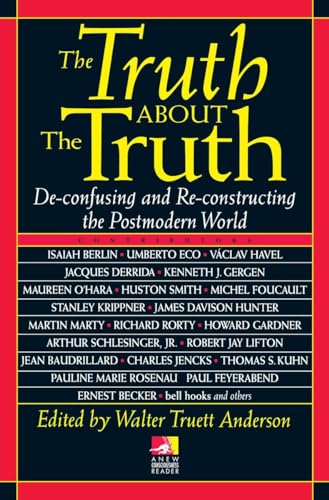
Includes essays and excerpts from the works of prominent modern thinkers such as Umberto Eco, Jacques Derrida, and Isaiah Berlin among others.
"synopsis" may belong to another edition of this title.
About the Author
Walt Truett Anderson's previous books included Reality Isn't What it Used to Be, To Govern Evolution, Rethinking Liberalism, The Upstart Spring and Open Secrets. A longtime resident of the San Francisco Bay Area, he is a fellow of the Meridian Institute, an international network of Scholars and practitioners concerned with issues of governance, earning, leadership and the future. He writes regularly for the Pacific News Service and currently serves as president of the American division of the World Academy of Art and Science.
Reviews
There is no longer one ``truth about the truth,'' observes freelance journalist Anderson (Reality Isn't What It Used to Be), who has compiled 33 previously published short pieces by postmodern pundits grappling with problems of belief, identity and society. In an engagingly skeptical, aphoristic voice (``look at the post modern world as a kind of jailbreak from the Grand Hotel''), Anderson provides continuity between sections as diverse as ``Symbols at Work and Play'' (which includes a relatively lucid passage from Jacques Derrida on ``the dubious relationship between a word and its referent'' and Stephen Katz's spoof on ``How to Speak and Write Postmodern'') and ``Science Without Scientism,'' featuring passages from Thomas Kuhn and Paul Feyerabend on the instability of scientific principles. Final chapters from Arthur Schlesinger Jr. and Vaclav Havel about necessary links between politics and faith suggest where Anderson's real sympathies lie. That Anderson has chosen some of the most accessible writings on postmodernism available is both a strength and a weakness. Academics may view this work as a remedial postmodern primer, while the larger audience for whom the volume seems intended may still be put off by considerable vocabulary barriers: a problem of readership that points up the continuing chasm between what's on the minds of academics versus those of more regular folk.
Copyright 1995 Cahners Business Information, Inc.
"About this title" may belong to another edition of this title.
Search results for The Truth about the Truth: De-confusing and Re-constructing...

Seller Image
The Truth about the Truth: De-confusing and Re-constructing the Postmodern World (New Consciousness Reader)
Seller: 3Brothers Bookstore, Egg harbor township, NJ, U.S.A.
Seller rating 5 out of 5 stars

Condition: very_good. Cover may have light wear, pages in very good condition and binding is sturdy; may have other light shelf wear or creases. May have notes or highlighting. Seller Inventory # EVV.0874778018.VG
Stock Image
The Truth about the Truth: De-confusing and Re-constructing the Postmodern World
Seller: World of Books (was SecondSale), Montgomery, IL, U.S.A.
Seller rating 5 out of 5 stars
Paperback. Condition: Good. Includes essays and excerpts from the works of prominent modern thinkers such as Umberto Eco, Jacques Derrida, and Isaiah Berlin among others. Seller Inventory # 00100835810
Stock Image
The Truth about the Truth: De-confusing and Re-constructing the Postmodern World (New Consciousness Reader)
Published by
Tarcher (edition Later Printing), 1995
ISBN 10: 0874778018
ISBN 13: 9780874778014
Used
Paperback
Seller: BooksRun, Philadelphia, PA, U.S.A.
Seller rating 5 out of 5 stars
Paperback. Condition: Very Good. Later Printing. It's a well-cared-for item that has seen limited use. The item may show minor signs of wear. All the text is legible, with all pages included. It may have slight markings and/or highlighting. Seller Inventory # 0874778018-11-1
Stock Image
The Truth about the Truth : De-Confusing and Re-constructing the Postmodern World
Published by
Penguin Publishing Group, 1995
ISBN 10: 0874778018
ISBN 13: 9780874778014
Used
Softcover
Seller: Better World Books: West, Reno, NV, U.S.A.
Seller rating 5 out of 5 stars
Condition: Good. Pages intact with minimal writing/highlighting. The binding may be loose and creased. Dust jackets/supplements are not included. Stock photo provided. Product includes identifying sticker. Better World Books: Buy Books. Do Good. Seller Inventory # 4432726-6
Stock Image
The Truth about the Truth : De-Confusing and Re-constructing the Postmodern World
Published by
Penguin Publishing Group, 1995
ISBN 10: 0874778018
ISBN 13: 9780874778014
Used
Softcover
Seller: Better World Books, Mishawaka, IN, U.S.A.
Seller rating 5 out of 5 stars
Condition: Good. Pages intact with minimal writing/highlighting. The binding may be loose and creased. Dust jackets/supplements are not included. Stock photo provided. Product includes identifying sticker. Better World Books: Buy Books. Do Good. Seller Inventory # 4432726-6
Stock Image
The Truth about the Truth: De-confusing and Re-constructing the Postmodern World
Published by
Penguin Publishing Group, 1995
ISBN 10: 0874778018
ISBN 13: 9780874778014
Used
Paperback
Seller: ThriftBooks-Phoenix, Phoenix, AZ, U.S.A.
Seller rating 5 out of 5 stars
Paperback. Condition: Very Good. No Jacket. May have limited writing in cover pages. Pages are unmarked. ~ ThriftBooks: Read More, Spend Less. Seller Inventory # G0874778018I4N00
Stock Image
The Truth about the Truth: De-confusing and Re-constructing the Postmodern World
Published by
Penguin Publishing Group, 1995
ISBN 10: 0874778018
ISBN 13: 9780874778014
Used
Paperback
Seller: ThriftBooks-Reno, Reno, NV, U.S.A.
Seller rating 5 out of 5 stars
Paperback. Condition: Very Good. No Jacket. May have limited writing in cover pages. Pages are unmarked. ~ ThriftBooks: Read More, Spend Less. Seller Inventory # G0874778018I4N00
Stock Image
The Truth about the Truth: De-confusing and Re-constructing the Postmodern World
Published by
Penguin Publishing Group, 1995
ISBN 10: 0874778018
ISBN 13: 9780874778014
Used
Paperback
Seller: ThriftBooks-Atlanta, AUSTELL, GA, U.S.A.
Seller rating 5 out of 5 stars
Paperback. Condition: Very Good. No Jacket. May have limited writing in cover pages. Pages are unmarked. ~ ThriftBooks: Read More, Spend Less. Seller Inventory # G0874778018I4N00
Stock Image
The Truth about the Truth: De-confusing and Re-constructing the Postmodern World
Published by
Penguin Publishing Group, 1995
ISBN 10: 0874778018
ISBN 13: 9780874778014
Used
Paperback
Seller: ThriftBooks-Dallas, Dallas, TX, U.S.A.
Seller rating 5 out of 5 stars
Paperback. Condition: Very Good. No Jacket. May have limited writing in cover pages. Pages are unmarked. ~ ThriftBooks: Read More, Spend Less. Seller Inventory # G0874778018I4N00
Stock Image
The Truth about the Truth: De-confusing and Re-constructing the Postmodern World (New Consciousness Reader)
Seller: Wonder Book, Frederick, MD, U.S.A.
Seller rating 5 out of 5 stars
Condition: Good. Good condition. A copy that has been read but remains intact. May contain markings such as bookplates, stamps, limited notes and highlighting, or a few light stains. Seller Inventory # A04A-03557