
Items related to You Already Know What to Do: 10 Invitations to the...
Synopsis
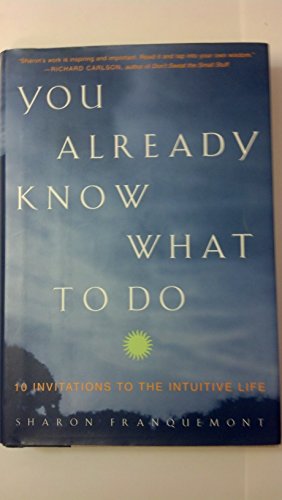
An expert on the nature of intuition shows how developing our intuitive senses can positively influence all aspects of life, giving advice on developing and learning to trust these special creative powers. 12,500 first printing.
"synopsis" may belong to another edition of this title.
About the Author
Sharon Franquemont is a national and international intuition trainer, consultant, coach, and speaker who has been working in the field for twenty-six years. With two other colleagues, she promoted intuition as a legitimate part of studies for graduate students at John F. Kennedy University, Orinda, CA where she taught for six years before going into private work. Know for her depth of understanding and her communication skills with people, she has taught in Europe, South America, and in many states throughout the United States. Her work addresses the role of intuition in business, psychotherapy, education, and science as well as its importance in everyday life.
Sharon Franquemont is renowned among her colleagues for promoting the intuitive life rather than intuition as a tool or technique a person picks up and puts down. Her conviction is that an intuitive life is synonymous with people achieving a more passionate, purposeful, and powerful life. In addition to the more familiar individual development of intuition, Sharon is an expert on collaborative intuition in organizational settings and coaches couples on the role intuition plays in their relationship.
Besides Sharon's teaching skills, she is known as a skilled intuitive and worked at The Psychical Research Foundation in Durham, North Carolina. Her subsequent association with the scientific research community for fourteen years gives her strong background in the logical approach to intuition as well as the wisdom direct personal encounters with the intuitive world provides.
Her expertise and skills as a speaker have placed her in demand on radio and TV while she lived in North Carolina, worked frequently in Pennsylvania, and in her present home of California. Among others, she has appeared on KRST radio, KNBR radio, KGO TV's The Morning Show with Jim Hansen and Katherine Crosby, and the international public television show Thinking Allowed. Sharon presently serves on the Advisory Board of Intuition Magazine and is an active member in The Intuition Network.
From the Back Cover
"Sharon's work is inspiring and important. Read it and tap into your own wisdom." --RICHARD CARLSON, Don't Sweat The Small Stuff
"Sharon Franquemont's book takes the subject of intuition to a new level. It's a must read for people at every stage of intuitive ability." --CAROL ADRIENNE, The Purpose of Your Life and The Celestine Prophecy: An Experiential Guide
"The wise words inside You Already Know What To Do will open your life. I thoroughly support this message." --NEALE DONALD WALSCH, Conversations With God
"Psychology and education have long ignored the importance of intuition. Sharon Franquemont's landmark book gives intuition the place it deserves." --STANLEY KRIPPNER, Ph. D., Saybrooke University; Realms of Healing, Dream Telepathy, Human Possibilities
"You Already Know What To Do is an inspiring, accessible guide to the intuitive way of life, a book you can use not just now and then, but all the time." --GEORGE LEONARD, Education and Ecstasy, Mastery
"The wealth of Sharon Franquemont's twenty-eight years in the field of intuition is found in this book. It's entertaining and thought provoking style helps you tap your intuition to enhance the power, passion, and purpose of your life." --COLLEEN MAURO, Publisher, Intuition Magazine
"By virtue of the depth of her soul, Sharon Franquemont has assumed a position of leadership within the Intuition Network. You Already Know What To Do comes from her heart and contains a rich mixture of messages that will touch every reader." --JEFFREY MISHLOVE, Ph.D.; President, Intuition Network and Host of Public Television's Thinking Allowed
"Sharon Franquemont offers a wealth of rich examples and practical exercises to show the core connection between these inborn gifts of ours and our essential, spiritual nature." --BELLERUTH NAPERSTEK, Your Sixth Sense
Excerpt. © Reprinted by permission. All rights reserved.
from Chapter One
Intuition: Tell Me More
Whether in my college classes or in other settings, people want me to tell them more about intuition and repeatedly ask me to answer these five questions:
1. Can I really improve my intuition?
2. How can I keep my logic from putting down my intuition?
3. Doesn't this stuff make you weird?
4. What is the difference between psychic and intuitive events?
5. In the big picture, what purpose does intuition serve?
These are excellent questions and, although they might appear superficial, they address deep issues in human experience. Throughout the centuries philosophers, scientists, Indigenous cultures, psychologists, and spiritual people have asked themselves these question and, as a result, have developed a variety of ways or models for understanding what intuition is and how it might work. In fact, questions 2-5 are best answered by exploring four of these ways. This exploration is important for two reasons: (1) the models move your understanding of intuition from a flat dictionary definition to a four dimensional perspective and (2) you'll discover which of the ways is most natural for you and be able to turn to it whenever you need to throughout this book.
In addition, exercises which help you apply the ideas behind the models follow each discussion. Important hint: If you find yourself by-passing the exercises, examine the answers to these two things questions. (1) Am I so left-brained oriented, that I invalidate intuition by not investing in the exercises? If you answer "Yes" to this question, practice by acting "as if" you believed in intuition. Invest in a new adventure. (2) Am I so right-brained oriented, that I am reading the text for moral support, but think the exercises are unnecessary for me? If your answer is "Yes" to this question, humble yourself and recognize that there is always room for growth and improvement.
Application is everything in intuitive development. In both cases, give yourself over to the experience by doing the exercises.
In contrast to questions 2-5, question number one doesn't require any model; it is easy.
1. Can I really improve my intuition?
"Absolutely!" I always answer, "You are designed to know what you know."
Unfortunately, many people don't realize this. They accept their analytical skills can be improved upon, but believe their intuitive abilities are limited at birth to some kind of intuition allotment. Some people are born with lots of intuition, some with less, or some with none at all. Or, they believe if you are born a man you don't have much, but if you are a woman, you have a lot. Both these beliefs, in my opinion, are nonsense. Regardless of your gender, you have plenty of intuition, although it may be true that you are not using it. And, like any other skill, intuition is strengthened by use, stays dormant with disuse, and varies with expertise.
It is not surprising people believe in an intuition allotment theory because, unlike analytical skills, public school curriculums do not try to improve their intuition or identify their particular area of intuitive expertise. Multiple choice questions which help students evaluate when and how they intuit best, rewards for essays such as "My Greatest Intuitive Experience", or college courses labeled "Intuition 101" don't exist. People have to decide to do these things for themselves. When they do, they don't regret it because intuition is part of healing. Most people raised in Western culture are divided within, separated from their deepest knowledge and wisdom. Our long and fruitful journey into science and technology now begs for an end to this inner division and a return to ancient knowledge methods which are not bound by superstitions, but revealed by expanded consciousness. It is important that we journey to this consciousness as a species not simply out of fear for our collective survival, but because we love and are committed to all Life. Commitment requires changes and, while changes motivated by fear are fleeting, changes impelled by love last.
Intuition is an ancient friend. Although its meaning wears different hats in each culture, the best of its presence is always associated with illumination. Ironically, the English word intuition is not very illuminating and many people wonder, "Precisely what is this thing called intuition?" When I use the word intuition, I am referring to a specific skill in consciousness for obtaining knowledge. I believe intuitive awareness exists on a continuum within us, although we use different words to describe it. For example, we call non-rational knowledge in our bodies, "instinct," in our emotions, "psychic," in our minds, a creative "Ah Ha," in our vision, "precognition," and in our experience of the Absolute, "mystic or spiritual."i Naturally, people get confused because like the mythic Prometheus our right to know what we know changes forms according to our present awareness.
To get around this nomenclature problem and capture the breadth of intuitive abilities, I often use the phrase, "intuitive intelligence" or what I call your InQ. We are all familiar with IQ (intelligence quotient), a number which represents people's ability to provide predetermined correct answers to questions focusing on a variety of analytical skills. In contrast, your InQ (intuition quotient) reflects your ability to go inward, respond to a variety of intuitive skills, perceive connections and thrive in the unknown. While IQ is associated with the brain, your InQ is distributed throughout your body because we literally do know with our minds, emotions, and bodies. In short, your InQ describes a huge piece of inner territory. This can complicate people's confidence in the learning process until they realize what their intuitive long suit is. Working with this book gives you an opportunity to know where your greatest intuitive abilities lie (in your body, emotions, visions, silence, or joy) and to begin mapping your InQ strengths.
Another problem people encounter is the multi-tasked nature of the word intuition.ii The word is a noun, yet, it is used to describe a process (the arrival of knowledge in unique ways) much like a verb is used. The real verb, intuit, is rarely used. So, most people choose to say, "I used my intuition to know the answer" rather than "I intuited the answer." This subtle distinction robs intuition of its action in the world and makes it a thing to understand rather than an action to take. By the end of this book, I hope you are as comfortable with the word intuit as you are with the word intuition.
You will also notice that I frequently refer to intuition as a living force, saying things like, "Intuition is calling you." Whenever I say that, remember it comes from a belief that this "living" intuition serves as a communication bridge, a language, for the soul. Therefore, this book engages you in enhancing a skill (intuition as process,) making friends with your intuition (as a living force,) and learning the language of your soul. All of these things begin when you turn on your intuition (Invitation One) and I'll do my best to lead you through a step-by-step acquisition of intuition's inner wealth.
One last thing about your entitlement to know what you know. Fortunately, the wealth of intuition flourishes in the context of purpose and soul. This provides an ethical dimension to its information which is often sadly lacking in the domain of knowledge. Take for example, this story of a man whose inner development had a magnetic effect on others. The man, a salesperson, liked the money he earned, but wanted more. On one sales call, unhappy not to have met his financial goals, he decided not to correct one of his customers when she mistakenly thought an item cost $150 more than its actual price. Driving home with the extra money in his pocket, he was mentally distracted by justifying his decision to himself and accidentally bashed in his front bumper. When he later received a repair bill for precisely $150, he recognized the folly of his thinking and its inevitable outcome. Intuition is powerful, and a sincere commitment to intuition makes it impossible for you to abandon ethical behavior for long. This is a bonus in your development package.
2. How can I keep my logic from putting down my intuition?
As people begin to work with their intuition, often their inner analytical voice, berates them saying things like, "This isn't real" or "You can't trust this stuff. It isn't logical." This voice can be so destructive that it cripples or invalidates intuitive information before you are even able to completely receive, act on, and evaluate your intuition. Logic appears to love checkmating intuition. An answer to why logic puts down intuition is found in the first of our four ways of understanding intuition: The Scientific Model.
Important background for this model comes from philosopher Alfred North Whitehead who in 1925 declared the absolute dominance of the scientific revolution, which he defined as "a vehement and passionate interest in the relation of general principles to irreducible and stubborn facts."iii Intuition, which is not an irreducible stubborn fact and is experimentally unreliable, non-repeatable, and uncontrollable, went out as the scientific tide came in.
The tide didn't start turning until 1972 when Robert Ornstein popularized scientific research on the differences between the left and right brain. The research, which was based on studies of people with severed connections between the two hemispheres, suggested that each hemisphere has its own area of expertise.iv The left brain is an expert at verbal, linear, detailed processing. The right brain excels at non-verbal, spatial, wholistic and symbolic processing (see diagram.)
This discovery partially, but not entirely, sanctioned intuition which usually uses non-verbal, symbolic methods to communicate. The sanction remains partial because most Westerners have been educated about right brain expertise in a left brain manner. Immersion in right brain learning styles is rare and, in fact, the few educational subjects which emphasize right brain skillsart, music, dance, some aspects of sportsare considered optional or eliminated first in a budget cut. For most of us, the right brain remains the technical, but silent partner of the left. It is this silence and little direct experience with intuition which foster logic's ability to put intuition down.
No where is this more evident than in the Great Brain Debate exercise I conduct in intuition seminars. Participants begin by sharing with each other a "wildly" creative plan they haven't dared to follow. I then ask, "What does your left brain say to your right brain about your plan?" There is never a moment's hesitation. People mimic it saying things like, "You don't know what you're doing!", "Who do you think you are? You can't do that," "You're just a dreamer," "You're a fool for believing that," and "How are you going to explain why?" When I ask people how their right brains defend themselves, usually silence fills the room. Most people's right brain is paralyzed in a debate with the left. In my latest workshop, the silence was explained by someone calling out, "The right brain isn't verbal."
When I ask people what they imagine the right brain might say if it talked, they always begin with statements like, "You (left brain) don't know everything!", "You are so short sighted," "My perspective has more meaning than yours," "My images are colorful and caring compared to yours," and "You miss the big picture completely." At this point the debate sounds like two egos locked in combat over who is going to "command operations." This ego combat must stop in order for you to end your logic's ability to put down intuition and vice versa.
A key to truce is understanding that combativeness is not a right brain quality. The right brain loves connections and relationships. When people realize that combative statements are not natural to the right brain, healing sentences such as, "Let's work together," "Our partnership can contribute to the world," "You can show me what things comprise something and I'll show you the overall result," and/or "Enumerate something for me and I'll reveal its elegance" emerge. People then feel the potential of whole brain thinking-intuition working with logic not against it or as a substitute for it.
This is our goal, and it can help us monitor ourselves. If your life is feeling dull and uninspired, you know you need to go out dancing, take up art or poetry, or find other creative outlets. On the other hand, if creative projects surround you, but nothing is getting done, you need a course in time management or other organizational skills. In short, you need your whole brain to actualize your talents.
In summary, when your logic tries to put down your intuition, go to inclusive and cooperative statements. Also, remind yourself that (1) the acquisition of knowledge is not only a linear process, (2) the right brain processes information in symbolic and spatial ways, (3) whole brain thinking allows you to access more talents, and (4) science supports learning in ways other than analyticalv.
"About this title" may belong to another edition of this title.
Search results for You Already Know What to Do: 10 Invitations to the...

Stock Image
You Already Know What to Do: 10 Invitations to the Intuitive Life
Seller: World of Books (was SecondSale), Montgomery, IL, U.S.A.
Seller rating 5 out of 5 stars

Condition: Good. Item in good condition. Textbooks may not include supplemental items i.e. CDs, access codes etc. Seller Inventory # 00084936578
Stock Image
You Already Know What to Do: 10 Invitations to the Intuitive Life
Seller: World of Books (was SecondSale), Montgomery, IL, U.S.A.
Seller rating 5 out of 5 stars
Condition: Very Good. Item in very good condition! Textbooks may not include supplemental items i.e. CDs, access codes etc. Seller Inventory # 00085525972
Seller Image
You Already Know What to Do: 10 Invitations to the Intuitive Life
Seller: Greenworld Books, Arlington, TX, U.S.A.
Seller rating 5 out of 5 stars
Condition: very_good. Fast Free Shipping â" Very Good condition book with a firm cover and clean pages. Shows normal use and some light wear or limited notes markings. A solid, nice copy to enjoy. Seller Inventory # GWV.0874779464.VG
Stock Image
You Already Know What to Do: 10 Invitations to the Intuitive Life
Seller: BooksRun, Philadelphia, PA, U.S.A.
Seller rating 5 out of 5 stars
Hardcover. Condition: Very Good. With dust jacket. It's a well-cared-for item that has seen limited use. The item may show minor signs of wear. All the text is legible, with all pages included. It may have slight markings and/or highlighting. Seller Inventory # 0874779464-8-1-29
Stock Image
You Already Know What to Do: 10 Invitations to the Intuitive Life
Seller: More Than Words, Waltham, MA, U.S.A.
Seller rating 5 out of 5 stars
Condition: Good. A sound copy with only light wear. Overall a solid copy at a great price! Seller Inventory # BOS-Q-12j-01553
Stock Image
You Already Know What to Do: 10 Invitations to the Intuitive Life
Seller: HPB Inc., Dallas, TX, U.S.A.
Seller rating 5 out of 5 stars
hardcover. Condition: Very Good. Connecting readers with great books since 1972! Used books may not include companion materials, and may have some shelf wear or limited writing. We ship orders daily and Customer Service is our top priority! Seller Inventory # S_460378603
Stock Image
You Already Know What to Do : 10 Invitations to the Intuitive Life
Published by
Penguin Publishing Group, 1999
ISBN 10: 0874779464
ISBN 13: 9780874779462
Used
Hardcover
Seller: Better World Books, Mishawaka, IN, U.S.A.
Seller rating 5 out of 5 stars
Condition: Good. Pages intact with minimal writing/highlighting. The binding may be loose and creased. Dust jackets/supplements are not included. Stock photo provided. Product includes identifying sticker. Better World Books: Buy Books. Do Good. Seller Inventory # 5565775-6
Stock Image
You Already Know What to Do : 10 Invitations to the Intuitive Life
Published by
Penguin Publishing Group, 1999
ISBN 10: 0874779464
ISBN 13: 9780874779462
Used
Hardcover
Seller: Better World Books, Mishawaka, IN, U.S.A.
Seller rating 5 out of 5 stars
Condition: Very Good. Pages intact with possible writing/highlighting. Binding strong with minor wear. Dust jackets/supplements may not be included. Stock photo provided. Product includes identifying sticker. Better World Books: Buy Books. Do Good. Seller Inventory # 4438778-6
Stock Image
You Already Know What to Do: 10 Invitations to the Intuitive Life
Seller: HPB-Diamond, Dallas, TX, U.S.A.
Seller rating 5 out of 5 stars
hardcover. Condition: Very Good. Connecting readers with great books since 1972! Used books may not include companion materials, and may have some shelf wear or limited writing. We ship orders daily and Customer Service is our top priority! Seller Inventory # S_471653837
Stock Image
You Already Know What to Do: 10 Invitations to the Intuitive Life
Seller: Wonder Book, Frederick, MD, U.S.A.
Seller rating 5 out of 5 stars
Condition: Good. Good condition. Very Good dust jacket. A copy that has been read but remains intact. May contain markings such as bookplates, stamps, limited notes and highlighting, or a few light stains. Seller Inventory # L06B-02822