
Items related to Marathon: The Ultimate Training and Racing Guide
Synopsis
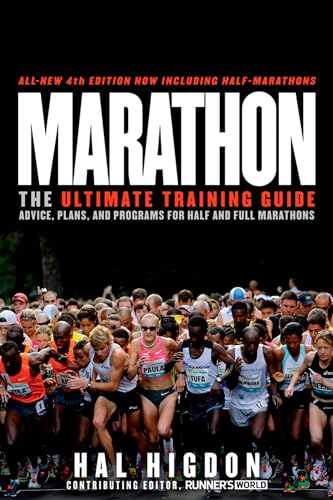
As running's popularity soars, millions are taking the marathon challenge. Let Hal Higdon, veteran of more than 100 marathons, guide you through the training and preparations to ensure that you cross the finish line in triumph.
"synopsis" may belong to another edition of this title.
About the Author
Hal Higdon is among the most respected and widely read writers in the world of running. A senior writer for Runner's World magazine, he also writes the "Ask the Expert" column on the magazine's Web site. He is the author of 31 books, including Hal Higdon's Smart Running and Hal Higdon's How to Train. He is a competitive masters runner and lectures frequently at running clubs and races around the world.
Reviews
Though the running boom appears to have peaked and even tapered off somewhat, the marathon is still the ultimate running experience for many runners. Higdon's book, although well written, offers very little in the way of new information on training for or running the marathon. Previously published works such as Joe Henderson's Complete Marathoner (Anderson World, 1978), Andy Friedberg's How To Run Your First Marathon (S. & S., 1987), and Ricard Benyo's Making the Marathon Your Event (Random, 1992) offer very similar advice. However, Higdon's anecdotal style provides entertaining reading and may inspire aspiring marathoners. The author provides details of many of his personal marathon experiences as well as those of other top American marathoners such as Bill Rodgers, Don Kardang, and Dick Buerkle. This book will appeal to general readers seriously considering training for their first marathon. For large sports collections.
- Susan L. Patton, Tennessee Valley Authority, Knoxville
Copyright 1993 Reed Business Information, Inc.
Excerpt. © Reprinted by permission. All rights reserved.
1
The Mystique of the Marathon
Running 26 Miles 385 Yards Is a Humbling Experience
What would we do for fun if the Persians in 490 BC had won the Battle of Marathon? This thought occurred to me while I was in Greece several years ago to celebrate the 2,500th anniversary of that battle—and the legendary run from Marathon to Athens by Pheidippides, who announced, “Rejoice, we conquer!” and immediately died.
That legend—and it is more legend than historical fact—inspired a race in 1896 at the first modern Olympic Games over approximately the same route from the plains of Marathon on the Aegean Sea to the Olympic stadium in downtown Athens. Only seventeen runners participated in that first race; twenty thousand runners appeared more than a century later for the anniversary celebration. By then, similarly long races with that many runners and more had become common throughout the world. Races that, by the way, are called marathons, that term having conveniently taken hold as a description of a running race precisely 26 miles 385 yards long. (More on that later.)
Not everybody understands the drive that causes hundreds of thousands of runners each year to punish themselves and train for months for the seemingly dubious pleasure of running 26 miles 385 yards. One year at the Twin Cities Marathon, approximately 8 miles into the race, I overheard a woman in the crowd comment: “To think they paid to do this.”
I understood what she meant. Twenty-six miles is a long way. Adding 385 more yards seems to make the distance even longer and further confuses people who do not understand what motivates us to run marathons. “How far was that marathon?” they ask after we show up at the office on Mondays with medals hanging around our necks, limping but with smiles on our faces. Despite the rising popularity of big-city marathons, not everybody knows—or understands—why the distance is a precise (but foolish) 26 miles 385 yards. Even thinking about running that far takes a certain amount of endurance. And courage. And maybe even arrogance. Yet somehow those of us who call ourselves marathoners do it again and again and again.
The woman’s comment at Twin Cities failed to disturb me at the time. First of all, I thought there was some truth to what she said. Second, I was too busy running as fast as I could to worry about what the spectators were thinking.
Only later would her remark begin to haunt me. It was obvious that she failed to comprehend the mystique of the marathon and why running such a quirky distance appeals to so many otherwise normal people. How do you fully explain to friends and family the joy and pain that go into running 26 miles 385 yards?
I still remember another woman who showed up at my booth at the Chicago Marathon expo one year and immediately started crying. She could not talk. She made a few hand gestures in an attempt to cover her embarrassment but still failed to stem the flow of tears. I smiled—tolerantly. I told her to relax. I knew the reason for her emotional breakdown.
She was about to run her first marathon.
Tears are common when it comes to the marathon. And they are not tears of pain; they are tears of joy. Some runners shed tears crossing the finish line. I did so once myself after finishing fifth (first American) at the Boston Marathon with a time so fast I knew I never again would come close to duplicating it, because never again would I be able to summon the will to train as hard as I had for that one peak performance.
Recognizing the Real You
“The marathon can humble you,” Bill Rodgers, who won the Boston and New York City marathons four times each, once said. Boston Billy meant that sometimes even the best runners crash for reasons not easily explainable to family or friends—or themselves. It happened to him in the middle of that span of victories, when he failed to finish one year at Boston after running in the lead much of the way. But the marathon can humble you in many ways. The classic long-distance race can expose all your nerve endings and bring you closer to recognizing the real you, all flaws and virtues on the surface. Whether or not the woman who cried standing before my booth realized that fact, she was displaying a humbling emotion not uncommon among marathoners.
The tears subsided. She made an unnecessary apology and thanked me for the training program that after 18 weeks had altered her life. She bought a copy of one of my books as a gesture of thanks, came around the desk, gave me a hug, and posed for a cellphone picture. She thanked me again and, eyes still moist, disappeared into the crowd of runners flowing past my booth.
I never saw her again. I never got the crying woman’s name. I never found out how she did in the race, her time, whether it matched her expectations. I never learned what motivated her to run what most certainly was a First Marathon (caps intended). I never learned whether she cried again crossing the finish line, although I suspect she did. And at the starting line, too. And maybe a couple of times en route. And maybe while describing the experience to friends and relatives after. I never learned whether she ran a second marathon, or a third, or a fourth, or more.
Many runners have achieved success using my training programs after reading this book or discovering those programs online. I estimate that I’ve coached more than a half million marathoners, based on sales of this book and visits to my website. One woman who stopped by my booth at the Indianapolis Monumental Marathon said she had used my Novice 1 program in thirteen consecutive marathons. But that is not the record for loyalty. Some months after that, while I had dinner in the Plaka after the Athens Marathon in Greece, a woman at a nearby table shouted a greeting. She claimed to have used me as coach for all of her marathons—and she had just finished number fifty-one!
The marathon has been an important part of my life. As a younger runner, I focused my training on making the Olympic team and winning the Boston Marathon—understandable goals. Even though I failed to achieve them, I came close enough to make the quest worthwhile.
As I aged, I often chose more quixotic goals to keep myself moving from day to day and year to year. Sometimes these goals were outside the competitive arena. One summer, my best friend, Steve Kearney, and I decided to run the length of the state of Indiana, some 350 miles. Steve formerly taught and coached at Chesterton High School in Indiana. Like me, Steve is certifiably insane. We convinced eight other runners to join us on what became a 10-day trek from the Ohio River to Lake Michigan. When people asked afterward why we wanted to do such a crazy stunt, Steve and I would shrug and say, “It seemed like a neat thing to do.”
Selecting Goals
Not everybody who arrives at the starting line of a marathon will have motivated himself or herself by choosing such far-reaching goals as running the length of a state, not even a small state like Rhode Island. Indeed, a large percentage of people entering the most popular marathons are running their first marathon—and it may turn into their only marathon. Thirty-six percent of those who run Chicago each year are first-timers. Nevertheless, each one of those nouveau marathoners will have chosen goals as carefully as I have chosen mine.
For most of them, the goal is simply to finish the 26 miles 385 yards. And that is how it should be. But those of us who have been running for more than a few years often choose different goals. We want to run marathons in all fifty states. We want to run marathons on all seven continents. If you follow my advice and run your first marathon in a sensibly slow time aimed mainly at getting yourself to the finish line, you may want to pick bettering that time as a goal for your second or third marathon.
Certain numbers contain their own magic; thus, runners attempt to break 6 hours or 5 hours or 4 hours. To be asked your time for the marathon and be able to begin your answer by saying “three” puts you in an almost elite, ego-building category, even if your time was 3:59:59. Respond with a time that begins with “two,” and if the person asking the question is also a marathoner, his eyebrows will rise and his jaw will drop. I know because I possess a marathon personal record of 2:21:55, and I see the reaction of people when I tell them my time: “What planet were you born on?”
That may sound fast—and it was in its day—but, consider this: If I were able to re-create that time today (as I write this chapter), I would finish nearly 3 miles behind today’s elite runners. That’s the men; I would also finish more than a mile behind the fastest women. Among the men, Kenyan Eliud Kipchoge ran 2:01:39 at the 2018 Berlin Marathon. Among the women, the UK’s Paula Radcliffe ran 2:15:25 at the 2003 London Marathon.
Finishing times mean much less to me today than they did decades ago, and it is not entirely because I know my best times are behind me. Most important is just being there, doing that. For me and for so many other experienced runners, it is not merely the race itself but also the preparation that goes into the race: the steady buildup of miles, the long runs on Sundays, the inevitable taper, the ceremonial aspects of the total experience.
"About this title" may belong to another edition of this title.
Search results for Marathon: The Ultimate Training and Racing Guide

Stock Image
Marathon: The Ultimate Training and Racing Guide
Seller: World of Books (was SecondSale), Montgomery, IL, U.S.A.
Seller rating 5 out of 5 stars

Paperback. Condition: Good. Especially in tough economic times, running offers an affordable and positive way to relieve stress and gain a sense of accomplishment. Marathons and--more than ever--half-marathons are the ultimate achievement for runners and have experienced an unprecedented boom in the last several years. New hunger for reliable information on marathon and half-marathon training, as well as new technologies that have revolutionized ordinary people's ability to train intelligently, means the time is right for a new edition of longtime Runner's World contributor Hal Higdon's classic guide to taking the guesswork out of preparing for a marathon, whether it's a reader's first or fiftieth. Since its original publication in 1993, Higdon's definitive manual has sold over a quarter of a million copies through all channels. The book is such a consistent seller for many reasons, but above and beyond all the others is this one: It works. At the core of the book remains Higdon's clear and essential information on training, injury prevention, and nutrition. With more than 25 percent new material, this fourth edition of a running classic will be a must-own for both longtime runners and those new to the sport. Seller Inventory # 00084319927
Stock Image
Marathon : The Ultimate Training and Racing Guide
Published by
Potter/Ten Speed/Harmony/Rodale, 1993
ISBN 10: 0875961592
ISBN 13: 9780875961590
Used
Softcover
Seller: Better World Books, Mishawaka, IN, U.S.A.
Seller rating 5 out of 5 stars
Condition: Good. No Edition Listed. Pages intact with minimal writing/highlighting. The binding may be loose and creased. Dust jackets/supplements are not included. Stock photo provided. Product includes identifying sticker. Better World Books: Buy Books. Do Good. Seller Inventory # GRP97970481
Stock Image
Marathon : The Ultimate Training and Racing Guide
Published by
Potter/Ten Speed/Harmony/Rodale, 1993
ISBN 10: 0875961592
ISBN 13: 9780875961590
Used
Softcover
Seller: Better World Books, Mishawaka, IN, U.S.A.
Seller rating 5 out of 5 stars
Condition: Fine. No Edition Listed. Used book that is in almost brand-new condition. May contain a remainder mark. Better World Books: Buy Books. Do Good. Seller Inventory # 49696072-6
Stock Image
Marathon: The Ultimate Training and Racing Guide
Seller: Wonder Book, Frederick, MD, U.S.A.
Seller rating 5 out of 5 stars
Condition: Very Good. Very Good condition. A copy that may have a few cosmetic defects. May also contain light spine creasing or a few markings such as an owner's name, short gifter's inscription or light stamp. Seller Inventory # J09A-01553
Stock Image
Marathon: The Ultimate Training and Racing Guide
Seller: Wonder Book, Frederick, MD, U.S.A.
Seller rating 5 out of 5 stars
Condition: Good. Good condition. A copy that has been read but remains intact. May contain markings such as bookplates, stamps, limited notes and highlighting, or a few light stains. Seller Inventory # L18C-02232
Stock Image
Marathon: The Ultimate Training and Racing Guide
Seller: The Maryland Book Bank, Baltimore, MD, U.S.A.
Seller rating 5 out of 5 stars
paperback. Condition: Very Good. No Listed. Used - Very Good. Seller Inventory # 12-J-1-0224
Stock Image
Marathon: The Ultimate Training and Racing Guide
Seller: HPB-Diamond, Dallas, TX, U.S.A.
Seller rating 5 out of 5 stars
paperback. Condition: Very Good. Connecting readers with great books since 1972! Used books may not include companion materials, and may have some shelf wear or limited writing. We ship orders daily and Customer Service is our top priority! Seller Inventory # S_474918478
Stock Image
Marathon: The Ultimate Training and Racing Guide
Seller: Half Price Books Inc., Dallas, TX, U.S.A.
Seller rating 5 out of 5 stars
paperback. Condition: Very Good. Connecting readers with great books since 1972! Used books may not include companion materials, and may have some shelf wear or limited writing. We ship orders daily and Customer Service is our top priority! Seller Inventory # S_471092183
Stock Image
Marathon: The Ultimate Training and Racing Guide
Seller: HPB-Emerald, Dallas, TX, U.S.A.
Seller rating 5 out of 5 stars
paperback. Condition: Very Good. Connecting readers with great books since 1972! Used books may not include companion materials, and may have some shelf wear or limited writing. We ship orders daily and Customer Service is our top priority! Seller Inventory # S_456049210
Stock Image
Marathon: The Ultimate Training and Racing Guide
Seller: ThriftBooks-Atlanta, AUSTELL, GA, U.S.A.
Seller rating 5 out of 5 stars
Paperback. Condition: Very Good. No Jacket. May have limited writing in cover pages. Pages are unmarked. ~ ThriftBooks: Read More, Spend Less. Seller Inventory # G0875961592I4N00