Items related to Movies And Mental Illness: Using Films To Understand...
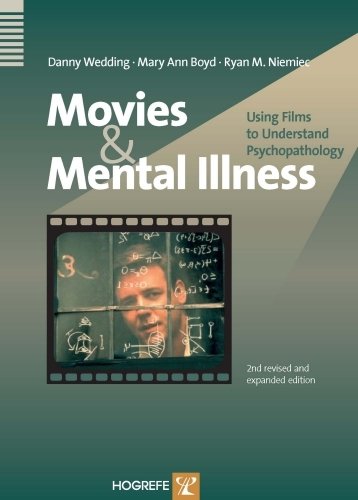
Synopsis
Films are a powerful medium for teaching students of psychology, social work, medicine, nursing, counselling, and also literature or media studies about psychopathology. The 15 core clinical chapters of this book thus each use a case history along with synopses and scenes from one or two specific, often well-known films to explain and teach students about the most important disorders encountered in clinical practice. Helpful teaching tools such as suggestions for class discussion and key issues to consider while viewing films are provided throughout.
Now in an updated edition, with expanded coverage of sleep, eating, impulse control, and adjustment disorders, as well as sexual dysfunction and violence, this book has established a great reputation as an enjoyable and highly memorable supplementary teaching tool for abnormal psychology classes.
"synopsis" may belong to another edition of this title.
From the Author
John Milton, in Paradise Lost, tells us that we must 'strike the visual nerve, for we have much to see.' So, too, in this present work, do Wedding, Boyd, and Niemiec admonish us that there is much to learn by seeing with the mind’s eye what these well-chosen films, by turns sad and silly, offer us in illuminating the psychopathologies set forth in the Diagnostic and Statistical Manual of the American Psychiatric Association. "Wedding, Boyd, and Niemiec provide a brief synopsis of the particular film in relation to the major category of psychopathology being covered in a chapter, and they relate the manifest and latent content of the film to the various diagnostic symptoms within a category, such as childhood disorders, and further provide an illustrative case study to assist in the process of generalizing from the film to actual diagnostic work. "The authors provide a lively expository style, and the use of epigraphs for each chapter is a particularly happy device for setting a tone for each chapter. "[This work] is likely to become a classic of its type and a particularly useful teaching tool for the diagnosis and understanding of the various psychopathologies for students of the helping professions. I commend it to the reader, be the reader student or professor.
Allan Barclay, PhD, St. Louis, Missouri
"About this title" may belong to another edition of this title.
Search results for Movies And Mental Illness: Using Films To Understand...

Stock Image
Movies And Mental Illness: Using Films To Understand Psychopathology
Published by
Hogrefe & Huber Pub (edition 2), 2005
ISBN 10: 0889372926
ISBN 13: 9780889372924
Used
Paperback
Seller: BooksRun, Philadelphia, PA, U.S.A.
Seller rating 5 out of 5 stars

Paperback. Condition: Good. 2. It's a preowned item in good condition and includes all the pages. It may have some general signs of wear and tear, such as markings, highlighting, slight damage to the cover, minimal wear to the binding, etc., but they will not affect the overall reading experience. Seller Inventory # 0889372926-11-1
Quantity: 1 available
Stock Image
Movies And Mental Illness: Using Films To Understand Psychopathology
Seller: Once Upon A Time Books, Siloam Springs, AR, U.S.A.
Seller rating 4 out of 5 stars

Paperback. Condition: Acceptable. This is a used book. It may contain highlighting/underlining and/or the book may show heavier signs of wear . It may also be ex-library or without dustjacket. This is a used book. It may contain highlighting/underlining and/or the book may show heavier signs of wear . It may also be ex-library or without dustjacket. Seller Inventory # mon0001277028
Quantity: 1 available
Stock Image
Movies and Mental Illness : Using Films to Understand Psychotherapy
Seller: Better World Books: West, Reno, NV, U.S.A.
Seller rating 5 out of 5 stars
Condition: Good. 2nd. Used book that is in clean, average condition without any missing pages. Seller Inventory # 5125127-6
Quantity: 3 available
Stock Image
Movies and Mental Illness : Using Films to Understand Psychotherapy
Seller: Better World Books, Mishawaka, IN, U.S.A.
Seller rating 5 out of 5 stars
Condition: Very Good. 2nd. Used book that is in excellent condition. May show signs of wear or have minor defects. Seller Inventory # 7724011-6
Quantity: 1 available
Stock Image
Movies And Mental Illness: Using Films To Understand Psychopathology
Seller: Half Price Books Inc., Dallas, TX, U.S.A.
Seller rating 5 out of 5 stars
paperback. Condition: Very Good. Connecting readers with great books since 1972! Used books may not include companion materials, and may have some shelf wear or limited writing. We ship orders daily and Customer Service is our top priority! Seller Inventory # S_445720389
Quantity: 1 available
Stock Image
Movies And Mental Illness: Using Films To Understand Psychopathology
Seller: ThriftBooks-Atlanta, AUSTELL, GA, U.S.A.
Seller rating 5 out of 5 stars
Paperback. Condition: Good. No Jacket. Pages can have notes/highlighting. Spine may show signs of wear. ~ ThriftBooks: Read More, Spend Less. Seller Inventory # G0889372926I3N00
Quantity: 1 available
Stock Image
Movies And Mental Illness: Using Films To Understand Psychopathology
Seller: ThriftBooks-Phoenix, Phoenix, AZ, U.S.A.
Seller rating 5 out of 5 stars
Paperback. Condition: Good. No Jacket. Pages can have notes/highlighting. Spine may show signs of wear. ~ ThriftBooks: Read More, Spend Less. Seller Inventory # G0889372926I3N00
Quantity: 1 available
Stock Image
Movies And Mental Illness: Using Films To Understand Psychopathology
Seller: ThriftBooks-Phoenix, Phoenix, AZ, U.S.A.
Seller rating 5 out of 5 stars
Paperback. Condition: Very Good. No Jacket. May have limited writing in cover pages. Pages are unmarked. ~ ThriftBooks: Read More, Spend Less. Seller Inventory # G0889372926I4N00
Quantity: 1 available
Stock Image
Movies And Mental Illness: Using Films To Understand Psychopathology
Seller: ThriftBooks-Dallas, Dallas, TX, U.S.A.
Seller rating 5 out of 5 stars
Paperback. Condition: Very Good. No Jacket. May have limited writing in cover pages. Pages are unmarked. ~ ThriftBooks: Read More, Spend Less. Seller Inventory # G0889372926I4N00
Quantity: 1 available
Stock Image
Movies And Mental Illness: Using Films To Understand Psychopathology
Seller: ThriftBooks-Atlanta, AUSTELL, GA, U.S.A.
Seller rating 5 out of 5 stars
Paperback. Condition: Very Good. No Jacket. May have limited writing in cover pages. Pages are unmarked. ~ ThriftBooks: Read More, Spend Less. Seller Inventory # G0889372926I4N00
Quantity: 1 available