
Items related to The Partnering Intelligence Fieldbook: Tools and Techniques...
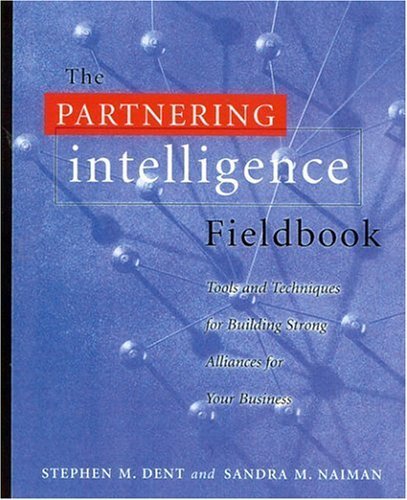
The Partnering Intelligence Fieldbook: Tools and Techniques for Building Strong Alliances for Your Business - Softcover
Synopsis
Full of tools, techniques, and skill-building exercises for increasing partnering intelligence, this step-by-step field book leads practitioners through the powerful stages of partnership and relationship development in a process that's been used to develop hundreds of successful partnerships in corporations.
"synopsis" may belong to another edition of this title.
About the Author
Stephen M. Dent is an internationally renowned author and consultant, and founding principal of Minneapolis-based Partnership Continuum, Inc. Through his research and application of the Partnerhsip Continuum model, he has helped organizations such as NASA, Bank of America, Exult, Xcel Energy, Girl Scouts of the USA, and hundreds of others form award-winning, sustainable, and profitable alliances and partnerships. This fieldbook is based on his book PARTNERING INTELLIGENCE.Sandra M. Naiman is a principal of Topline Associates, Inc., a Denver-based consulting firm specializing in helping clients accelerate revenue growth through business planning; selection, retention, and development of top talent; and achieving sales results through sales process improvement, activity management, and partnering. She has worked throughout the United States, Canada, Mexico, and Europe with clients such as Sun Microsystems, J.P. Morgan, Kellogg Corporation, Lockheed Martin, Ford, and Exxon Mobil.
Excerpt. © Reprinted by permission. All rights reserved.
INTRODUCTION
Every person or team using this fieldbook has the potential to be a great partner. We are naturally wired to want to work together. This is how we as a species have survived throughout our history. Enormous hardships such as climatic change, famine, wars, and plagues have not prevented us from prospering; arguably, the world is a safer, healthier, and wealthier place today than ever before.
One of the most important factors in moving humankind forward has been our ability to partner. While we can all cite examples of failed partnerships, thousands of successful partnering endeavors have improved lives and living conditions for all of us. Individual genius may exist in a Mozart or an Einstein, but most of humankind's achievements have been the result of people working together--a proven strategy for success.
Yet, being a great partner is not easy. In fact it often requires us to act in ways counter to what we have been taught and how we are socialized. We spend our formative years being dependent on our caregivers. Craving independence, we bound from the confines of our homes and families as soon as we are able--to be on our own and free to make our own choices. Our independence is rewarded as we are recognized for who we are and what we accomplish in school, clubs, sports, the arts, and other personal endeavors.
Partnering requires us to put aside our desires for immediate and instant self-gratification. Smart partners know that to be a great partner, you must understand and work hard to satisfy your partner's needs, and that in the process you will also get your needs met. It takes a huge leap of faith to believe that if you work hard to satisfy your partner's needs, he or she will work hard to satisfy yours. For this to happen, all the partners involved must have high Partnering Intelligence--the ability to create a partnering culture.
In this fieldbook, we offer you a step-by-step guide to how to use the Partnership Continuum (TM) model. The model comprises two separate yet intertwined and concurrent processes known as the Stages of Relationship Development and the Stages of Partnership Development. The Stages of Relationship Development--Form, Storm, Norm, and Perform--describe the behavioral cycle people travel to establish trust with each other in order to work well together. The Stages of Partnership Development--Assess, Explore, Initiate, and Commit--describe the steps required to build the partnership.
To benefit from these two sets of development stages, and to create a successful partnering culture, each partner, or potential partner, must be adept in the use of the behavioral skills known as the Six Partnering Attributes (TM), which include:
* Self-Disclosure and Feedback
* Win-Win Orientation
* Ability to Trust
* Future Orientation
* Comfort with Change
* Comfort with Interdependence
These skills are designed to provide you with personal insights and competencies you'll need to be able to navigate through the Stages of Relationship Development. Mastery of the Six Partnering Attributes is the goal of smart partners and smart organizations, creating an environment that allows trust to take root and flourish. This is critical if partners are to believe that each person is working hard to get the other's needs met.
Part One of this fieldbook is designed to help individuals understand and increase their competencies and skills in the Stages of Relationship Development, which are embodied in the Six Partnering Attributes. In Part Two we review the Partnership Continuum model and focus on the Stages of Partnership Development. This portion of the book is designed to be worked on in small groups.
Improving one's own Partnering Intelligence and following a deliberate and purposeful partnering process are the two crucial elements of building smart partnerships.
"About this title" may belong to another edition of this title.
Search results for The Partnering Intelligence Fieldbook: Tools and Techniques...

Stock Image
The Partnering Intelligence Fieldbook: Tools and Techniques for Building Strong Alliances for Your Business
Seller: BookHolders, Towson, MD, U.S.A.
Seller rating 5 out of 5 stars

Condition: Good. [ No Hassle 30 Day Returns ][ Ships Daily ] [ Underlining/Highlighting: NONE ] [ Writing: NONE ] [ Edition: First ] Publisher: davis-Black publishing Pub Date: 6/27/2002 Binding: Paperback Pages: 264 First edition. Seller Inventory # 5983152
Stock Image
The Partnering Intelligence Fieldbook: Tools and Techniques for Building Strong Alliances for Your Business
Seller: HPB-Red, Dallas, TX, U.S.A.
Seller rating 5 out of 5 stars
paperback. Condition: Good. Connecting readers with great books since 1972! Used textbooks may not include companion materials such as access codes, etc. May have some wear or writing/highlighting. We ship orders daily and Customer Service is our top priority! Seller Inventory # S_467459550
Seller Image
The Partnering Intelligence Fieldbook: Tools and Techniques for Building Strong Alliances for Your Business
Seller: Blue Vase Books, Interlochen, MI, U.S.A.
Seller rating 5 out of 5 stars
Condition: good. The item shows wear from consistent use, but it remains in good condition and works perfectly. All pages and cover are intact including the dust cover, if applicable . Spine may show signs of wear. Pages may include limited notes and highlighting. May NOT include discs, access code or other supplemental materials. Seller Inventory # BVV.0891061665.G
Stock Image
The Partnering Intelligence Fieldbook: Tools and Techniques for Building Strong Alliances for Your Business
Seller: SHIMEDIA, Brooklyn, NY, U.S.A.
Seller rating 4 out of 5 stars

Condition: New. Satisfaction Guaranteed or your money back. Seller Inventory # 0891061665