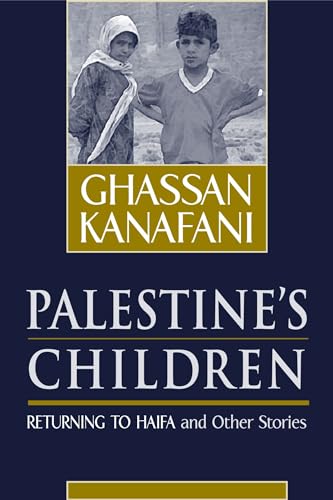
Palestine's Children: Returning to Haifa & Other Stories - Softcover

Kanafani, Ghassan

  • 4.44 out of 5 stars
    1,043 ratings by Goodreads
 
9780894108907: Palestine's Children: Returning to Haifa & Other Stories

Synopsis

"Palestine's Children offers the concerned reader an excellent work wherein the translation maintains the powerful spirit that animates the Arabic original."—Aida A. Bamia, Journal of Third World Studies

"[Kanafani] unabashedly depicts the hardship of life in the refugee camps, the agony of succumbing to numerous political or ideological shifts, and life nearly devoid of hope.... The novella Returning to Haifa speaks volumes about the enduring traumas of war.... In a moving, concise manner, this story touches upon many small issues that together contribute to the conflict between the Palestinians and Zionists including identity, language, class strife, and the deceptively difficult task of defining ‘homeland.'"—Christine Dykgraaf, MESA Bulletin

"Politics and the novel," Ghassan Kanafani once said, "are an indivisible case." Fadl al-Naqib reflected that Kanafani "wrote the Palestinian story, then he was written by it." His narratives offer entry into the Palestinian experience of the conflict that has anguished the people of the Middle East for more than a century.

In Palestine's Children, each story involves a child--a child who is victimized by political events and circumstances, but who nevertheless participates in the struggle toward a better future. As in Kanafani's other fiction, these stories explore the need to recover the past--the lost homeland--by action. At the same time, written by a major talent, they have a universal appeal.

This edition includes the translators' contextual introduction and a short biography of the author.

CONTENTS: 
  • Introduction—K.E. Riley and B. Harlow.
  • The Slope.
  • Paper from Ramleh.
  • A Present for the Holiday.
  • The Child Borrows His Uncle's Gun and Goes East to Safad.
  • Doctor Qassim Talks to Eva About Mansur Who Has Arrived in Safad.
  • Abu al-Hassan Ambushes an English Car.
  • The Child, His Father, and the Gun Go to the Citadel at Jaddin.
  • The Child Goes to the Camp.
  • The Child Discovers that the Key Looks Like an Axe.
  • Suliman's Friend Learns Many Things in One Night.
  • Hamid Stops Listening to the Uncles' Stories.
  • Guns in the Camp.
  • He Was a Child That Day.
  • Six Eagles and a Child.
  • Returning to Haifa.

"synopsis" may belong to another edition of this title.

About the Author

Born in Acre (northern Palestine) in 1936, Ghassan Kanafani was a prominent spokesman for the Popular Front for the Liberation of Palestine and founding editor of its weekly magazine Al-Hadaf. His novels and short stories have been published in sixteen languages. He, along with his niece, was killed in Beirut in 1972 in the explosion of his booby-trapped car.

Excerpt. © Reprinted by permission. All rights reserved.

Palestine's Children

Returning to Haifa and Other StoriesBy Ghassan Kanafani

Lynne Rienner Publishers

Copyright © 2000 Ghassan Kanafani
All right reserved.

ISBN: 9780894108907


Introduction


KAREN E. RILEY & BARBARA HARLOW


For nearly a century, politics, violence, anddiplomacy have all failed to resolve the complex, mythified,and misunderstood clash that since 1948 has come to beknown as the Arab-Israeli conflict. Certainly it is not for lack ofstudy; books on the subject in English alone could fill a small-townlibrary. Perhaps what has been missing?or ignored?throughoutis the quotidian human reality underlying the vitalhistory that continues to connect Palestinians everywhere to theland once called Palestine. Often, literature can provide thehuman dimension that the historian's work alone cannot. Theliterary works of the Palestinian writer Ghassan Kanafani resonatewith precisely that human dimension.


* * *


Ghassan Kanafani's activities as a writer were diverse, rangingfrom journalism and political essays to historical studies, theater,and literary criticism. As a journalist and critic, he playedan important role in introducing new authors and their worksto Arab readers. It was Kanafani as well who, in his study on the"Literature of Resistance in Occupied Palestine," first employedthe term "resistance" (muqawamah) in speaking of Palestinianliterature. His fiction, including short novels, stories, and children'sliterature?the stories and poems composed for his nieceLamees?represents a major contribution to modern Arabic literature.The stories, however, like Kanafani's other writings,address specifically the Palestinian situation. Kanafani describesthe political, social, and human realities that characterize thelives of his people at a critical period in their history, when thetraditional order and structure of their existence are being profoundlyaltered by events on both a regional and internationalscale. Kanafani's stories tell of mothers in the refugee campswho proudly send their sons to the fidayeen and who then visitthem in the mountains with gifts of food from home, of fatherswhose role of authority within the family is being threatened bythe transformations in their social world, of children who learnearly to fight for a place in that social order, of concern and loveand fear and suspicion among neighbors who feel threatened bystrangers in their land.

    The stories and novella translated in this volume are all setbetween 1936 and 1967. Many have as their temporal locus theyear 1948. The dates mark significant moments in the twentieth-centuryhistory of the Palestinians, for in 1936 there beganin Palestine a widespread popular revolt and 1967 saw a seriouscheck, in the form of the June War, to Palestinian national aspirations.In 1948, the state of Israel was founded, an eventaccompanied by the massive displacement of Palestinians fromtheir homeland and the beginning of the years and thendecades of exile. Each of the stories here involves in some way achild, a child who, though victimized by the structures ofauthority that dominate the social and political world he livesin, nonetheless, by assuming new roles, participates personallyin the struggle toward a new and different kind of future.

    Kanafani's stories present a Palestinian perspective on aconflict that has anguished the Middle East and the Arab worldfor most of the twentieth century. It is a perspective that is vitalto understand and to acknowledge, the product of the experienceof decades of dispossession and struggle that, although notunique to the Palestinians, finds in them both a real and a symbolicexpression. It is this experience that must be taken intoaccount in considering the violence and brutal intensity ofsome of the stories in this volume, a violence that is at the sametime rendered problematic in the internal conflicts of the charactersthemselves and in their literary and historical setting.

    The stories are told from the point of view of the childrenof Palestine by a writer who was long involved with their educationand development. Kanafani, who attended the UNRWAschools for Palestinian refugees in Damascus after he leftPalestine with his family in 1948, later became a teacher inthose same schools. The years he spent as a student and teacherwere to have a significant effect on his subsequent developmentas a writer.

    The tension between the political and historical events andtheir literary transformation distinguishes the writings ofGhassan Kanafani. Through narrative, historical necessities losetheir implacableness as faits accomplis and become rich withpossibility. According to Fawaz Turki, another Palestinianwriter, "If the Palestinian revolution is armed with a philosophyat all, it is armed with the anti-determinist vision of the open-endednessof the future." It is the open-endedness of the futurethat Kanafani creates and that becomes visible in his literaryexposition of the events of Palestinian history.

    Both "The Child Goes to the Camp" (1967) and "A Presentfor the Holiday" (1968) are set in the Palestinian refugee camps.These camps were first created in 1950 in order to provide temporaryshelter and sustenance for those people who wereobliged to flee their homes in Palestine in 1948. They were furtherpopulated by another generation of refugees in 1967, followingthe June War, when the areas now known as the WestBank and the Gaza Strip were occupied by Israel. Life in thecamps thus acquired a significance over time and a history thathas become crucial to the Palestinian experience. The childrenwho came in 1948 gave birth to children of their own, the awladal-mukhayyamat or "children of the camps." This historical significanceof the camp life is unavailable, however, to the child-narratorof "The Child Goes to the Camp." For him, it was arelentless present, a "time of hostilities," in which finding fivepounds in the street while he and his cousin Isam were collectingleftover produce from the market for the family's meal wassufficient to mark a turning point in his day-to-day existence."It was war-time," the story begins, only to qualify its terms."Not war really, but hostilities, to be precise ... a continuedstruggle with the enemy. In war, the winds of peace gather thecombatants to repose, truce, tranquility, the holiday of retreat.But this is not so with hostilities which are always never morethan a gunshot away, where you are always walking miraculouslybetween the shots. That's what it was, just as I was telling you,a time of hostilities." The conflicts exist within the society andinside the traditional order. "The whole thing is that there wereeighteen people from different generations living in one house,which would have been more than enough at any time.... Wefought for our food and then fought each other over how itwould be distributed amongst us. Then we fought again."Historical time has collapsed into hostile disorder, and past,present, and future generations vie with each other for immediatecontrol over the administration of five pounds.

    In "A Present for the Holiday," even commemorative timehas lost its ritual significance and symbolic value. The narratorhas been awakened by a telephone call from a friend who hasplans for a project to distribute holiday presents to the childrennewly arrived in the refugee camps following the 1967 war. "Iwas half asleep. The camps. Those stains on the forehead of ourweary morning, lacerations brandished like flags of defeat, billowingby chance above the plains of mud and dust and compassion."The story of the telephone call, interrupted by thenarrator's recollections of his own childhood in the camps, ispunctuated by the recurrent refrain: "But all that is beside thepoint." Its repetition suspends the movement from past tofuture in the meaninglessness of the present.

    "Guns in the Camp" (1969), still another story that has asits setting the Palestinian refugee camps, describes a transformationwithin the life of the camps, a transformation motivatedby the emergence of a budding resistance movement. Thestory is one of a series of episodes that tell the history of UmmSaad, a Palestinian mother who, as her husband Abu Saadproudly says of her, "has borne sons who have grown up tobecome fidayeen. She provides the children for Palestine." Theresistance movement becomes symbolic of a re-entry thatwould confer meaning on the past and create possibilities forthe future. "`The grapevine is blooming, cousin! The grapevineis blooming!' I stepped towards the door where Umm Saad wasbent over the dirt, where there grew?since a time which at thatmoment seemed to be infinitely remote?the strong firm stemswhich she had brought to me one morning. A green headsprouting through the dirt with a vigour that had a voice of itsown." Here the rootedness of the plant in the soil stands as asymbolic counterweight to the historical forces of displacementand dispersion. The alienation of dispossession is made toacquire through the literary and poetic images a creative powerof its own.

    Through the narrative, however, perhaps even more importantlythan through the imagery, Kanafani's stories contendwith chronology and its closures. In telling these stories, storiesof the Palestinian people and their children, Kanafani isretelling their history and re-establishing its chronology. Theepic flashback no less than the stream-of-consciousness servesto confute the sense of time and temporality. Historical datesbecome commemorative, "so that people would say," as in anearly story by Kanafani, "`it happened a month after the day ofthe massacre'." Works of literature, stories and novels, arebrought then to participate in the historiographic process. Thepolitical immediacy and historicity of these stories are, however,as much a part of a literary project as it is the case that literaturewill be used in the service of a given historical vision. Ofhis own relationship to literature and politics, Kanafani hassaid, "My political position springs from my being a novelist. Inso far as I am concerned, politics and the novel are an indivisiblecase and I can categorically state that I became politicallycommitted because I am a novelist, not the opposite. I startedwriting the story of my Palestinian life before I found a clearpolitical position or joined any organization."

    Kanafani's stories and literary histories are located within aspecific historical context. It is a context, however, whose verydeterminism the stories call into question through their narrativeexamination of interpretation and the parameters of storytelling.The questioning is undergone as well by the charactersthemselves in each of the stories. Four of these stories recountthe coming of age of Mansur, a child from the Galilee village ofMajd al-Kurum, who participates in a series of armed conflictssurrounding the establishment in 1948 of the state of Israel.Mansur's stories (1965) are: "The Child Borrows His Uncle'sGun and Goes East to Safad," "Doctor Qassim Talks to EvaAbout Mansur Who Has Arrived in Safad," "Abu al-HassanAmbushes an English Car," and "The Child, His Father, and theGun Go to the Citadel at Jaddin." Mansur must find someonefrom whom he can borrow a gun in order to join the battlebeing waged by the villagers at Safad. Guns, however, are thepossessions of adults, his father, his uncle, the older men of thevillages, and Mansur is subject to their authority. If his father isnot interested in his ideals of resistance and patriotism,Mansur's uncle, Abu al-Hassan, tells him that he is too young,that he is just a child. And Hajj Abbas wants to negotiate afinancial arrangement. Doctor Qassim, Mansur's older brother,meanwhile is having breakfast with Eva, a Jewish girl in Haifa.

    In telling the story of the child Mansur's role in the 1948struggle, Kanafani narrates the larger political and social conflictscreated within the Palestinian community from outside.According to Ann Lesch, a political historian of Palestine underthe British Mandate, "the generational differences within theArab political leadership played an important political role. Theolder politicians tended to be more conciliatory, more willingto work within legal channels than the young men, [but] theimpact of the generational division was reduced by the Arabs'deferential culture. Respect for one's father and for an elderstatesman who consulted the other leaders and expressed thegeneral consensus remained powerful forces, drawing togetherthe differing drives of young and old in a politically effectivemanner." At the same time, then, that the social order ofPalestinian life is being attacked by foreign forces, the traditionalstructures of authority serve to sustain vital elements of thesense of community and solidarity. The authoritative structures,however, are being radically modified by the forces of circumstanceand the political coming of age of the child. WhenMansur at last reaches the citadel at Jaddin, his second expeditionfollowing upon the skirmish at Safad, he finds his fatherpresent there in the circle of armed men. In the moment ofretreat, however, Abu Qassim is left behind. It is Mansur whoreturns for him, only to find him fatally wounded. "Mansurstood in the wet emptiness watching his father slowly dying,impotent and unmoving except for the deep throbbing whichshook him. His veins were like taut wires bulging from hishands and extending around the torso of the gun. Finally theyall began to blur together: the tree, the man and the gun, frombehind the darkness of the angry rain, and through his tears.But to Mansur, they were not together. There was only the quietcorpse."

    Mansur, on his way to participate in the events ofPalestine's history, has traversed the Galilean countryside, visitingits villages, skirting its fields, and making his way across thejunctions of its thoroughfares. Like other of Kanafani's stories,including "Paper from Ramleh" (1956) and "He Was a ChildThat Day" (1969), the fictional narratives provide not only ahistorical account of Palestine, but a topographical record aswell. Much of the area and its villages no longer exist as theyonce did; they have been not only obliterated by the passage oftime, but destroyed, rebuilt, and renamed by political events.What James Joyce did for Dublin or William Faulkner for theU.S. South, Kanafani in his stories has provided for Palestine.The intimate connection between history and the land is essentialto Palestinian political and cultural ideology, its poetry, itsprocesses, and its praxis. Despite the transformations and reinterpretationsto which it has been subjected, the stories'record is there.

    Returning to Haifa has two historical settings, roughlytwenty years apart: 1948 and 1967. The primary action takesplace a few weeks after the end of the June 1967 war in whichIsrael captured the West Bank, Sinai, Gaza, and the Golan. Forthe first time since 1948, the borders between pre-1967 Israeland the West Bank and Gaza are opened by the Israelis for passageby Palestinians. As the novella's protagonists, Said S. andhis wife Safiyya, make their way from their West Bank home inRamallah back to Haifa, their former home, their thoughts areinterwoven with memories of the events of April 21, 1948,when they, along with thousands of Haifa's Palestinian residents,left the city in a panicked exodus as it changed overnightfrom British to Jewish control. The dramatic flight ofPalestinians during the battle for Haifa forms the central imageof Returning to Haifa's opening chapter and also the axisaround which the protagonists' lives develop and much of thenovella's later dialogue revolves.

    In February 1947, Great Britain, the mandatory power governingPalestine since the aftermath of World War I, announcedthat the mandate had become unworkable due to the increasinglyviolent and uncontrollable conflict between the nativePalestinians and Zionists intent on their goal of establishing aJewish homeland in Palestine. Britain's decision to relinquishPalestine upon expiration of the mandate pushed the matterinto the hands of the United Nations, which recommended partitioninto Arab and Jewish states.

    From that point on, fierce struggles ensued for control asthe British began to evacuate city after city and the Jewishforces sought to secure not only the territory allotted for aJewish state but also territory allotted for an Arab state by theUnited Nations partition plan. By May 14, 1948, the day onwhich Israel declared its statehood, at least 200,000 Palestinianshad fled Palestine; by the end of the war that ensued, some700,000 had become refugees. Many settled in West Banktowns, and approximately 150,000 Palestinians remained withinthe borders of what became the state of Israel. In the aftermathof the war, Jordan annexed the West Bank, and the Palestiniansliving there came under Jordanian rule. The situation remainedthus for nearly twenty years until, in June 1967, the bordersbetween the original state of Israel and the territories capturedin the Six Day War were opened to Palestinians for passage.Refugees who had settled in the West Bank or Gaza could nowreturn to see their old homes. Children too young to remember1948, and children born in exile, were now able to see for thefirst time the homes they knew of only from their parents'reminiscences.

    The opening of the border between Israel and the newlyoccupied territories in 1967 allowed the exiled Palestinians toconfront physically their past lives, and at the same time forceda psychological confrontation with the reasons for that exile. Itis not surprising, therefore, that Ghassan Kanafani shouldexplore this collision within the framework of a novella, sinceall of his fiction is intimately tied to the emotional heart of thePalestinian community, not just reflecting it but actually constitutinga vital part of that community's psychological evolution.

    In Returning to Haifa, that psychological evolution isreflected by Kanafani's juxtaposition of the events of 1948 and1967. Radwa Ashur points out that Said's and Safiyya's journeyback to Haifa is representative of the Palestinian people as awhole at that stage facing up to its responsibility for losing, or"abandoning," Palestine and the fruitlessness of having spenttwenty years doing little more than crying over the loss.Kanafani recreates that sense of loss and fruitlessness by parallelingthe political events of 1967 with the "abandonment" ofthe infant Khaldun in 1948. By layering the two settings, hecaptures the fundamental influence that the loss continued toexert on the Palestinians' existence, remaining with them "inevery bite of food" they took throughout the intervening twentyyears. This duality of psychological and political exile is alsoprojected by Kanafani's narrative style. Referring to Men in theSun, Edward Said writes:


Kanafani's very sentences express instability and fluctuation?the present tense is subject to echoes from the past, verbs of sight give way to verbs of sound or smell, and one sense interweaves with another?in an effort to defend against the harsh present and to protect some particularly cherished fragment of the past.


His commentary is particularly applicable to Returning toHaifa, since the novella's very structure is based on reliving inthe present a past event at the site where it first took place.Transitions from past to present and vice-versa occur seeminglyarbitrarily, in the same way that memory and reality intermingle,giving the novella a sense of temporal ambiguity.

    The present itself is experienced as if it were already amemory, already lost, such as when Safiyya, in the midst of herdesperate flight through Haifa, realizes that she has left herinfant son behind. She feels she will never again be able to faceher husband, and is frightened that she is "about to lose themboth?Said and Khaldun." She becomes aware that the memoryof the present moment will have bitter repercussions on thefuture. It is a poignant portrayal of the sense of loss, brilliantlyfashioned by Kanafani.

    The imagery in Returning to Haifa is also marked by thisrelationship between time and space, between loss and memory,concretizing the pivotal role played by memory in the emotionaland physical condition endured by the Palestinian exileas a result of the cataclysmic loss suffered in 1948. When, forexample, Said first catches sight of his former house in Haifa, hesees it not as it is, but as he remembers it, and instantaneouslyhe imagines that his wife, "young again with her hair in a longbraid," will step out onto the balcony. Immediately upon theheels of this interplay of memory inside Said's mind, Kanafaniinserts a statement describing something new and differentabout what Said is looking at, skillfully looping past, present,and future together: past, because of Said's memories; presentbecause he is pulled back from recollection; and future, becausethe vivid detail heightens the expectation that something "newand different" may happen to Said. This congruence of imageryand temporal interaction simultaneously evokes the loss ofSafiyya's youth as well as the loss of the home in which theyonce lived and, by extension, the loss of Palestine. At the sametime, it foreshadows the change in Said, his ultimate recognitionthat man is indeed a cause and his discovery of "the truePalestine, the Palestine that's more than memories, more thanpeacock feathers, more than a son, more than scars written bybullets on the stairs."

    Such images are implicit, in that they convey a multidimensionalunit of time triggered by the sight of the house. Otherimages are explicit, such as when, near the novella's conclusion,Said reflects that his memories of his child are nothing morethan "a handful of snow" melted by the sun. Forced to confrontthe reality of the past?the old/new house, the old/new inhabitants,the old/new son?Said recognizes that the past has "melted"and been replaced by a new reality. He has made, in effect, ajudgment, and with it, a new commitment.

    There is, in addition, a certain dissonance in Kanafani'simagery that serves to highlight not only the violence of 1948,but also its brutal abruptness and the powerlessness felt by thePalestinians in the face of it. There is little sense of the normalpassage of time, for example: events occur "suddenly" or characters"suddenly" become aware of something?such as thesound of the ocean?or of events or feelings that normally onewould perceive gradually. There are images of violence anddestruction: "walls collapse" in conveying the recall of a memory;people are "hurled down" or struck by an "electric shock" asa result of verbal exchanges that cause mental rather thanphysical confrontation. Frequently, these images are internalized,as when names "rain down inside" a protagonist's head.

    All of these aspects of Kanafani's style make translationespecially difficult because an exact rendering can result inunconventional or even awkward English. Yet it is critical toaccentuate such ambiguities of tense or image in order to maintainthe integrity of the original as an expression of thePalestinians' emotional, psychological, and political conflictand frustration.

    Politics imposes itself on Kanafani's style in yet another, butmore indirect manner. He wrote extensively?indeed, daily inlater years?for newspapers and political and news magazinesor journals. His commitment both to the Palestinian cause andto the craft of writing was so strong that he felt compelled tocapture each moment of Palestinian experience by expressinghimself in every genre available to him, despite advice fromfriends and critics that he put aside journalism and concentrateon literature. The year in which Returning to Haifa was published,1969, was one of intense journalistic activity for him, ashe founded and became editor-in-chief of al-Hadaf. InReturning to Haifa certain repetitive expressions appear frequently,paralleling journalistic Arabic, which tends to employformulaic expressions that are recognizable as the accepted wayof making certain statements. As such, notably in a late worklike Returning to Haifa, these recurrences constitute an elementof Kanafani's style that is directly related to the circumstancesof his own life as well as his political position.

    At the time Kanafani wrote Returning to Haifa, he was formulatinga sense of the Palestinian struggle as one of social andpolitical justice. In an interview he once stated:


At first I wrote about Palestine as a cause in and of itself.... Then I came to see Palestine as a symbol of humanity.... When I portray the Palestinian misery, I am really presenting the Palestinian as a symbol of misery in all the world.


As noted earlier, in 1969 he became the official spokesman ofthe Marxist PFLP, and his other fictional work of that year,Umm Saad, explores the issues of oppression and class strugglethat lead to political action and social revolution.

    In Returning to Haifa, he approaches these philosophicalexplorations differently. The two Jewish characters, IphratKoshen and his wife Miriam, far from being Zionist zealots, areportrayed instead as ordinary Jews fleeing Nazi Poland, misledby idealized Zionist literature into expecting something quitedifferent from the reality they found upon reaching Palestine.Ashur credits Kanafani with the first attempt in Arabic literatureto portray Jewish characters as sensitive human beingsrather than as caricatures of the enemy. When Miriam sees adead Arab child being tossed into the garbage by a Jewish soldier,she identifies the child with her own young brother, killedbefore her eyes by the Nazis, and she wants to leave Palestineimmediately. Of Miriam, Ashur notes:


Ghassan Kanafani relates, by means of this character and her history, for the first time in Arabic literature, the agony of oppressed peoples in all places, the agony of Palestinians at the hands of the Zionists and the agony of the Jews at the hands of the Nazis.


    Miriam and Iphrat, however, do not leave Palestine, despitetheir initial moral misgivings. The justifications for theirremaining, along with the reasons for the Palestinians' departure,are explored by Kanafani through the device of a conversationamong the Arab and Jewish protagonists, set in what hadonce been Said's and Safiyya's house. According to critic F.Mansur, the dialogue between these characters represents


the first time the Palestinian and the Jew meet each other, not on the battlefield but in a normal room, where each of them puts forth his point of view and discusses it with the other.


The discussion is as thought-provoking to the reader today as itwas to the Palestinian community at the time it was written.

    Kanafani was a highly successful journalist, widely publishedand read. Yet, he continued to write stories. If his onlyaim had been the expression of political ideology and analysis,he would have had ample opportunity to do so without undertakingthe additional task of creating an artistic framework forhis ideas. To concentrate, therefore, exclusively on the symbolismor the political or ideological posture of Returning to Haifais to lose sight of an important aspect of its value and impact.Like all of Kanafani's works, Returning to Haifa is realistic, filledwith the physical details and vital turns of emotion of botheveryday life and momentous historical events. According toAshur, it is this "piercing grasp of reality" that distinguishesKanafani's works from the greater part of Palestinian fictionwhich, up to that point, tended to rely on the sympathy it mightarouse in the reader but which inevitably presented a false orflat picture that "ignored the full dimensions and complications"making up the reality of the situation.

    Kanafani himself on numerous occasions expressed theimportance of realism: "In my novels I express reality, as Iunderstand it, without analysis." In an interview given shortlybefore his death and published posthumously, several of hiscomments shed light on the importance he gave to this aspectof his writing:


I think the greatest influence on my writing goes back to reality itself, what I witnessed, the experiences of my friends and family and brothers and students, my life in the camps with poverty and misery.


I didn't choose my characters for artistic literary reasons. All of them came from the camp, not from outside of it.


When I review all the stories I have written about Palestine up to now, it seems to me that every story is tied, directly or indirectly, by a thin or strong thread, to my personal experiences in life.


An earlier statement about his aims sums up the relationshipbetween realism and symbolism or ideology in his fictionalworks: "I want my stories to be one hundred percent realisticwhile at the same time presenting something unseen."

    In Returning to Haifa it is the realistic details that lead tothe "something unseen." The portrayal of the mass exodus fromHaifa is gripping and vivid not only because it is grounded inhistorical fact, but because Kanafani renders it with acute sensitivity.The minute details of Said's and Safiyya's house in Haifa,and their "rediscovery" of those details, vibrate with feeling andreveal their relationship to the house now and in their memories.The atmosphere is emotionally charged and builds up asthe novella unfolds with quiet intensity, preparing the readerfor the climactic dialogue that explodes into the "somethingunseen": the human and emotional dimension underlying thepolitical dilemma of the Palestinian question for more thanforty years.

    Mansur states that Returning to Haifa is Kanafani's"masterpiece ... his most mature work," and goes on to postulate that"after Returning to Haifa, there was no room to doubt thatwhen the definitive Palestinian novel was written, its authorwould be Ghassan Kanafani." These statements have validityprecisely because this work is more than a "historical politicaldocument." The political dynamics have changed in the interveningyears since it was written, but the social dynamics thatcharacterize the Palestinian conflict have not. Two generationsafter 1948, people's lives continue to be disrupted at the mostelemental levels as a result of what happened in 1948. Thehuman dimension is what Ghassan Kanafani succeeds inexpressing through the images, the narrative style, and the compellingrealism of Returning to Haifa, and it is what continuesto make his work so compelling today.


Chapter One


The Slope


Muhsin walked with slow hesitatingsteps along the corridor leading to his classroom.This was to be his first experience in the world ofteaching and he did not see why he had to go in just then. Hewas doing his utmost to postpone the moment as long aspossible.

    He had spent the night before tossing and turning in hisbed until morning thinking about one thing: how hard it wasfor someone to stand up in front of people ... and for what? Toteach them! Who do you think you are? he asked himself. You'vespent your miserable life without anyone teaching you anythinguseful. Do you really think you have anything to teach others?You, of all people, who have always believed that school was thelast place where a man learns about life? And now you're goingto be a schoolteacher?

    In the morning he dragged himself off to the principal'soffice where he sat listening to the other teachers discussingmuch the same question, only it was from another point ofview ...

    "What are we supposed to do in this class when the childrenhave no books?"

    The principal's reply was short and even disdainful: "Aqualified teacher knows how to conduct his class withoutbooks!" Then he added nastily: "Just ask one of the children totake care of the class for you if you can't do it yourself."

    Muhsin thought to himself: "It seems this principal wantsto give his teachers a lesson in discipline and obedience rightfrom the start. He's had our salaries for a week and now hewants to get our souls as well." He gulped down his tea andstood up ...

    The long corridor was filled with the shouts and clamor ofchildren. It seemed to Muhsin, with his heavy steps, that he wasmoving through an eddying whirlpool leading him into ameaningless future, a future of nothing but more noise andmore nonsense.

    "I have a good story, teacher! ..." This was shouted out by achild slumped in one of the last seats who saw the confusion asa likely opportunity to tell his story. And before Muhsin couldeven object to the suggestion the child had left his seat and wasfacing his comrades. He was wearing short pants that were fartoo large for him and a shirt made out of old material, thekind women wear. His thick black hair hung down to his eyebrows.

    "My father was a good man. His hair was white and he hadonly one eye. His other eye he had poked out himself one daywhen he was stitching the thick sole of a heavy man's shoe. Hewas trying hard to get the big needle into the leather, but thesole was very tough. He pushed on the needle with everythinghe had in him, but no luck. He pushed harder and still it didn'tgo. Then he put the shoe to his chest and pushed with all hismight. All of a sudden the needle went through one side andout the other straight into his eye.

    "My father was a good man. He didn't have a long beard,but then it wasn't so short either. He worked very hard and hewas good at his work. He always had a lot of shoes to repair andmake like new.

    "But my father didn't own his own repair shop and therewas no one to help him in his work. His shop was really notmuch more than a box made out of wood and sheet metal andcardboard. There was hardly even enough room for him, somenails, and the shoes and the anvil. Any more and there wouldn'teven be room for a fly. If a customer wants his shoes repaired hehas to wait outside the shop ...

    "The shop was on the side of a hill, and at the top of the hillwas the palace of a rich man. No one who looked for the shopfrom the balcony of this rich man's palace would be able to seethat it was there, because there were plants growing all alongthe ground. And so my father was not afraid that the owner ofthe palace would discover his hiding place and make him leave.The rich man never left his palace. His servants took care ofbringing everything he wanted to the palace. They all agreedthat they would keep my father's secret from their master onthe condition that he would repair their shoes in return.

    "So my father went on about his work and wasn't afraid.People found out that he could repair shoes so well that theycame out looking like new. More and more shoes were broughtto him every day. He worked without stopping all day and halfthe night. And then he said to my mother: `Tomorrow the childrenare going to go to school.' To which my mother answered:`Then you'll rest a little from all this work.'"

    When the child went back to his seat, his comrades satabsolutely still, so Muhsin asked: "Why don't you clap for yourfriend? Didn't you like his story?"

    "We want to hear the rest of it ..."

    "Is there any more to your story?"

    "A month ago or maybe more it got to be that my fatherhad so much work piled up that he couldn't even come homeany more. My mother told us that he was working night andday and couldn't leave his shop. He had no time to go out.Meanwhile the rich man sat on his balcony all day long and allnight eating bananas and oranges and almonds and walnutsand throwing away the peels and shells. He threw them over therails of the balcony of his palace and onto the side of the hill.One morning the hillside was so covered with all these peelsand shells that the servants couldn't even find my father's boxin the middle of all of them. My mother says that he was soabsorbed in his work that he never even noticed all the stuffthat was thrown on top of his box. He worked just as he alwaysdid. Probably he is still sitting in his box, working away atrepairing all the shoes he has so that he can finish them on timeand go home. But what I think is that he died there."

    The pupils all clapped when the child returned to his seat,where he sat quietly. Sixty staring eyes, a twinkle, but Muhsin...

    Muhsin took the child to the principal's office, and on theway there he asked him: "Do you really think your father isdead?"

    "My father didn't die. I only said that so that the storywould end. If I didn't, it would never end. Summer is coming ina couple of months and the sun will dry up all the piles of peelsand shells, so they won't be so heavy and then my father canmove them away from on top of him and go back to the house."

    When Muhsin reached the principal's office he said to him:"I have a genius in my class. He's incredible. Ask him to tell youthe story of his father ..."

    "What's your father's story?"

    "His shop is very small and he is very skillful. One day hisfame reached the owner of the palace that looks out over his littleshop, and the rich man sent my father all the old shoes hehad and told my father to repair them and make them like newagain. All the servants set to work carrying the shoes to the littleshop. They worked for two whole days, and when they had finishedbringing all the shoes, my father was completely smotheredunder the huge pile and there was not enough room in theshop for all the shoes ..."

    The principal put his thumbs in his vest pockets, reflected amoment, and said: "This child is crazy. We had better send himto another school."

    The child said: "But I'm not crazy. Just go to the rich man'spalace and look at his shoes and you'll find little pieces of myfather's flesh on them. Maybe you'll even find his eyes and hisnose in the sole of one of the shoes ... Just go there ..."

    The principal interrupted: "In my opinion this child iscrazy."

    Muhsin answered him: "He's not crazy. I myself used tobring my shoes to his father's to be repaired. The last time Iwent, they told me he was dead."

    "How did he die?"

    "He was pounding the sole of an old shoe. One day hepounded a great many nails into an old shoe to make itabsolutely firm. When he had finished he found that he hadnailed his fingers between the shoe and the anvil. Just imagine!He was so strong that he could pound a nail through an anvil.But when he tried to get up, he couldn't. He was stuck right tothe anvil. The passers-by refused to help him and he remainedthere until he died."

    The principal looked again at Muhsin, who was standingbeside the child, one next to the other as if they were one. Heshook his head several times without saying anything. Then hewent back and sat down in his soft leather chair and began toleaf through his papers, looking from time to time out of thecorner of his eye at Muhsin and the child.

?translated by Barbara Harlow

Continues...

Excerpted from Palestine's Childrenby Ghassan Kanafani Copyright © 2000 by Ghassan Kanafani. Excerpted by permission.
All rights reserved. No part of this excerpt may be reproduced or reprinted without permission in writing from the publisher.
Excerpts are provided by Dial-A-Book Inc. solely for the personal use of visitors to this web site.

"About this title" may belong to another edition of this title.

Other Popular Editions of the Same Title