
Items related to Privacy: It's None of Your Business
Synopsis
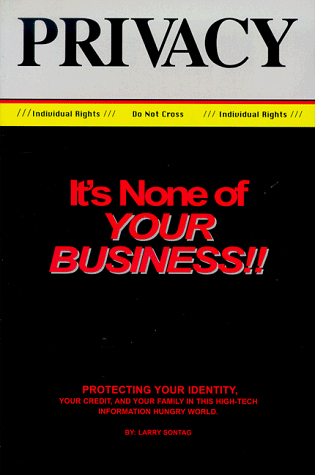
It's None of Your Business is the most consumer-friendly, powerful, and informative book written on protecting and regaining your privacy. It points out not only the problems associated with our loss of privacy, but includes literally a warehouse of strategies and solutions. The book also addresses those most at risk, including women, the elderly, victims of stalkers, and those with significant assets. It contains complete sections discussing what to do in the home, at work, in public, in school, on the Internet, on the phone, at the bank, at a store, using the mail, dealing with insurance companies, travel, and investing. It provides extensive background material showing where the risks are, how to minimize them, and how to develop a plan of action to protect yourself, your identity, your credit, and your family. The author also provides incredible insight into the root causes of the problem, showing government and big business plans for the future in a cash-less society, where the government has instant access to your bank account and big business controls everything you are allowed to purchase. He comments on the collusion between business and government for complete control of your health care, finances, employment, transportation, education, social, and professional life, and even where you live. The greatest value of the book however, is that it is crammed with solutions, from controlling who has access to information about your private life and where you live, to what information goes into the major data banks, to what to do to protect your assets. Strategies are spelled out in layman's terms that everyone can understand. Unlike many books that give out a little information and leave you needing more, this book provides details about how to control the dissemination of every type of personal information you can imagine. It also contains an excellent resource section listing dozens of books, organizations, web sites, and newsletters to keep you informed and to help with your personal plan of action.
Because the author has spent over 15 years in the database consulting business, he is well versed in the potential for errors in huge data files that are kept on everyone. He addresses the problem of finding the files containing your personal data and then how difficult it is to extract information from them whether they be in big business or government agencies' computers. He notes that it is easy to get into a database, but very difficult, if not impossible, to get out of one. He also discusses how difficult it is to correct information that is contained therein. He includes strategies for improving the accuracy of personal data files and ways of stopping the addition of new data into the files. He also includes a discussion of the Y2K computer bug and its impact on the proliferation of inaccurate data. He suggests ways of preparing yourself and your family so that necessary information is available to medical personnel or financial institutions should data be lost or made unavailable because of loss of electricity or other essential services. Because data in these huge files is so important and yet so difficult to monitor, the author provides a wide range of options and strategies to take back control of one's personal information, so that it is accessible to them and truly their own, not subject to the whims and mistakes of large impersonal bureaucracies. He also discusses in great detail how to protect personal data on one's own computer so that it is not available to everyone else and so that it is safe from viruses and other programs that are capable of stealing or altering it when the owner is unaware. He suggests a variety of programs and strategies that anyone can implement at low cost to protect themselves while surfing the Internet or doing other online transactions.
Not only are there strategies for taking back control of personal information, but the author delves into the larger issues of freedom and control. He provides great insight into the inner workings of business and government agencies, showing their true plans and schemes for the manipulation of the consumer. He shows how you can short circuit these plans so that you can lead a life of your own choosing, free from dictatorial controls and constraints. He provides information about private banking, health care, employment, investing, and normal everyday purchases. Because most people are unaware of the myriad of resources out there for providing everyday needs without public disclosure to the world, the author lists dozens of ways the average person can live their life completely normal, but without revealing to the world all the intimate details, thereby maintaining the right to make their own decisions about what is right for themselves and their families. No other book does such a complete job of providing strategies and plans for gaining back control of one's own identity and life.
"synopsis" may belong to another edition of this title.
About the Author
Larry Sontag, a Washington native and current resident has been a contract database programming consultant for the past 15 years. His clients include small and large businesses alike, from Boeing and NOAA to insurance companies, retail businesses, municipal departments, and nation-wide franchises. Prior to his consulting business, he taught special education, secondary math, and science in public and private schools in New England. He has also developed and led computer application seminars for business personnel along with teaching on the college level. He has a Bachelors degree in Chemistry and a Masters in Education. He is a strong individualist and believer in inherent human rights. As an amateur inventor and inveterate entrepreneur, he loves the thrill of a challenge, and the mastery of new skills or knowledge. He also believes in the power and value of volunteerism. As a former VISTA volunteer and Big Brother, he espouses giving back to society and one's fellow man. He has traveled extensively, especially in the U.S., Canada, and Mexico, but also in Europe and the Caribbean. Favorite recreational interests include skiing, woodworking, hiking, traveling, and tennis.
From the Back Cover
Government, big business, and common thieves are monitoring your every move, every purchase, every visit to the doctor, every phone call. Your safety and financial security depend on your ability to regain your privacy. Strangers now know more about you than you do. With Twentieth Century technology you leave an electronic trail wherever you go. Your personal information is stored, analyzed, and shared with people who can and do use it for profit. Your very identity is threatened as today's high-tech computers allow thieves to virtually steal your name, your credit, your medical history and your good reputation. You can and MUST protect yourself! Current laws protecting privacy are completely inadequate. Government has a vested interest in reducing, not increasing our rights to privacy protection. This book contains up-to-date information on how you can fight back by taking yourself off mailing lists, keeping your financial transactions completely private, preventing big business and bureaucrats from gathering more data about you, surfing the Internet anonymously, learning how to communicate, travel, and receive medical care privately, and protecting your identity, credit, and your physical safety by small changes in your daily routines and behaviors. You can dictate what others know about you. This book shows you in complete detail, what to do and how to do it. Its an invaluable aid for those being stalked or harassed in any way, and for any one who needs the security of anonymity.
Excerpt. © Reprinted by permission. All rights reserved.
Section one entitled "Who's Spying on You and How Bad Is It?" examines various ways that our lives are observed, how information is gathered, and by whom. The author begins with video surveillance, and how our activities are videotaped at every turn in some of the most innocent and unsuspecting places imaginable. He gives extensive disclosure of how our lives are documented, beginning at birth, and then by schools, employers, doctors, driver's license bureaus, insurance companies, credit agencies, utility companies, law enforcement, and various government agencies throughout our lifetime. He examines how the IRS, marketing companies, and even criminals obtain and use this information to invade and control our lives. He also points out the myriad of data that is gathered by the most unsuspecting means, and how our personal safety is placed at risk. He points out how information gets corrupted, which causes a snowball effect with credit agencies, medical and insurance records.
Section two on strategies for taking back control is the most extensive and detailed section of the book. In it the entire privacy issue is covered, from A to Z, beginning with our rights to privacy and what laws and the Constitution say about the subject. The author names various information gathering groups and organizations (both public and private), and how we inadvertently add to the problem by giving out personal data at the most innocent of times and circumstances. Special treatment is given to those with even greater than average risk of privacy invasion, like the elderly, women, and victims of stalkers. He provides strategies for every type of situation, and advice on who, what, when, and where to avoid, so the reader can be aware of potential traps and dangers. He examines the pitfalls of the proposed national ID, and various forms of legislation that members of Congress have drafted to help solve the problem. Sontag discusses the phenomenon of Y2K, which will begin to affect many businesses as early as March 1, 1999, and will add to the problem of data integrity. He also suggests ways to prepare, especially with regard to personal records.
Section three instructs the reader on how to structure a plan for taking back control of their personal information. In this chapter, Sontag provides over 100 thought-provoking actions and strategies that can be taken immediately. He examines the issue of identity, how to protect it, and how to stay anonymous. His strategies are part of a carefully drafted campaign of counter measures to aid the reader in regaining control of their lives and privacy. He explains the importance and uses of trusts, how they can be used to protect a person's estate and assets, and how they can be used in the running of a business to provide tax benefits and protection from lawsuits. He also discloses how the reader can begin to impair the privacy invasion, by short-circuiting the ongoing accumulation of credit, financial, and banking information. Lastly, he discusses insurance, employment, communications, purchases, and licensing along with many other facets of a person's life and what to do in each area to gain back control.
Section four provides the reader with sources of information where they can become educated and stay informed on the issue of privacy. He cites legislation that was drafted to protect privacy, but which often acts against the best interests of consumers. Sontag includes the names of support groups, books, and other publications, as well as web sites of non-profit organizations and news clip services who regularly monitor the news and keep the consumer informed.
"About this title" may belong to another edition of this title.
Search results for Privacy: It's None of Your Business

Seller Image
Privacy: It's None of Your Business
Published by
Peanut Butter Pub, 1998
ISBN 10: 0897168569
ISBN 13: 9780897168564
Used
Soft cover
First Edition
Seller: Rosario Beach Rare Books, Lake Stevens, WA, U.S.A.
Seller rating 5 out of 5 stars

Soft cover. Condition: Near Fine. 1st Edition. *Veteran-Owned, Family-Run, Small Book Store in the Pacific Northwest* FAST SHIPPING!! Clean text, no markings, tight binding. 206 pp. Seller Inventory # ABE-1780104035122