
Items related to Wave of Terror
Synopsis
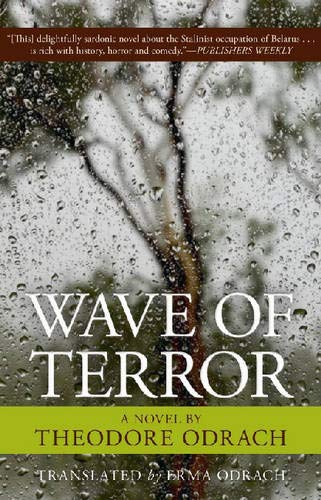
This novel is a major literary discovery, and Odrach is drawing favorable comparisons with such eminent writers as Chekhov and Solzhenitsyn. Odrach wrote in Ukrainian, while living an exile's life in Toronto. This remarkable book is a microcosm of Soviet history, and Odrach provides a first-hand account of events during the Stalinist era that newsreels never covered. It has special value as a sensitive and realistic portrait of the times, while capturing the internal drama of the characters with psychological concision. Odrach creates a powerful and moving picture, and manages to show what life was really like under the brutal dictatorship of Stalin, and brings cataclysmic events of history to a human scale.
"synopsis" may belong to another edition of this title.
About the Author
Theodore Odrach wrote three novels, two collections of short stories, and two non-fiction works, all but one (Wave of Terror) published during his lifetime in Ukranian, the language of their original composition. He was born Theodore Sholomitsky in 1912 near Pinsk, Belarus, in the heart of the Pinsk Marshes. At the age of 9, he was caught stealing and was sent by the Polish authorities to reform school in Vilnius. He remained in Vilnius and, when he came of age, enrolled in Stephan Bathory University (now Vilnius University) where he studied philosophy and ancient history. When the Bolsheviks invaded Vilnius in 1939, Odrach returned to Pinsk, where he became a teacher and, later, the editor of an underground, anti-communist newspaper, The Informer. Denounced by the Soviets, he fled to Ukraine where he assumed a Ukranian identity, then found his way across the Carpathian mountains into Czechoslovakia. Eventually, he made his way to Germany, then England, and settled in Toronto in 1953. He died in 1964.
For the past twenty years (on and off) Erma Odrach has been translating the works of her father. Many of her translations have appeared in literary journals in Canada and the U.S.: Translation (Columbia University), Mobius: the Journal of Social Change; Flipside (California University of Pennsylvania); Antigonsh Review and Connecticut Review, to mention a few. In 1993 Erma received an honorable mention from the Translation Center at Columbia University for her translation of Whistle Stop and Other Stories. She is a member of the American Literary Translators Association (University of Texas at Dallas) and lives with her husband and two daughters in Toronto.
Reviews
Odrach's delightfully sardonic novel about the Stalinist occupation of Belarus that began in 1939 is rich with history, horror and comedy. The story unfolds in Pinsk and the villages of the Pinsk Marshes, where peasants who endured czars and Polish conquerors squirm helplessly under the boot of a regime more authoritarian than any they've known. Families are sent to labor camps on trumped-up charges; hapless innocents are tortured and executed without explanation. Ivan Kulik, the headmaster of an elementary school in the Ukrainian-speaking village of Hlaby, is frustrated with farcical Soviet demands, especially that classes be taught in Belorussian (none of the students or teachers speak the language). University-educated Ivan is fluent in Russian but prefers his native tongue, which doesn't help when he becomes infatuated with the beautiful Marusia Bohdanovich, who incompetently affects Russian airs. Potentially deadly trouble looms for Ivan and Marusia after she catches the eye of a sociopathic secret police lieutenant named Sobakin. There's a surplus of tragedy, but Odrach finds amid the havoc an affecting thread of humanity. The novel has been skillfully translated into English by Odrach's daughter. (Jan.)
Copyright © Reed Business Information, a division of Reed Elsevier Inc. All rights reserved.
"About this title" may belong to another edition of this title.
Search results for Wave of Terror

Stock Image
Wave of Terror
Published by
Academy Chicago Publishers (edition ), 2008
ISBN 10: 0897335627
ISBN 13: 9780897335621
Used
Paperback
Seller: BooksRun, Philadelphia, PA, U.S.A.
Seller rating 5 out of 5 stars

Paperback. Condition: Very Good. It's a well-cared-for item that has seen limited use. The item may show minor signs of wear. All the text is legible, with all pages included. It may have slight markings and/or highlighting. Seller Inventory # 0897335627-11-1
Stock Image
Wave of Terror
Published by
Academy Chicago Publishers, 2008
ISBN 10: 0897335627
ISBN 13: 9780897335621
Used
Softcover
Seller: World of Books (was SecondSale), Montgomery, IL, U.S.A.
Seller rating 5 out of 5 stars
Condition: Good. Good condition ex-library book with usual library markings and stickers. Seller Inventory # 00104422173
Stock Image
Wave of Terror
Published by
Academy Chicago Publishers, 2008
ISBN 10: 0897335627
ISBN 13: 9780897335621
Used
Paperback
Seller: ThriftBooks-Atlanta, AUSTELL, GA, U.S.A.
Seller rating 5 out of 5 stars
Paperback. Condition: Very Good. No Jacket. Former library book; May have limited writing in cover pages. Pages are unmarked. ~ ThriftBooks: Read More, Spend Less. Seller Inventory # G0897335627I4N10
Seller Image
Wave of Terror
Published by
Academy Chicago Publishers, 2008
ISBN 10: 0897335627
ISBN 13: 9780897335621
Used
Softcover
Seller: Goodwill, Brooklyn Park, MN, U.S.A.
Seller rating 4 out of 5 stars

Condition: very_good. Item may have minor cosmetic defects such as marks, wears, cuts, bends, or crushes on the cover, spine, pages, or dust cover. Shrink wrap, dust covers, or boxed set case may be missing. Item may contain remainder marks on outside edges, which should be noted in listing comments. Item may be missing bundled media. Seller Inventory # MINV.0897335627.VG
Seller Image
Wave of Terror
Published by
Academy Chicago Publishers, 2008
ISBN 10: 0897335627
ISBN 13: 9780897335621
New
Softcover
Seller: Shakespeare Book House, Rockford, IL, U.S.A.
Seller rating 5 out of 5 stars
Condition: new. Seller Inventory # EBBV.0897335627.N
Seller Image
Wave of Terror: A Novel
Published by
Academy Chicago Publishers, 2008
ISBN 10: 0897335627
ISBN 13: 9780897335621
Used
Softcover
Seller: The Book Junction, Shippensburg, PA, U.S.A.
Seller rating 5 out of 5 stars
Softcover. Condition: VG. Some rubbing & edgewear; overall clean & tight. 326 pages. Seller Inventory # 21511
Stock Image
Wave of Terror
Published by
Academy Chicago Publishers, 2008
ISBN 10: 0897335627
ISBN 13: 9780897335621
Used
Softcover
Seller: MusicMagpie, Stockport, United Kingdom
Seller rating 5 out of 5 stars
Condition: Very Good. 1781887815. 6/19/2026 4:50:15 PM. Seller Inventory # U9780897335621
Buy Used
US$ 10.28
US$ 7.41 shipping
Ships from United Kingdom to U.S.A.
Ships from United Kingdom to U.S.A.
Quantity: 1 available
Seller Image
Wave of Terror
Published by
Academy Chicago Publishers, 2008
ISBN 10: 0897335627
ISBN 13: 9780897335621
New
Softcover
Seller: GreatBookPrices, Columbia, MD, U.S.A.
Seller rating 5 out of 5 stars
Condition: New. Seller Inventory # 5310912-n
Seller Image
Wave of Terror
Published by
Academy Chicago Publishers, US, 2008
ISBN 10: 0897335627
ISBN 13: 9780897335621
New
Paperback
Seller: Rarewaves USA, OSWEGO, IL, U.S.A.
Seller rating 5 out of 5 stars
Paperback. Condition: New. This panoramic novel hidden from the English-speaking world for more than 50 years begins with the Red Army invasion of Belarus in 1939. Ivan Kulik has just become Headmaster of school number 7 in Hlaby, a rural village in the Pinsk Marshes. Through his eyes we witness the tragedy of Stalinist domination where people are randomly deported to labour camps or tortured in Zovty Prison in Pinsk. The author's individual gift that sets him apart from his contemporaries is the range of his sympathies and his unromantic, unsentimental approach to the sensual lives of females. His debt to Chekhov is obvious in his ability to capture the internal drama of his characters with psychological concision. Seller Inventory # LU-9780897335621
Stock Image
Wave of Terror Format: Paperback
Published by
Academy Chicago Publishers, 2008
ISBN 10: 0897335627
ISBN 13: 9780897335621
New
Softcover
Seller: INDOO, Avenel, NJ, U.S.A.
Seller rating 5 out of 5 stars
Condition: New. Brand New. Seller Inventory # 9780897335621